



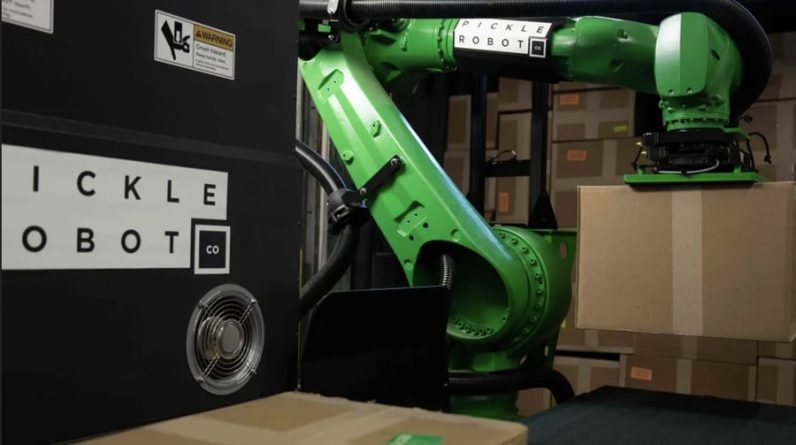
A new class of trailer-clearing robots is stepping into dock doors, using vision and generative AI to automate one of logistics’ toughest, highest-injury tasks at industrial speeds.
Automation
Autonomous unloading robots are quickly becoming a fixture at U.S. logistics hubs, taking on one of the most physically punishing jobs in the supply chain: clearing packed trailers during round-the-clock shifts. Designed to lift boxes up to 50 pounds and place them onto onboard conveyor belts, the systems are now unloading between 400 and 1,500 cases per hour, depending on package size and weight performance levels that have drawn interest from major parcel, retail, and third-party logistics operators.
– Advertisement –
The machines are built around industrial robotic arms paired with sensors, machine vision, and generative AI models that allow them to enter an unfamiliar trailer and begin operating almost immediately. A mobile base lets the robot reposition itself inside the cramped space, while a suction-based end-effector adapts to a broad range of package geometries.
The shift toward automation is being driven by stubborn workforce challenges. Trailer unloading remains one of the most injury-prone warehouse tasks, with turnover rates so high that many workers rarely last more than a few months. Early customer pilots showed that offloading this “brute force” task to robots frees human workers to handle exceptions, quality checks, dock coordination, and other higher-value responsibilities.
The founding team behind the technology engineers with deep experience in embedded systems, robotics, and large-scale hardware-software integration initially explored multiple industries before zeroing in on logistics. A short proof-of-concept video posted online triggered hundreds of inbound requests from warehouse operators, validating that demand for robotic unloading was far greater than the team had anticipated.
– Advertisement –
Following year-long trials in harsh environments, including desert warehouses where container interiors can exceed 50°C, deployments have expanded across U.S. logistics centers. The company is now scaling production and building out a software layer designed to coordinate with other warehouse robots such as palletizers, autonomous forklifts, and drones hinting at a fully orchestrated, multi-agent automation network. Development of a next-generation system is already underway, including plans for a dual-arm variant aimed at broader warehouse workflows. For now, robotic unloading marks only the opening chapter of a much larger push to automate the supply chain from inbound trailers to last-mile distribution.