



BIRMINGHAM, Mich. — Manufacturers are accelerating investments in automation and artificial intelligence, but many are encountering a common obstacle: the networks supporting those systems were not designed for the demands they now face.
From mobile robots to sensor-driven analytics, modern production environments depend on continuous data exchange. As those systems scale, the limitations of traditional wireless infrastructure are becoming more visible.
“Technologies are good for what they’re built for,” said Tamer Kadous, General Manager of the XCOM RAN business unit. “The problem happens when you start stretching them beyond that.”
For many facilities, Wi-Fi has served as the default wireless solution. It offers high data rates and broad accessibility, making it effective for general communication. But its design centers on best-effort delivery, not guaranteed output.
“It can deliver the data, but not necessarily at a particular time,” Kadous said.
That distinction matters in environments where timing and reliability are critical. Automation systems rely on consistent communication for control signals, safety functions and coordination between machines. As more devices are added to a network, maintaining that consistency becomes more difficult.
“If you have a lot of devices in a given area, the performance gets worse and worse,” he said.
Looking for quick answers on assembly and manufacturing topics?
Try Ask ASM, our new smart AI search tool.
Ask ASM
Industrial settings add another layer of complexity. Metal structures, machinery and overlapping processes introduce interference that can disrupt wireless signals. Under these conditions, networks that perform well in office environments may struggle on the factory floor.
“You have mobile robots like AGVs and AMRs, and you have sensors everywhere,” Kadous said. “All of this data needs to go to a central system for analytics.”
That flow of information is essential to improving efficiency, but it also places greater demands on the network. Data must move quickly and reliably to support real-time decision-making and system coordination.
Private 5G networks are gaining attention as a way to address those requirements. Unlike Wi-Fi, they are designed to provide more consistent output, particularly in dense environments with many connected devices.
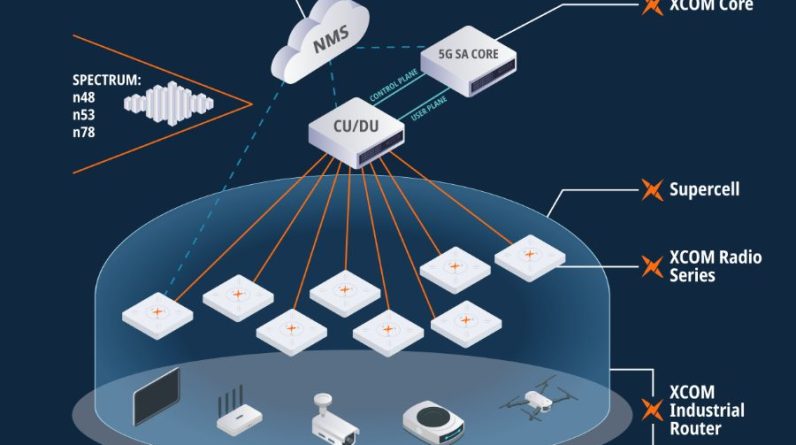
One such system is XCOM RAN, a private 5G platform designed to address performance limitations in dense industrial environments. Rather than treating each radio as a separate cell, the system coordinates multiple radios to operate as a single, unified network across a facility.
That approach is intended to reduce interference and maintain consistent performance as devices move through a plant, while also increasing overall capacity. In settings where robots, sensors and analytics systems are all operating simultaneously, that level of coordination can help stabilize communication across the entire production space.
They also offer advantages in coverage and scalability. Large facilities that might require hundreds or thousands of Wi-Fi access points can be served with fewer cellular nodes, reducing infrastructure complexity.
More broadly, new approaches within private 5G are focusing on how networks are structured, not just where they are deployed.
This approach can improve reliability and reduce disruptions caused by handoffs or interference between cells. It also allows manufacturers to scale output
by adding more radios within a facility, increasing capacity without redesigning the entire network.
As AI and automation evolve, these capabilities are becoming more relevant.
Physical AI systems, in particular, introduce new connectivity demands. Unlike traditional automation, they rely on continuous feedback between machines and processing systems. Data flows both upstream and downstream, creating a constant loop of information.
“You need to get the right data, and you need to get it on time,” Kadous said. “That depends on having connectivity that is built for that purpose.”
For manufacturers, this shifts how networks are viewed. Connectivity is no longer just a supporting layer; it is directly tied to system performance and operational outcomes.