



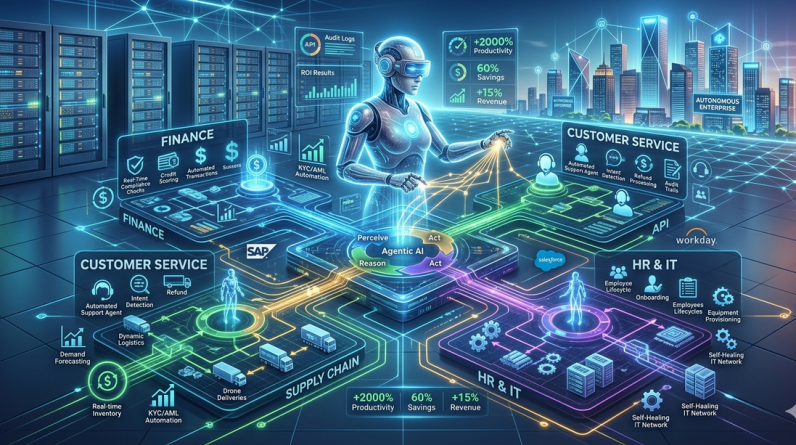
Agentic AI pilots are transforming businesses into an autonomous enterprise, where intelligent systems handle complex tasks without human intervention. As an agentic AI, businesses are becoming more than passive AI assistants to be autonomous digital workers with complex workflows that they can handle independently. Unlike chatbots or RPA, AI pilots in enterprises operate in dynamic environments using real-time decision-making. In contrast to the old-fashioned chatbots that simply propose actions or Robotic Process Automation (RPA) with strictly followed scripts, agentic AI pilots work in a Perceive-Reason-Act-Learn (PRAL) loop, monitoring the real-world state of affairs, making decisions in context, performing tasks across the systems, and refining themselves based on the result. This shift is redefining enterprise automation beyond traditional tools.
What makes Agentic AI pilots different
Modern AI pilots in enterprises function through intelligent agentic workflows, enabling systems to perceive, reason, act, and learn continuously. The strengths of agentic systems are that they can further subdivide high-level business objectives into runnable steps without human code. They break down such goals as onboard new supplier into sequenced activities, such as checking vendor credentials, creating contracts, updating ERP systems, planning compliance reviews. Contextual reasoning considers live variables (customer history, inventory levels, regulatory changes) and makes decisions about the best next actions instead of decision trees. These agentic AI pilots adapt to real-world changes, making them far more powerful than rule-based automation.
The systems automatically run over enterprise tools through secure APIs, parsing data in SAP, initiating transactions in Salesforce or updating records in Workday automatically. Self-corrective mechanisms check the results, in case of shipping delay, the agent finds alternatives by himself or changes schedules. This self-directed learning results in agentic AI being exponentially more flexible than conventional automation.
Core functions of Agentic workflows
The strength of agentic workflows lies in their ability to break down complex goals into actionable steps, unlocking scalable enterprise AI use cases.
Finance: Agentic pilots explore compliance alerts, score credit risk, and process loans between intake and sanction and provide 200 percent -2,000 percent productivity improvements in KYC/AML processes by removing manual exception handling.
Customer Service: These systems detect intent, process refunds/rebooking and update CRMs automatically, saving up to 60 percent of manual ticket processing and leaving audit trails to ensure compliance.
Supply Chain: Demand forecasting, real-time inventory, and logistics rerouting due to disruptions generate 15 percent revenue increase per order and 50 percent accelerated delivery, which are key in unstable markets.
HR/IT: Full employee lifecycle (hiring, equipment provisioning, tax forms) and self-healing IT infrastructure reduces HR inquiry resolution time by 80, as seen with implementations of AMD.
From supplier onboarding to compliance checks, agentic AI pilots automate multi-step business processes seamlessly.
AI pilots in enterprises integration
Advanced enterprise automation is achieved as AI pilots in enterprises integrate with systems like SAP, Salesforce, and Workday.The dominant businesses will avoid piloting purgatory by operationalising agentic AI as infrastructure, rather than an experiment. Human-in-the-loop (HITL) guards make sure that high-risk actions such as large refunds are approved by humans. agentic orchestration systems (UiPath, Microsoft Copilot, Kore.ai) organise agents, who are specialists, into digital workforces; a supervisor agent allocates duties among finance, HR and supply chain workers. These integrations allow agentic workflows to execute tasks across departments without manual intervention.
Leading organisations are scaling AI pilots in enterprises into full production systems, turning agentic AI pilots into core infrastructure.
Platforms like UiPath, Microsoft Copilot, and Kore.ai orchestrate these digital workers efficiently. Governance models require unchangeable audit trails describing all independent choices, meeting Fortune 500 regulatory standards. The 2024-2025 transition is 30 percent -80 percent speed/cost better than deployed workflows, demonstrating enterprise-readiness of agentic AI.
High impact industry applications
Real-world enterprise AI use cases are accelerating the shift toward an autonomous enterprise across industries. JPMorgan Chase implemented LAW (Legal Agentic Workflows) in custody/fund services contracts, automating legal processes that had in the past involved several human teams.
Top enterprise AI use cases demonstrate how agentic AI pilots deliver measurable ROI and productivity gains. The OpenAI-powered assistant at Klarna first responded to two-thirds of customer inquiries (equivalent to 700 agents) with a projected annual revenue of 40 million dollars, though they later implemented a hybrid system following empathy concerns, which agentic AI is most effective in large-volume operations, rather than high-volume interactions.
Using agentic models that analyse sensor data to predictively activate repairs to avoid expensive downtime, Siemens/DHL realised 20 percent maintenance cost savings. Companies like JPMorgan Chase, Klarna, and Siemens have already scaled these systems successfully.
Agentic AI vs. Traditional RPA
Compared to RPA, agentic AI pilots bring adaptive intelligence to enterprise automation, eliminating the limitations of rigid scripts.
| Metric | Traditional RPA | Agentic AI |
| Adaptability | Fails on UI/format changes | Self-adapts to new layouts/contexts |
| Governance | Rigid, centralised | Distributed self-healing |
| ROI Speed | Months to develop | Goal-oriented rapid deployment |
| Error Recovery | Human intervention required | Autonomous retry/alternatives |
The autonomous enterprise horizon
The future belongs to the autonomous enterprise, where AI pilots in enterprises will handle critical operations across departments. Industry observers estimate that by 2030, intelligent agents will be autonomously performing half of HR functions and more extensive enterprise applications will reach 30 percent of organisations using AI agents in multiple departments, which is a huge jump compared to the less than 5 percent high-autonomy applications by 2025. Reports from Gartner and Deloitte highlight rapid adoption trends globally.
Gartner projects such scaling as agentic systems becoming mission-critical infrastructure, with Deloitte estimating 25 percent of generative AI companies will deploy agentic pilots by 2025 and 50 percent by 2027. These autonomous digital employees, organising in hierarchical agent crews with supervisor agents coordinating specialised task agents in finance, supply chain, and customer service will turn repetitive business processes into self-managed operations, with the benefit of immutable audit trails and Fortune 500 compliance, and achieve 30-80 percent speed and cost improvements, already proven in initial deployments. As adoption grows, agentic AI pilots will become the backbone of enterprise automation, enabling businesses to scale faster, reduce costs, and operate autonomously.
FAQ’s
What are agentic AI pilots?
Agentic AI pilots are advanced AI systems that act as autonomous digital workers, capable of managing complex agentic workflows without constant human input. They follow a perceive-reason-act-learn model to make real-time decisions.
What is an autonomous enterprise?
An autonomous enterprise is a business where AI systems, including AI pilots in enterprises, handle operations like customer service, finance, and supply chain with minimal human intervention.
How are agentic AI pilots different from traditional RPA?
Unlike rule-based RPA, agentic AI pilots adapt to changing environments and make contextual decisions. They bring intelligence and flexibility to enterprise automation, reducing dependency on predefined scripts.
How do agentic workflows improve business efficiency?
Agentic workflows break down complex business goals into actionable steps and execute them automatically, improving speed, reducing errors, and enhancing enterprise automation efficiency.
What are the top enterprise AI use cases of agentic AI pilots?
Key enterprise AI use cases include:
- Automated KYC and loan processing in finance
- Customer support automation
- Supply chain optimisation
- HR and IT workflow automation using agentic workflows
Also Read:
AI Tools in 2026: What Each Platform Does Best in Real-World Workflows
Gemini 2.0 Pro vs 1.5 vs Flash: What’s Google’s Smartest Model Yet?
Microsoft adds Anthropic AI to Copilot for Word and PowerPoint generation
OpenAI Rolls Out GPT-5.4 Mini and Nano for Scalable AI Systems