


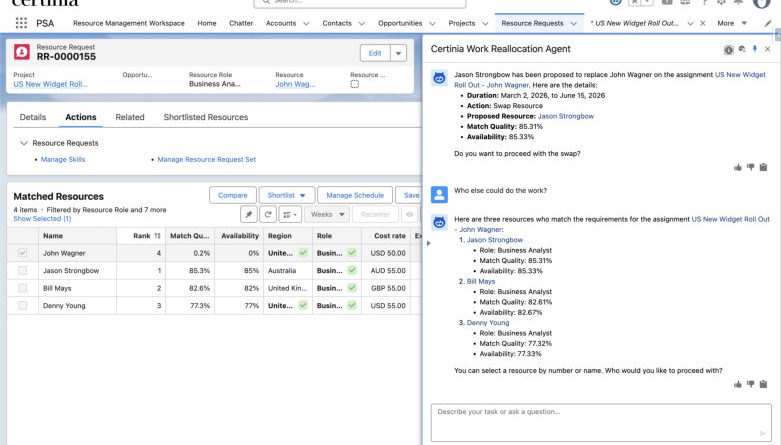
Veda’s Reallocation Agent in Certinia’s Spring 2026 Release
Professional Services Automation (PSA) vendor Certinia today joins the broader industry trend towards multi-purpose AI agent platforms with the launch of Veda. It describes Veda as “an enterprise-grade intelligent operations engine” for services organizations, which comes with a suite of 10 pre-packaged, role-based agents available in beta, along with a total of 64 intelligent actions that they draw on, which are now generally available.
Veda’s 10 pre-packaged agents cover processes such as services estimation, project resourcing, customer success management, financials and customer health monitoring — some of these encompass capabilities that were previously announced as separate agents in last year’s summer and winter releases. All the agents are customizable and customers can also build any of the underlying 64 actions into their own custom workflows and agents. Meanwhile, Certinia’s engineers are busy developing future agent capabilities with more autonomous processes. All in all, it’s a big milestone for the company, with DJ Paoni, its CEO, declaring:
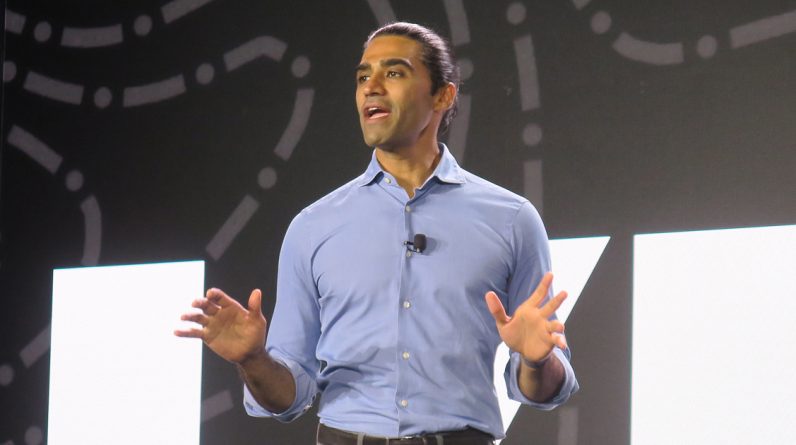
This is the next chapter of the Certinia story. We’re not just following the AI trend. We’re actually defining how modern services organizations will operate for the next decade.
The emphasis is on practical automation of day-to-day workflows in services organizations, and Certinia emphasizes the real-world results its customers have experienced when given advance access to Veda. Paoni says:
For the last year, we’ve worked with over 20 lighthouse customers. We’re seeing hours- and days-long processes compressed into minutes. In the services world, as we all know, velocity is the primary currency. And so we feel, by accelerating internal operations, we’re helping our customers accelerate their own time-to-value for their clients.
Boost to capacity
Concrete examples include savings of 10 hours a month for resource managers using Veda to automate staffing analysis, bench matching and work reallocation, 20 hours a month for project managers from automatically compiling reports on project metrics, and a 1% impact on utilization and retention through automation of time-intensive workflows in customer success. Raju Malhotra, Chief Product & Technology Officer at Certinia, elaborates on the boost to capacity from the time savings that agents bring to services teams:
What we are seeing in terms of service delivery is that it’s becoming hybrid. It’s a hybrid team of humans and agents, and when you think about that hybrid team, it fundamentally unlocks a demand-side constraint that has always been a constraint for professional services. That constraint has been, you can only sell or bid on what you can deliver, because humans are available only with certain skills, certain timezones, certain availability, et cetera. That constraint goes away when you think about this as a hybrid team, because of the agents being part of the equation.
That actually unlocks addressable sales pipeline — we did this analysis a few months ago with a third party analyst — we saw that increases the addressable sales pipeline by six to 7x. This is actually really an interesting learning and an implication for professional services, because there is a lot of doom and gloom about the impact of AI on our business, on our customers’ business, and we actually see a lot of opportunity because of this hybrid team.
It’s all about enabling collaboration between humans and agents, he adds, through the Veda agentic layer replacing elements of workflow automation with its autonomous agency:
We don’t see a world where agents have unfettered access to all your enterprise data and kind of roaming around within the enterprise. We see a world where humans and agents work together. That requires a human and agent collaboration. That is what we are building towards. That requires workflow automation, working with the agent orchestration. That’s really [what] the focus for Veda is.
We believe that, with our understanding of the customer domain, the capabilities, the problems we solve, all the way from estimation of services projects, to selling, to delivering, to managing, and all the aspects of it, we can deliver value not only faster to our customers, but also in a much better way.
Context layer
Embedding the agent platform in Certinia’s existing data model and established processes provides the right context for the technology to operate effectively, as Paoni explains:
Data without meaning is just noise. We’ve spent years baking our deep domain expertise, the operational patterns of thousands of firms, directly into our data layer. We don’t just know what a project is. We know what a healthy project looks like…
Many vendors are out there attempting to shortcut the context layer, like they believe you can simply just point a general-purpose LLM at a raw data lake and achieve ‘intelligence’. We don’t necessarily agree with that. AI without context is hallucination-prone and it’s ungrounded in a professional services environment. You cannot automate what you do not deeply understand.
Trust is the bridge between insight and execution. Because we provide the context, we provide the trust. And that’s why Certinia, we believe, is uniquely positioned to move from simply suggesting an action to actually executing it on behalf of the business.
Users can access Veda’s capabilities within both Certinia and Salesforce, as well as from Slack and Microsoft Teams messaging platforms. Malhotra comments:
Work happens wherever the users are, and they don’t necessarily have to be logged into Salesforce or Certinia to actually get those tasks done. In many cases, they can be done from Slack.
Veda is priced at $30 per user per month as an add-on to any Certinia user license, and also requires payment of consumption-based Agentforce Flex credits for use of the underlying Salesforce platform.
My take
This is a big step for Certinia and one that reflects well on its close collaboration with customers to help ensure its agentic capabilities deliver practical value. The vendor may, however be overdoing its talk of autonomous operation, as it’s clear that humans are still very much needed to verify that the actions recommended by agents are indeed the correct ones. Malhotra says:
Human is not only in the loop, but the users are always in control, and they are the ones that are really making subjective decisions. Because at the end of the day, accountability in all the world of agentic, is on humans, and the trust is about accountability. We believe by enabling the human and agent use cases within our application, we’re also making sure we are putting the humans in the front and center to drive a better level of trust as we improve the technology, improve the recommendations and the tasks that get done by this.
In other words, the path to full agentic autonomy is paved with human caution around factors such as the reliability and authority of the source material the AI draws on, the accuracy of its analysis and recommendations, and the depth of its learning about what to take into account when arriving at a decision. There’s still a fair bit to do along those lines before AI agents can really be trusted to act autonomously. But that caution doesn’t lessen the significance of today’s Veda announcement in Certinia’s journey along that path.