


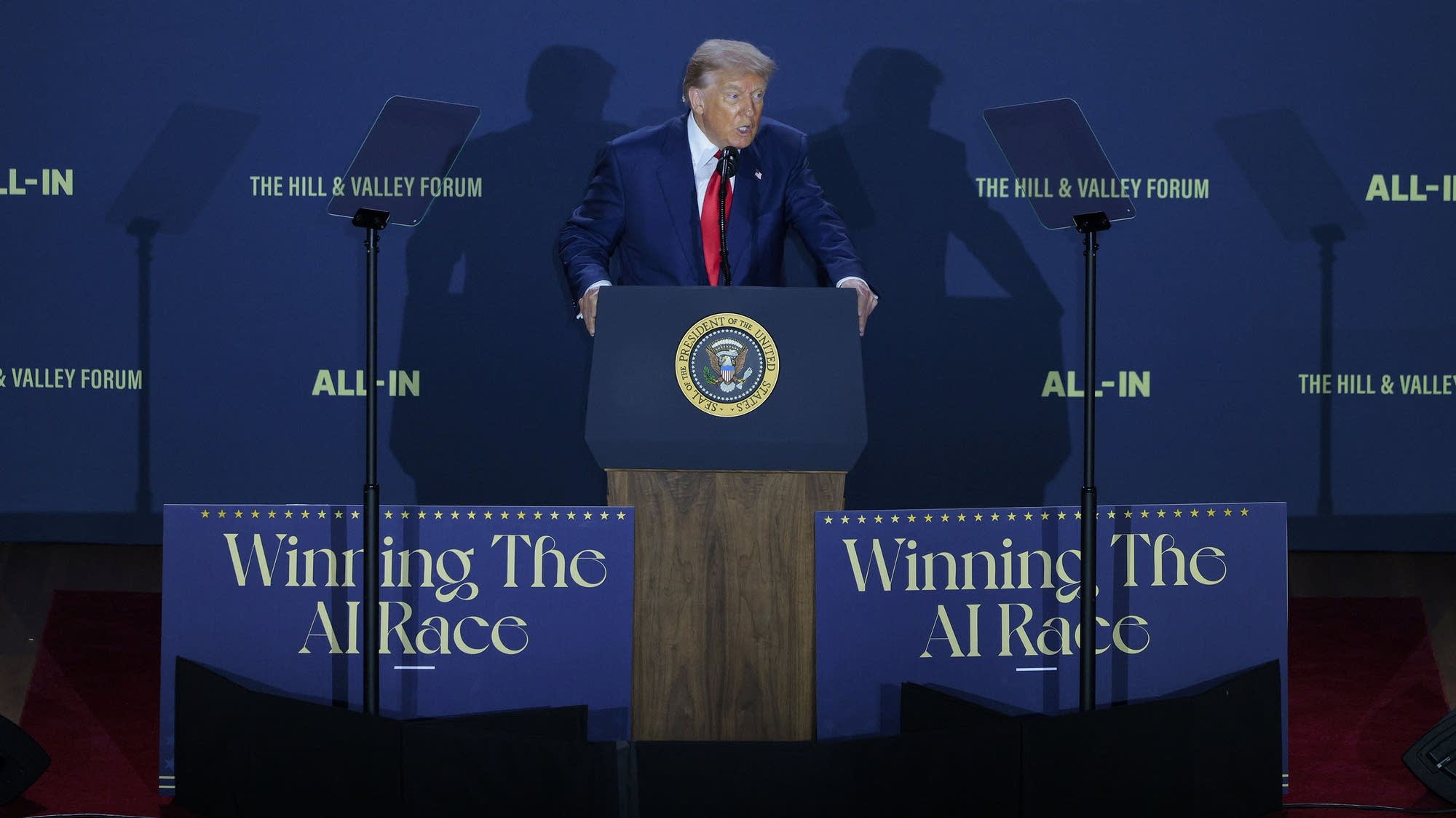
President Trump recently scrapped an executive order that would have created a federal review process for new AI models before their release. The executive order drew attention because the administration had previously taken a hands-off approach to AI regulation.
This comes as states across the country advance their own AI regulations. According to the National Conference of State Legislatures, 33 states have enacted more than 100 AI laws this year alone.
As the AI policy landscape becomes increasingly fragmented, a new project called Mapping AI is trying to track the organizations, policymakers, and public figures shaping the future of the technology — and where they stand on regulation, risk, and governance.
Think of the map as a blend of LinkedIn and Wikipedia — a tool for tracking connections and gathering community input. Beyond mapping the AI ecosystem itself, the co-leads of the project see their resource as a way to reimagine civic engagement.
Mapping AI is led by Anushree Chaudhuri and Sophia Wang, who come from very different professional backgrounds. Chaudhuri is a doctoral candidate at the University of Cambridge, where she researches large-scale energy infrastructure, while Wang is a research associate at Outliers Fund, a venture capital firm focused on emerging technologies.
They see the tool as a resource to help people better understand the rapidly evolving AI landscape.
“I do think a lot of people our age and just in general are feeling a huge lack of agency in understanding how to navigate something that’s changing so quickly,” said Chaudhuri. “So this tool was actually our way of bringing agency into understanding the space.”
Marketplace’s Nancy Marshall-Genzer spoke with Chaudhuri and Wang about their tool and what they’ve learned through tracking the AI landscape. Click the video below to see how Chaudhuri and Wang’s map can be used. The following is an edited transcript of their conversation.
Nancy Marshall-Genzer: So I played around with the map a little bit. Can you explain how it works? I guess people can add to it.
Sophia Wang: You can actually view around 1,800 different people and organizations that we believe are shaping the conversation about U.S. AI policy today — whether that’s frontier labs, like OpenAI and Anthropic, or safety organizations, ethics and bias advocacy groups.
And so you can click around and actually be able to look at their regulatory stance, their AGI timeline — so when they expect artificial general intelligence to arrive — as well as their funding model and the types of people and organizations they’re connected to, and so we’re trying to track really the structure of the entire ecosystem.
And I think that this kind of leads to a lot of interesting insights that can be derived around, for example, network centrality — who are the structurally most important people within the U.S. AI policy conversation today? Also, questions like how does the funding model influence the types of regulatory stances people and organizations have, as well as what types of bipartisan coalitions we can see forming around certain issues within AI policy?
Mapping the AI ecosystem as a side quest
Marshall-Genzer: What are some of the insights that you’ve gleaned from this? I mean, where have you seen — I don’t know — tensions or disagreements over AI policy?
Anushree Chaudhuri: Yeah, definitely. There’s a lot of surprising areas of both agreement and disagreement. I think often we try to view the left and right on an issue like AI as the right maybe wanting to accelerate the development of this technology and the left wanting to restrict it, but actually there’s a lot more issue-specific agreement on things like chip export controls.
So a lot of people want to restrict exporting a lot of the hardware that goes into making these AI systems possible to China. Almost everyone across the aisle agrees that there should be some kind of liability for developers, companies that make a model that causes some kind of harm that could be for child safety, mental health, misinformation. So, there’s a lot of areas of bipartisan agreement that we found by actually mapping out various claims that people have made, organizations have made on interviews, news reports, and then some pretty big areas of disagreement.
I think federal preemption of local regulation, thus trying to pause or restrict AI development, is [a] pretty deeply bipartisan issue.
Marshall-Genzer: I’m curious about why you decided to launch this huge project in your spare time, I suppose.
Chaudhuri: My background is actually as a social scientist studying the societal impacts of the energy transition across the U.S. and South Asia. So, I definitely don’t have a background in AI. I’m doing a PhD as my day job, but there are a lot of parallels in how I see any emerging technology as a choice point in how we design systems and build infrastructure that can expand opportunity for people to live more meaningful lives.
And I think AI systems are evolving at a time scale that almost compounds the risk and opportunity of all of these other types of technologies and infrastructures that will influence what the future looks like.
So I do think a lot of people our age and just in general are feeling a huge lack of agency in understanding how to navigate something that’s changing so quickly, so this tool was actually our way of bringing agency into understanding the space.
More on AI and our economy
Marshall-Genzer: I can relate to that feeling of a lack of control. Sophia, what about you? What led you to do this in your spare time?
Wang: My background is in aerospace engineering, and I’m specialized in the engineering of autonomous hardware systems, and I also work on the design of research institutions, and I’m kind of investigating public-private partnerships for deep tech industries like space. AI is this kind of like rapidly evolving technology that’s starting to collide with almost every other technological domain, and I see this very actively in the space industry, where I have formal background, and also just in market trends.
And our way of making an impact in this space is trying to create a transparency tool. We see this as kind of an opportunity for the public to get involved, even if they are not sort of in Silicon Valley themselves, developing these models, they have really important feedback to give, and we think this is part of kind of this broader conversation of how do we develop open civic tools in which everyone has a say and is able to contribute in their own ways?
Marshall-Genzer: How concentrated is the AI landscape, actually? I mean, what have you learned about that from your map?
Wang: Actually, one research insight we’ve been deriving is around network connectivity, whether that’s a person or an organization. How connected are they to the rest of the ecosystem? You actually have certain researchers like Paul Christiano, who are very connected within both government and think tanks or the DC circles, as well as frontier labs.
Then you also have certain policymakers like Senators Brian Schatz and Chris Murphy that are very connected within their DC policy and think tank circles. Another important question here: Which are the stakeholder groups that are systematically underrepresented in the map? They don’t have a say in the conversation. And right now we see certain categories of groups like ethics, bias and rights, as well as labor and civil society, that do not have connections to kind of the frontier labs, as well as the infrastructure and compute groups.
LinkedIn? Wikipedia? Both
Marshall-Genzer: What are you hoping that people will actually get out of your mapping AI project? Seems like it’s kind of like LinkedIn, you can see who’s linked to who else, and maybe get an idea of what you’re up against.
Chaudhuri: I mean, we’re all outsiders coming to this tool. The rest of our working group also has background in climate and organizing and housing policy, so none of us are coming from the AI space, but because this tool helped us make sense of this ecosystem, we’re hoping it can help anyone who’s both an insider or outsider make sense of it.
I think the tool is also only as strong as its data, and so the initial data we seeded with and our research methods are only as strong as how much time and information we’re able to find. And so we hope this will also be kind of like Wikipedia, where the strength of the tool is in how many people use it and submit flags when they see something that might be wrong.
I also think there’s an interesting nuance here about using AI to make AI better. A lot of people who are using AI systems for surveillance or cybersecurity attacks or defense, and I think there is also a future where we can use these tools thoughtfully and carefully to make policy that makes the tools safer, but also improves economic policies, improves ways for people in their local communities to get involved. So we’re hoping that this tool is an example of that as well.
Wang: Since we’ve launched Mapping AI, we’ve just had some unbelievable traction and a lot of inbound interest from everyone — from academic researchers to certain think tanks that want to use this tool to actually develop much broader coalitions to advocate for certain policy changes, as well as just the general public asking for resources for how they can host their own mapping parties.
And so mapping parties, mapping forums are ways for people to kind of derive certain insights from the tool, and then use that to inform locally who they should talk to and types of actions they can take, as well as build out more features. And so this is as much as kind of like an insight discovery tool as it is just an experiment to understand what the future of civic technology could look like and how we can build this as openly and in the public as possible.