



If you ask ChatGPT, it will give you a plausible-sounding answer. While convenient, haven’t you also found yourself pausing more often, wondering, âCan I really trust this conclusion?â The current way we interact with AI is defined by this simultaneous sense of convenience and unease.
This article is not a user manual, but a selection of five books to help you broaden your criteria for judgment. I have gathered books with different entry pointsâcovering the implementation of ethics, corporate risk management, algorithmic bias, and the boundary between humans and machines. You don’t need to read them all. Start with the one that addresses the question currently on your mind.
How to Think About AI Ethics: A Guide for Implementation / Reid Blackman (Translator: Hiromichi Kobayashi) / Hakuyosha
Written by philosopher and practitioner Reid Blackman, this book moves beyond âpretty declarationsâ of AI ethics and provides a framework for making them work within an organization. It translates issues like bias, explainability, and privacy into the language of implementationâsuch as statements, committees, and management involvement. Its strength lies in taking ethical discussions, which often stall at the abstract level, and bringing them to a point where you can take concrete action in the workplace.
Why you should read it:
When conversations end with âethics are important,â whatâs missing isn’t passion, but a design model. This book serves as an entry point for those who want to articulate what the organization should check before deciding whether or not to trust AI.
AI Risk Textbook: Crisis Avoidance & Business Acceleration Through Proactive Defense / IBM Japan AI Ethics Team / Nikkei BP

This is a practical guide compiled by the IBM Japan AI Ethics team on how to set guardrails when advancing AI within a company. Using hypothetical scenarios to simulate failure, it categorizes risks and breaks down countermeasures for developers, implementers, and users alike. The perspective of distinguishing between legality and social acceptance is particularly clear, making this a book not about âstopping out of fear,â but about âhow to move forward.â
Why you should read it:
It is effective when you want to turn personal unease into a common language for your company. It provides a foundation for discussion for those who remain unsure about the basis for saying, âIt is okay to go this far.â
Weapons of Math Destruction: How Big Data Increases Inequality and Threatens Democracy / Cathy O’Neil (Translator: Naoko Kubo) / Intershift
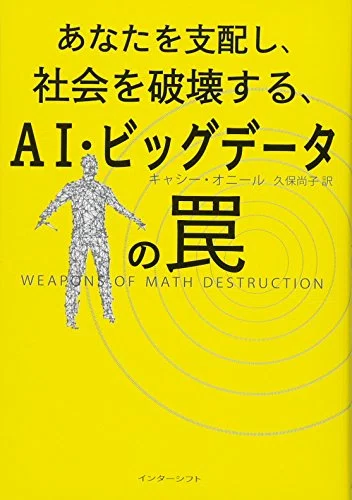
This is the Japanese translation of the global bestseller in which data scientist Cathy O’Neil exposes the bias and destructive power hidden behind seemingly neutral algorithms. Using concrete examples, she shows how âWeapons of Math Destructionâ sort people in areas close to our daily lives, such as education, employment, credit, and advertising. It helps you develop the habit of questioning whose goals and values are embedded in the models we find so convenient.
Why you should read it:
This book acts as a brake in moments when you might be tempted to accept something just because âthe AI determined it.â It is a book you will want to re-read as a form of literacy to avoid taking scores and rankings at face value.
The Core of Artificial Intelligence / Yoshiharu Habu & NHK Special Reporting Team / NHK Publishing (NHK Publishing Shinsho)

In this new book, shogi player Yoshiharu Habu delves into the core of artificial intelligence, centered on interviews from an NHK Special program. He explores AlphaGoâs âsubtractiveâ thinking, aesthetics, creativity, and what remains humanâwithout limiting the discussion of the technological frontier to just winning and losing. It is structured to be very easy to read as an introduction to organizing human-side questions before tackling difficult technical books.
Why you should read it:
If you measure âtrustworthinessâ only by technical specifications, you will miss things. This book provides material for thinking about the differences in how we interact with AI rather than just differences in capability, making it effective when paired with books on ethics and risk.
Can Androids Become Human? / Hiroshi Ishiguro / Bungeishunju (Bunshun Shinsho)

Roboticist Hiroshi Ishiguro re-examines âhuman feelingsâ and âhumanityâ from the front lines of android development. He uses real-world examples to discuss how appearance, gestures, and presence shake our human perceptions. Moving beyond the topic of AI alone, this is a philosophy-leaning read that makes you imagine what happens when machines become our neighbors.
Why I want you to read this:
It is not just about generative AI on a screen; the distance we keep from embodied machines is also part of future ethics and risk. When your understanding of ‘what it means to be human’ is challenged from the side of technology, your criteria for trust will deepen.
Conclusion
Whether or not to trust AI is not a simple Yes/No choice. By increasing your perspectivesâthrough the forms of statements (Blackman), organizational guardrails (IBM Japan), algorithmic traps (O’Neil), human-side questions (Hanyu), and the philosophy of boundaries (Ishiguro)âyou can break free from the binary choice of ‘use it because it’s convenient’ or ‘avoid it because it’s scary.’
Start with the book that addresses the question that bothers you the most. If you can draw a line in your own words after readingâdeciding ‘I will leave this up to AI’ versus ‘a human must oversee this’âthat is more than enough of an achievement for today.
#AIEthics #AIRisk #ArtificialIntelligence #RecommendedBooks #Reading