



‘You can create videos like this with AI’
When I watch tutorials, I think they’re amazing. I want to try it myself. But after I finish watching, I freeze.
In the end, what am I supposed to do first?
Hello, I’m Goat Taro. When I was first trying out AI-powered video editing, I was in this exact state.
The turning point that helped me move forward wasn’t finding another tutorial video, but consulting the AI directly.
What stood between ‘knowing it’s possible’ and ‘creating it myself’
At first, I was studying by watching introductions and tutorials for AI tools on YouTube.
You can make videos. You can build apps. There are so many convenient ways to use them. Tutorial videos are very helpful for learning about those possibilities.
On the other hand, what I wanted to know was something a bit more fundamental.
What kind of instructions were given? What kind of preparations were made? In my own environment, where should I start?
From what I was watching, I couldn’t figure that part out, and I remained in a state where I knew what was possible, but couldn’t start my own work.
So, I decided to try asking the AI I was already using directly.
Having the AI turn my desired outcome into words based on an example
However, just saying ‘I want to edit a video’ from the start wasn’t enough for me to explain the shape I was aiming for.
That’s because I didn’t have enough knowledge or ideas about video structure or presentation.
So, I used my favorite YouTube videos as a reference. I asked Codex to analyze those videos and come up with prompts or instructions to create a video with a similar structure.
Having the AI turn my vague feeling of ‘I kind of like this atmosphere’ into words for production became my clue to making it a reality.
Of course, I don’t want to use the content or expressions exactly as they are. While learning from the reference methods, I want to add my own stories and my own unique touch.
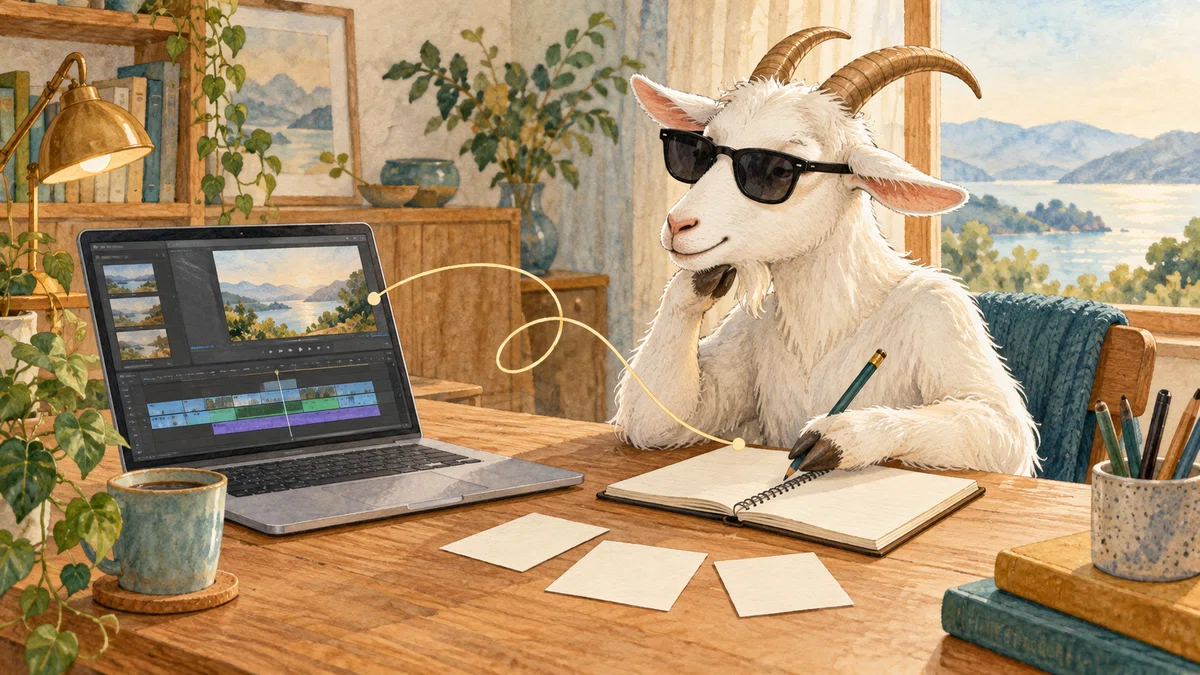
In my case, I use a goat, my favorite animal, as a character to express myself.
Even with an example, it didn’t turn out exactly as I imagined on the first try
If I have the AI analyze a reference video and create instructions, will it be finished in one go?
In my case, that was not the case.
The readability of the subtitles, how the characters are presented, and the cards summarizing the main points. When I try to make them, parts emerge where I think, ‘I want to change this a little’.
Even when something different from my image is created, that is not the end. I look at where it differs, adjust it, and check it again. Through that repetition, I am gradually bringing it closer to the shape I am aiming for.
Even when creating with AI, this kind of steady work remains. This is something I felt after actually trying it out.
‘Make it a little bigger’ is not enough to convey everything
There was also difficulty when asking for revisions.
I often use voice input, and for example, I tend to convey things vaguely, such as ‘make the subtitles a little bigger’.
However, just with that, it can sometimes deviate from the size or presentation I have in mind.
That is why I felt it was important to make the revision instructions specific. Which scene, what, and how do I want to change it? I needed to organize those points on my end as well.
If it is an example made specific for an article, it would be conveyed like this.
“Please make the summary subtitles at the beginning 20% larger than they are now. Adjust them so they do not overlap with the edges of the screen or the characters, and please create just the first 10 seconds for confirmation first.”
These numbers and seconds are not the settings actually used in the video, but an example to make the instructions specific. Please change them according to the video you want to create.
Instead of just handing over a ‘something feels different,’ put it into words as points you want changed. I feel that repeating the production process is also about learning how to convey my own ideas.
The first consultation can be ‘What should I do?’
If you cannot yet fully explain what you want to create, I think it is fine to consult from that state.
For example, the initial consultation text can be organized as follows. This is also an example created for an article based on this story.
“I want to create an explanatory video using audio I recorded myself. I am a beginner at video editing. Please check my environment and the materials I have on hand, and suggest one small task to try first. Please ask me if you need more information.”
If you try to prepare perfect instructions from the start, you will get stuck there. It suits me better to consult including the parts I do not understand, and based on the content that comes back, try what I can.
Create first. Look, fix, and ask again
There is a lot you can learn from watching tutorials.
That said, if you feel like you are ‘watching but still haven’t created anything,’ I think one way to start is to try telling AI what you want to do.
I am also still in the middle of trial and error to make my videos easier to watch. Consult first. Try to give it shape. Fix the parts that bother you. I will continue to repeat that process.
When you consult with AI, are there any tricks you use in how you phrase things? Please let me know in the comments about ways of asking that worked well, or experiences where it didn’t go as you expected.