



In architecture firms, the scope of generative AI use is expanding beyond just writing, information retrieval, and image generation to include design studies, BIM, code compliance, and project management.
At the same time, there are challenges such as what information is appropriate to input into AI, who is responsible for verifying AI-generated content, how to consider the architect’s responsibility, and what rules should be established within the firm.
The AIA (American Institute of Architects) has published “Guidance for the Responsible Use of AI by Architecture and Design Firms” to address these issues.
This article summarizes the AIA’s guidelines regarding ‘responsible AI use’ in architecture firms.
* This article is a translation and summary of the English document published by the AIA using generative AI. Please refer to the original document for accurate content.
What is the AIA ‘Guidance’?
“Guidance for the Responsible Use of AI by Architecture and Design Firms” is a relatively short, three-page document last updated on October 22, 2025, which outlines the AIA’s fundamental stance on AI and principles for architecture firms when using AI.
It also notes that AI has the potential to change not only current design practices but also procurement methods, project workflows, and client relationships, and calls on architects to prepare for such changes.
AIA: Guidance for the Responsible Use of AI by Architecture and Design Firms
‘Responsible AI Use’ as indicated by the Guidance
The Guidance first presents the AIA’s fundamental stance on AI, listing the following four pillars:
Furthermore, it provides the following nine guidelines for the use of AI in practice.
1. Maintain professional responsibility
AI is a tool to support design, not a substitute for professional judgment.
Even if something is created using AI, the architect remains responsible for the deliverables and judgments presented to clients, government agencies, and society. Additionally, content generated by AI must be reviewed and verified by professionals with appropriate expertise.
2. Establish an AI policy and management structure for the firm
Clarify who is responsible for managing and overseeing AI tools and AI-generated deliverables. Furthermore, it calls for establishing firm-wide policies regarding approved AI systems and use cases, data privacy and protection of confidential information, intellectual property, and ethical/legal standards.
Because AI capabilities change, it states that these policies must also be reviewed periodically.
3. Protect data, privacy, and intellectual property
Do not input client or firm confidential information into unverified AI systems. It also calls for confirming how external AI services store and reuse input information, and whether they use it to train AI models.
Regarding the intellectual property rights of content generated by AI, it suggests checking service terms of use and contracts, and consulting with legal experts as necessary.
4. Address transparency, bias, and fairness
Appropriately disclose to clients and stakeholders when and how AI is being used in a project.
It also calls for verifying that the data used by AI and its results do not contain bias, and for the firm to have procedures in place to identify and correct inappropriate outputs.
5. Invest in AI literacy and staff education
It calls for continuous learning so that staff can use AI responsibly and effectively.
For example, educational content includes how to prompt generative AI, ethics and responsibilities when using AI, and the limitations and appropriate use of AI.
6. Collaborate and share learning
It indicates that the industry as a whole should accumulate knowledge by sharing not only success stories but also failure cases regarding AI use.
It also calls for advancing AI utilization in practice while collaborating with experts in other fields, such as engineers, technicians, and contractors, not just architects.
7. Protect the economic value of architectural design services
The Guidance also touches on the economic value of architectural design services so that efficiency gains from AI do not weaken firm management.
It suggests that firms should consider moving from purely time-based fee models to value-based pricing.
This means thinking about pricing and contracts based on outcomes, impact, and expertise, rather than just the time spent.
8. Responsibility for AI use including stakeholders
The scope of thinking about AI use is not limited to within the firm itself.
It suggests considering requiring certain rules or disclosures regarding AI use from collaborating firms, and including clauses on AI use and ethics in contracts with consultants.
It also assumes cases where the client side is introducing AI systems, and calls for architects to maintain appropriate professional authority even in those situations.
9. Engage with policy and regulation
It mentions grasping trends in legal systems surrounding AI and engaging in policy formation as necessary.
It indicates that as AI spreads, professionals should advocate to ensure that the professional scope of architects and the value of architectural design services are treated appropriately.
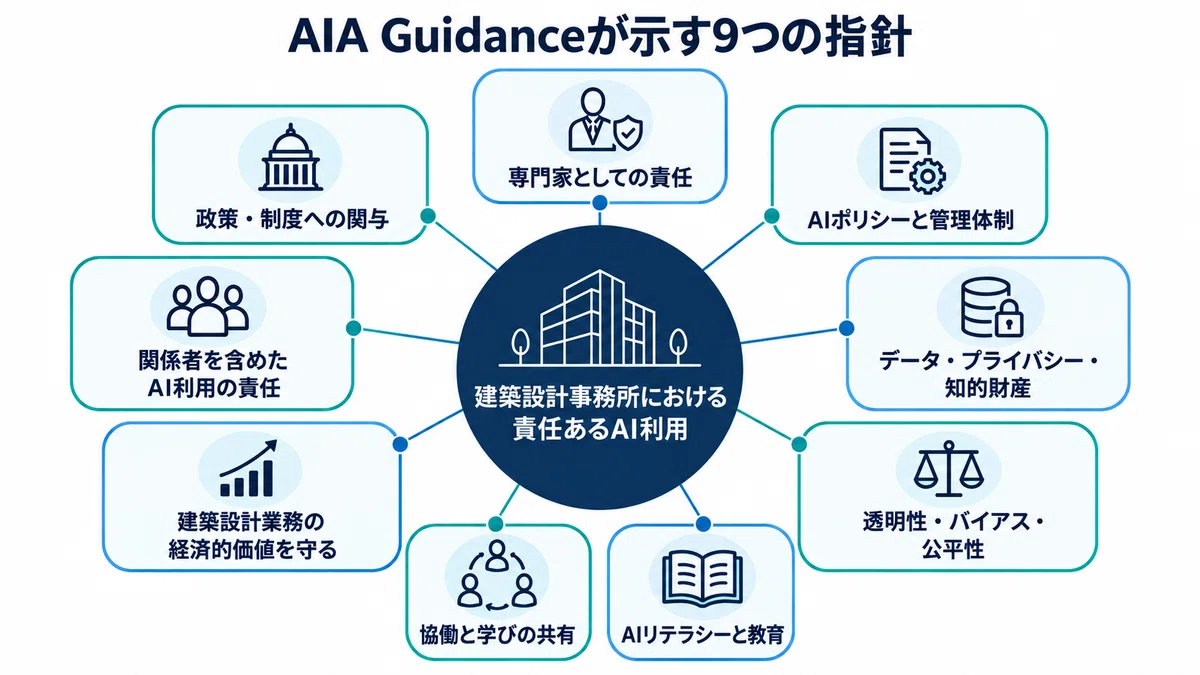 9 Guidelines for ‘Responsible AI Use’ presented by AIA Guidance
Source: Created based on AIA ‘Guidance for the Responsible Use of AI by Architecture and Design Firms’
Finally, the Guidance also lists areas where AI can be used, such as design and idea exploration, visualization, project delivery, firm operations, and research and analysis.
Next time: To the ‘AIA AI Firm Toolkit’
The Guidance views AI use not only as a matter of professional responsibility and information management, but also includes staff education, collaboration with stakeholders, and the economic value of architectural design services.
The AIA has also released a more concrete ‘AIA AI Firm Toolkit’ for firms to actually introduce and operate AI.
Next time, I would like to look at the content presented in the Toolkit, such as AI maturity levels for firms, risk classification by use case, classification of handled information, and how to create an AI policy.
At BIMedia, we are also writing various articles about AI and architectural design in a series called ‘Questions Beyond BIM’. This connects to the topic of this article, so if you are interested, please take a look at that as well.