



- How can the world ensure that emerging technologies, including AI, will truly benefit the planet and the people who protect it, a new op-ed asks.
- At COP30, attendees claimed that AI has enormous potential to effectively advance environmental data science to address some of our biggest challenges, but experts urge caution and inclusion.
- “Western science should look to Indigenous experts to guide the development of ethical AI tools for conservation in ways that assert their own goals, priorities and cautions,” the authors argue.
- This article is a commentary. The views expressed are those of the authors, not necessarily of Mongabay.
See All Key Ideas
In November, we joined more than 50,000 Indigenous and world leaders, diplomats, scholars and activists at the 30th United Nations Conference of the Parties (COP30) in Brazil. Some of the most central discussions at “The People’s COP” revolved around the critical role Indigenous leaders and communities are playing in the future of global climate and conservation movements, what we can learn from Indigenous groups as we build increasingly complex technologies to solve environmental problems, and where Indigenous voices can be better amplified and listened to.
At COP30, attendees claimed that AI has enormous potential to effectively advance environmental data science to address some of our biggest challenges, including rising pollution, drastic biodiversity loss, worsening natural disasters, and more. At the same time, experts and Indigenous communities continue to raise alarms around AI ethics, privacy concerns and environmental impacts.
This raises a critical question: How can we ensure that emerging technologies, including AI, will truly benefit the planet and the people who protect it?
Understanding and upholding Indigenous digital sovereignty might be key.
Many Indigenous communities embrace the use of drones and other technologies to monitor their territories, as shown by these Yanomami youths, and some are also now investigating the use of ethical artificial intelligence tools to support their cultural and environmental priorities. Image courtesy of Evilene Paixão/HAY.
Indigenous digital sovereignty is the right of an Indigenous nation to govern the collection, ownership and application of its own data. Upholding Indigenous digital sovereignty in the environmental and climate fields means recognizing Indigenous ways of knowing as critical to problem-solving. Moreover, Indigenous ownership and management of data must guide technological advancements, including AI development. But how Indigenous knowledge is incorporated — and who has control over it — is critical to interrogate.
Western science is finally starting to recognize the benefits of traditional ecological knowledge (TEK). When TEK and Indigenous governance lead the way, scientific understanding advances in more just and effective ways. Examples of this include improved models for conservation, biodiversity monitoring and land management. Of course, challenges to these approaches are also diverse and well-documented.
We are part of a growing global effort to ensure innovative technologies serve Indigenous communities and their environmental priorities. As AI rapidly becomes even more ubiquitous, Western science should look to Indigenous experts to guide the development of ethical AI tools for conservation in ways that assert their own goals, priorities and cautions.
Responsible AI that benefits Indigenous communities and conservation must implement Indigenous data sovereignty principles, and determine how and if Indigenous traditional ecological knowledge should be incorporated into these systems. AI that is co-designed with Indigenous partners, rather than for them, can make these technologies more accessible, culturally appropriate and aligned with community goals.
Collaboration is fundamental, and trust building takes time. Relationship building cannot be rushed or skipped over in order to arrive at results more quickly. Powerful examples include an advanced sea ice modeling and forecasting service led by Alaska Natives and a Tribal Data Repository built by Indigenous academics and Tribes.
 Indigenous and western knowledge can be combined powerfully when the effort is collaborative. Here, a research team prepares to deploy an acoustic device designed to monitor fish populations in Bras D’or Lake, Nova Scotia. Image courtesy of Nicolas Winkler Photography.
We also want to acknowledge the deep ironies exposed at COP30. Early reports indicate attendance from a record number of fossil fuel companies and lobbyists. Indigenous participants were promised entry badges but systematically excluded. Peaceful Indigenous-led protests calling attention to mining, oil development and deforestation on Indigenous lands were met with violence. Additional barriers to access, including travel and lodging costs, made participation nearly impossible for many Indigenous delegates. Those most impacted by (and, often, the least responsible for) climate change are usually the most knowledgeable about adaptation and mitigation solutions.
However, too often these groups are excluded from decision-making spaces like COP30. We stand with leaders who continually call out these inequities, because they undermine the very goals that COPs set out to achieve.
At COP30 we heard many assert that Indigenous leadership is critical to the environmental movement. But non-Indigenous leaders must put this philosophy into practical action, which includes valuing and investing in Indigenous partnerships and knowledge.
Ultimately, achieving the necessary and highly ambitious Paris Agreement will take more than innovation — it will require humility, respect and inclusion of many ways of knowing.
Indigenous ecological knowledge that has sustained the planet for millennia must direct how we decide to be in relation with systems like AI in order to positively shape our collective future.
McKalee Steen is a citizen of the Cherokee Nation and a Ph.D. candidate in the Department of Environmental Science, Policy, and Management at the University of California, Berkeley. Magali de Bruyn is a data scientist at the Eric and Wendy Schmidt Center for Data Science & Environment at the University of California, Berkeley.
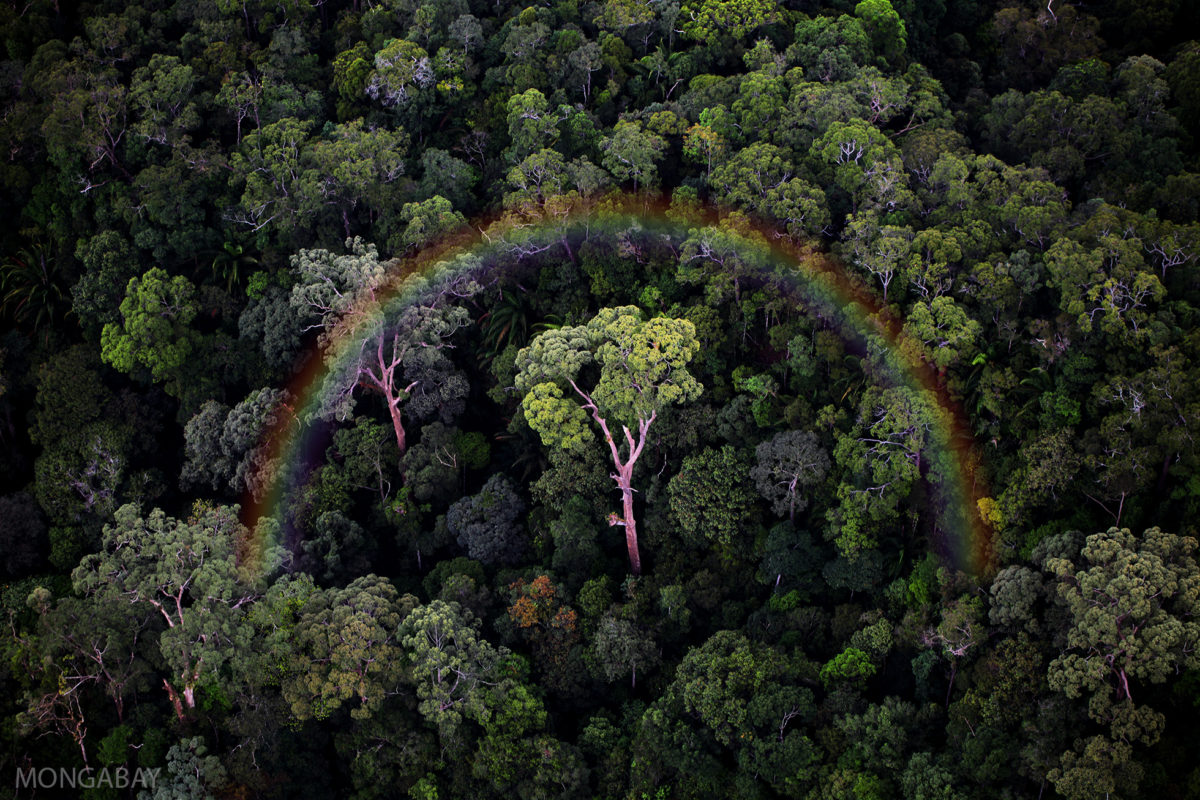
Banner image: Rainforest rainbow in Sabah, Indonesia. Image by Rhett Butler for Mongabay.
Related audio from Mongabay’s podcast: Indigenous communities can maintain their traditions, languages and knowledge while using Western science in supportive ways, listen here to a discussion with the director of Cultural Survival:
See related coverage:
‘I’m proud to be the first published Asháninka researcher’: Richar Antonio Demetrio on bees
Painting with fire: Cerrado land managers learn from traditional peoples
Citation:
Connor, T., Montealegre‐Mora, F., Saxon, B. J., Camarena, J., Sarna‐Wojcicki, D., De Bruyn, M., … Tripp, E. (2025). Indigenous knowledge and community‐derived counts produce robust wildlife population estimates: Roosevelt elk in Karuk Aboriginal territory. Ecology and Evolution, 15(10). doi:10.1002/ece3.72355