



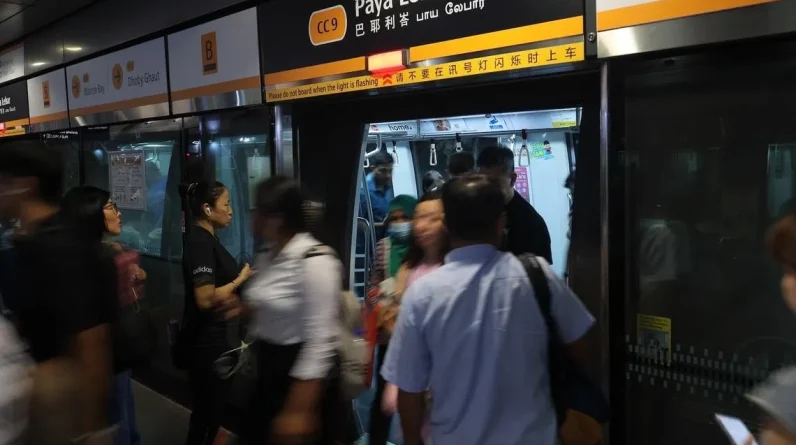
Ms Simran Kaur’s peak-hour commute requires little thought.
The 26-year-old student at Nanyang Technological University, who lives in Punggol, simply grabs her bag and heads for the station.
There is no need to plan her 8am train journey in advance, says Ms Kaur. She is currently doing an internship at a company in Bugis.
“I know a train will come in a few minutes,” she explains, “so I just go to the platform and wait.”
Ms Kaur rarely thinks about the technology powering trains behind the scenes. But she assumes “technologies like AI could (be helping to) improve (areas like) route planning and safety of our public transport systems”.
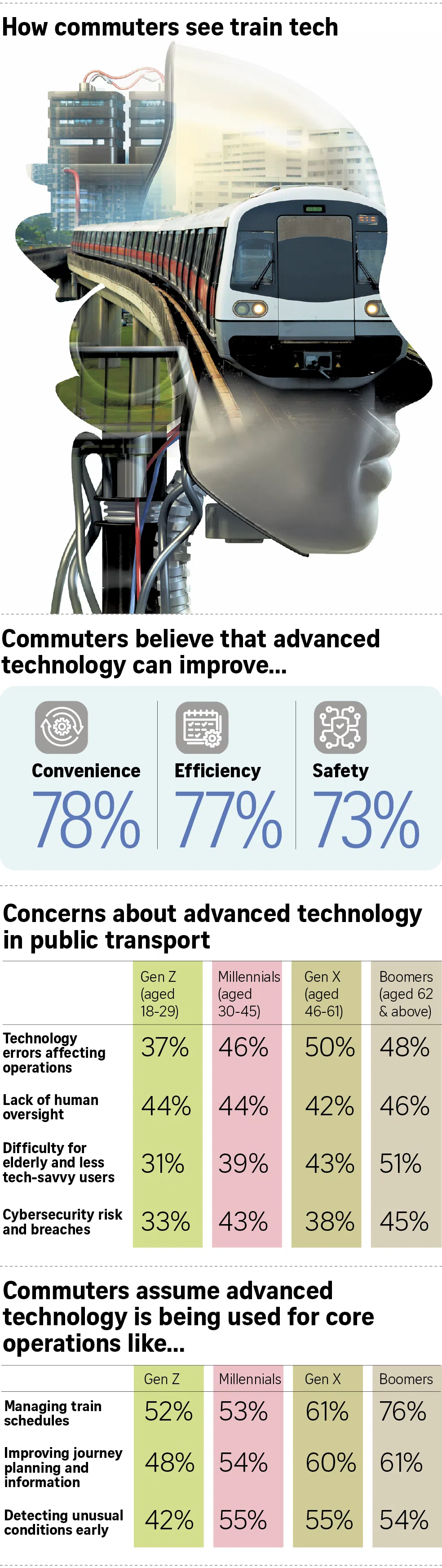
Like Ms Kaur, more than 70 per cent of commuters in Singapore believe advanced technology can enhance the convenience, efficiency and safety of train systems, revealed a recent survey.
The survey, commissioned by SPH Media and SMRT, polled 1,010 public transport users in Singapore in February 2026. Its aim: to understand how Singapore commuters perceive the use of advanced technologies like AI and automation in public transport, and their concerns and expectations.
Respondents were sourced from the Kantar Profiles Audience Network. Kantar is an independent market research company.
The reality is not far from the assumptions of survey respondents. The MRT network is a 24/7 interconnected system – one that relies on technology as well as people, says SMRT group chief engineering officer Ang Hang Guan, 59.
The public transport operator is increasingly using advanced technologies like artificial intelligence and automation to support operations and maintenance, he says, though “the human in the loop is still critical”.
It is a balance that commuters are already thinking about. The same survey found that the top concern among Gen Z commuters, aged 18 to 29, in using advanced technology is the potential lack of human oversight, flagged by 44 per cent of respondents in this age group.
Ms Kaur says while she assumes that AI is being used, she also believes there should be people overseeing the system, regardless of how advanced the technology becomes.
“I wouldn’t be surprised if (train operators) are using AI now to make their jobs easier,” she says. “But I don’t think they should 100 per cent depend on it.”
Ms Kaur, who uses tools such as ChatGPT and Microsoft Copilot for both internship and school work, is familiar with AI. This also makes her more aware of their limitations.
She points to chatbots, for example, which often carry disclaimers reminding users that AI-generated responses may contain mistakes.
Mr Ang agrees. “AI can help us to do certain things faster,” he explains. “It can help us with decision support (and) propose certain solutions to us, but the final decision maker (is still) the human.”
He stresses that the operator’s approach towards technology is not about replacing workers, but enhancing their ability to do their jobs more effectively.
“Things that are mundane and laborious (are what) we want to automate as much as we can,” he says.
For SMRT, technology is not just about making train systems more advanced, says its group chief engineering officer Ang Hang Guan, 59.
The operator’s approach to technology, he explains, centres on two key priorities: keeping rail operations safe and reliable, while supporting the people who use and run the system.
The Communications-Based Train Control (CBTC) system is a signalling system that lets trains exchange real-time location and speed data with trackside systems. Trackside systems monitor the location of trains within its zone, calculate safe distances between them, and signal trains to speed up or slow down.
Now used across the MRT network, the CBTC system enables shorter train intervals of under two minutes while ensuring safety, says Mr Ang.
Jarvis, SMRT’s data analytics platform, was rolled out in January 2026. It supports predictive maintenance by detecting potential issues early and enabling engineers to fix things before disruptions happen.
Automation and robotics are used at Bishan Depot to reduce the physical strain on workers and improve productivity, Mr Ang notes.
Rail-guided vehicles autonomously move bulky train parts which can weigh up to 4,300kg between workstations, so workers do not need to manually reposition heavy equipment. The number of six-car trains that can be overhauled in a month also doubled from two to four.
While younger commuters like Ms Kaur may think more critically about the limitations of AI, older commuters like Ms Sai Jin Lee, 65, take a more pragmatic view of using technology.
Ms Sai explains that she is less concerned with the use of technology than with the reassurance that the system will continue running smoothly.
“As long as it can work, then okay already,” says the kindergarten teacher.
She is currently on a sabbatical year and taking a part-time diploma in early childhood education. The course runs three to four times a week.
Ms Sai, who lives in Bishan, takes the train to attend classes in Paya Lebar. She says she has long assumed that train systems are already heavily automated.
Like her, the survey found that boomers, defined as those aged 62 and above, are the generation most likely to believe that advanced technologies are already used to manage operations across the public transport system.
Their biggest worry is its impact on commuters. Fifty-one per cent of boomers are concerned about technology making it more difficult for the elderly and less tech-savvy people. That outweighs their concerns over cybersecurity, human oversight and technology errors.
The human touch is key in the public transport network, says Mr Ang. At MRT stations, for example, there are staff who can help you around. “You need to be able to take care of a wide spectrum of people.”
“Whether it’s somebody with a lost child, (or someone who has) dementia – the human touch is important, and this is something that we hold dear to us,” he adds.
At its core, Mr Ang says, every commuter wants the same thing. “You want to be able to go (to your destination), you want to be able to take the train smoothly,” he says.
This tech-driven efficiency is something that Ms Kaur realised she took for granted when she went on a summer exchange in Alicante, the 10th-largest city in Spain, last July. In Singapore, trains typically arrive every two to three minutes during peak hours.
Alicante’s trams, however, arrive at fixed timings throughout the day. “Once I missed my morning tram by just a few minutes and was late as a result,” she recalls. The next tram only comes 15 to 20 minutes later.
The experience left her with a greater appreciation for Singapore’s public transport system, Ms Kaur says. “I can rely on the train system to get me around (punctually) without putting in much effort.”
-
In Perspective is a research-led content programme by SPH Media that combines insight-driven storytelling with expert perspectives on key issues shaping society.
In partnership with SMRT