



The survey of 193 compliance, ethics, risk, and audit leaders found that 90 percent of organizations using AI have deployed generative AI tools, such as ChatGPT and Claude. About 52 percent are using agentic AI for performing tasks, 51 percent are using large language models, and 42 percent are using predictive analytics or machine learning tools.
The lack of governance is likely a lag in putting such tools in place, said Vincent Walden, CEO of konaAI.
“It’s relatively new, just two-and-a-half years old,” Walden said of Generative AI. Compliance departments are drawn to AI’s capabilities because of its ability to automate the many manual and tedious processes required in compliance, like due diligence.
“It’s an exciting time to be disrupted with AI,” Walden said.
Businesses are using AI to handle many of these more labor-intensive compliance tasks because of the efficiencies that AI can bring, Walden said.
Survey respondents, about 30 percent who reported working in financial services, represent a range of organization sizes and industries. Slightly more than half of the leaders noted that their companies were smaller, with fewer than 5,000 employees. About 27 percent of the organizations had 5,000 to 50,000 employees, and about 18 percent had 50,001 to 100,000 employees.
These leaders expressed in the survey results that the efficiencies created by AI tools were intriguing in several key compliance areas.
For example, nearly 40 percent said their companies have deployed AI for risk assessment and monitoring, and about 61 percent said they planned to expand AI into that use soon.
Organizations using AI in compliance report huge benefits. About 84 percent of the leaders said AI has made their departments more efficient. About 54 percent said AI has improved analytics and monitoring, 49 percent said decision-making is better and faster, and 41 percent said AI has brought cost savings.
Agentic AI, a tool that can not only automate tasks but make decisions, could become a game changer in compliance. Business processes that are repetitive and that involve multiple people are ripe for agentic automation, Walden said.
His organization has had success—and fun—personifying AI agents.
One, named Eva, specializes in DOJ investigations and enforcements. If a whistleblower reports about a suspected bribery scheme involve particular employees and officials, Eva can quickly determine that two of the employees were previously warned about inappropriate behavior. She can be asked to write a work plan based on the information, Walden said.
External pressures, including the economy and politics, are also drivers in how AI is being adopted, he said.
“As political agendas change, new priorities emerge and compliance changes with it,” Walden said. The regulatory climate and politics are big factors.
“You have to be adaptable,” he added.
The survey results certainly indicated this: Nearly 80 percent of organizations plan to use AI in the area of tariffs, compared to only about 20 percent that use AI in that way.
Similarly, about one-third of organizations tap AI for regulatory reporting, and nearly 67 percent expect to use AI in the area of regulations in the near future.
While organizations are likely to have adopted AI, their compliance teams may not yet be using it, the survey found. And of those teams using AI, most are new converts.
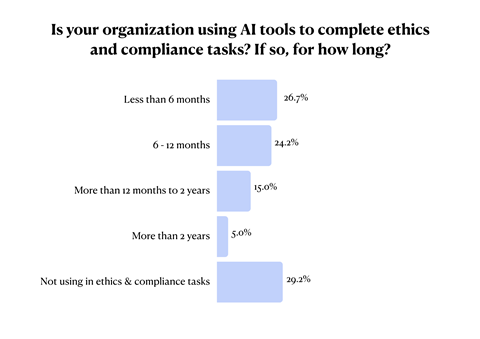
About 30 percent of compliance teams are not using AI yet to help accomplish ethics and compliance tasks. Nearly 27 percent have been using AI for less than six months, while just 24 percent of compliance teams have been using AI for six to 12 months, 15 percent for one to two years, and only five percent of compliance teams have been using AI for more than two years.
It’s a good idea to get on board with AI, Walden said.
“It’s just a matter of time before your CEO or CFO asks you what the heck you are doing” by continuing to expend valuable labor on tedious tasks, instead of turning to AI, Walden said.
The leaders also reported on the challenges of using AI. Nearly 66 percent of the leaders reported data quality or data access issues, 47 percent had training issues, 46 percent had data privacy and security problems, and 42 percent experienced unmanaged AI use by employees.
Getting help with AI risks and problems can itself be a struggle: About 54 percent of the leaders said a major problem was a lack of AI expertise.
Many compliance teams are spending a significant chunk of their tech budgets on AI-related projects and use cases. About 41 percent of teams plan to spend up to 25 percent of their budgets on AI. About 19 percent of teams will spend 25 percent to 50 percent on AI, and about eight percent expect to spend more than 50 percent of their tech budgets on AI. About 13 percent of survey respondents said their teams do not have a tech budget at all.
Some teams plan to cut back on their use of AI in areas where they currently use it, including training–nearly 58 percent of organizations use AI for training, and just 42 percent plan to use it for that purpose in the near future.
Companies also expect to cut back on AI for data analysis and for communications. Nearly 60 percent use it for data analysis now, but just 41 percent plan to use AI for data analysis in the future.
Those results speak to the fact that AI isn’t a good fit for all work endeavors, particularly those that require significant trust, like training and communications, Walden said. Trust is borne out of authenticity, inspiration, and being relatable, he said.
A training video featuring the CEO or a training session with a compliance or other professional “is a heck of a lot more inspirational, relatable and authentic,” Walden said.
About 63 percent of the organizations use AI now for communications, but only 37 percent plan to do so in the future.
About one-third of the companies custom-built their AI tools, and 43 percent are using third-party compliance platforms with AI features, the survey found.