


As AI models become more powerful and global technology companies race to develop AGI (Artificial General Intelligence) and superintelligence, concerns about job losses are intensifying. From customer service to coding, AI is increasingly performing tasks once handled by humans. While it promises higher productivity and lower costs, many junior employees worry about what this shift means for their future employment and long-term job security.
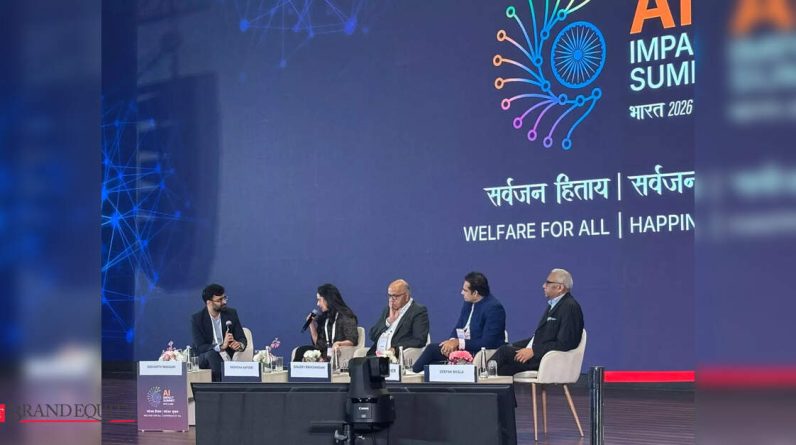
At the ongoing India AI Impact Summit 2026, held at Bharat Mandapam, New Delhi, entrepreneurs, policymakers, and AI leaders discussed the future of employment in the AI era.
The session was moderated by Sidharth Madaan, managing director and partner, BCG and featured: Sanjeev Bikhchandani, founder and executive vice chairman, Info Edge (India); Prashant Warier, co-founder and CEO, Qure.ai; Deepak Bagla, mission director, Atal Innovation Mission; and Radhicka Kapoor, senior employment specialist, decent work team for South Asia, International Labour Organization (ILO).
The panellists acknowledged that no one has a clear or definite answer on how deeply AI will affect jobs. While the impact is widely debated, the scale and speed of disruption remain uncertain.
Atal Innovation Mission’s Bagla mentioned that the next five years could be among the most challenging periods of disruption. “The disruption in the next five to ten years will be significant. All of us will have to learn, psychologically, how to deal with uncertainty, including the possibility of being without a job,” he emphasised.
Citing academic literature from the International Labour Organization (ILO), Kapoor explained that the share of jobs where almost all tasks are highly likely to be automated is relatively small. Globally, only about 3-4 per cent of jobs fall into this category and are at risk of being displaced.
However, she pointed out that the picture is more nuanced. “Around 20% of jobs are likely to see some tasks automated. This does not necessarily mean these jobs will disappear. Instead, automation could free up time for workers to take on new responsibilities and improve productivity,” Kapoor noted.
To manage the impact of AI on jobs effectively, Kapoor highlighted that two broad steps are necessary.
- First, it must be acknowledged that a small proportion of workers will lose their jobs and face displacement.
- Second, the focus should be on how these workers can be absorbed into other sectors. Kapoor stressed that this will require more than just skilling and reskilling programmes.
Policymakers will also need to think carefully about industrial policy, macroeconomic strategy, labour market reforms and, importantly, stronger social protection systems to support affected workers.
Offering a contrasting view, Bikhchandani said that Naukri’s growth has not been affected by AI so far. “On the ground, we are not seeing a reduction in hiring,” he highlighted, suggesting that fears of an immediate hiring slowdown may be overstated.
At the same time, Bikhchandani advised employees to proactively adapt to change. He suggested learning how to use at least three new AI platforms every quarter. By the end of a year, he said, individuals could be familiar with 12 different AI tools, helping them stay relevant in a rapidly evolving job market.
The impact of AI on healthcare will be different. Qure.ai’s Warier explained that in many parts of the global South, the real challenge is not job loss but limited capacity.
While concerns about AI leading to job losses are well-founded, the broader labour context also matters. International Labour Organization’s Kapoor pointed out that for gig and casual workers, especially in the informal sector, the main risk may not be excessive automation. Instead, the concern is that they could miss out on AI’s productivity gains altogether, widening existing inequalities.
The discussion made it clear that AI will change the world of work, but its impact will not be the same across sectors. While some jobs may be displaced, many roles could evolve or become more productive with AI, especially in healthcare, where AI could make healthcare workers more productive instead of leading to job loss.
- Published On Feb 20, 2026 at 06:41 PM IST
Join the community of 2M+ industry professionals.
Subscribe to Newsletter to get latest insights & analysis in your inbox.
All about ETBrandEquity industry right on your smartphone!