


“Can’t we update a lot every day if we use AI to write articles?”
“But won’t Google dislike articles written by AI?”
“In the first place, is there any point in writing blogs or articles in-house in an era where AI answers everything?”
Perhaps your company is also struggling with these questions.
In this series, we have looked at the necessary elements for the AI search era one by one: primary information (information only available here, obtained through actual experience and research by the company), reliability, external evaluation, reviews, and SNS/YouTube. And in the previous Vol. 38, we covered SXO (efforts to ensure that people who search and come to the site are satisfied and achieve their goals).
However, one question arises here. How can we continue all these measures with a limited number of people and time?
So this time,
we will reconnect these seemingly scattered measures with a single thread called ‘content marketing,’ and organize what changes and what does not in the AI era from seven perspectives.
This is a story I want you to know before you ‘write a lot with AI’.
Now, here is Vol. 39.
📌 A word here | This article is free for one week after publication.
In this AIO strategy series, to deliver the latest information to as many people as possible, new articles are available to read in full for free for one week after publication. After that, they will be switched to note membership-exclusive articles. If you want to read the latest articles during the free period, please follow this note.
Also, if you have any questions about AIO, GEO, or AEO, such as ‘I want to know this,’ ‘I don’t understand this part well,’ or ‘What should my company do?’, please let me know in the comments. I will answer in the comments as much as possible, and depending on the content, I will cover it in detail in future articles.
Now, let’s get into the main topic.
1. The ‘Premise’ of Content Marketing Has Changed
Content marketing, simply put, is a customer acquisition philosophy of building trust by continuously providing information that is useful to customers, making them think, ‘I want to consult with this company.’ It is characterized by building trust through information, rather than calling out ‘please buy’ like advertising.
If we compare it to a school club, advertising is calling out ‘Join the club!’ Content marketing is generously teaching practice tips and making people think, ‘I want to follow this senior.’
The basic form until now followed this flow:
With the spread of AI search, part of this flow is beginning to change.
Here, I will organize the changes taking place by separating facts from interpretations.
-
Fact: Mechanisms where AI summarizes and answers within search results, such as Google’s AI Overviews (the AI answer at the top of search results), AI mode, and ChatGPT’s search function, are spreading.
-
Interpretation: For questions like ‘What is XX?’ or ‘What is the market price for XX?’, there is a possibility that general answers that would be the same regardless of which company writes them will increasingly be handled by AI summaries.
-
Note: This does not mean that ‘articles are unnecessary.’ The material AI uses to answer is, after all, information on the web written by someone.
In other words, what has changed is not ‘whether to write articles’ but ‘what kind of articles are meaningful to write.’
② Google does not prohibit ‘writing with AI’ itself
First, let’s clarify a question that many people are concerned about. If I create articles using AI, will my evaluation from Google drop?
In an official blog post published in February 2023, Google explained its stance on AI-generated content (*1). The main points are as follows.
-
The axis of evaluation is not ‘how it was created,’ but ‘the quality of the content and whether it is useful to the user.’
-
However, using AI primarily for the purpose of manipulating search rankings is against the spam policy (simply put, Google’s rules that prohibit cheating to distort search results).
Additionally, Google’s guide on ‘Creating helpful, reliable, people-first content’ recommends considering ‘Who,’ ‘How,’ and ‘Why’ the content was created (*2).
Regarding ‘How’ in particular, self-check questions are provided for cases where automation like AI is used (*2). For example, whether you make it clear to the reader that it is automated, or whether you explain how it was used if necessary, and so on.
From this, we can conclude the following:
-
Using AI itself is not a problem.
-
The problem arises when the goal becomes ‘standing out in search’ rather than ‘being useful to people.’
It is easier to understand if you think of AI not in terms of ‘whether to use it or not,’ but rather **’what purpose you are using it for.’**
③ Why ‘mass generation with AI’ is dangerous
So, what happens if you create 10 articles a day with AI, totaling 300 in a month?
Google’s spam policy includes an item called ‘scaled content abuse‘ (*3). Simply put, this means creating a large number of pages for the purpose of manipulating search rankings rather than to help users.
As an example, Google cites ‘using generative AI tools or similar to create many pages without adding value for users’ (*3). Generative AI refers to AI that can automatically create text and images, such as ChatGPT.
To use a homework analogy, if you turn in 100 sheets of paper that are just copied answers, the teacher won’t consider that you have ‘studied’.
Furthermore, the aforementioned guide on user-first content lists the following questions as signs of ‘search engine-first content’ to avoid (*2).
-
Are you creating a large amount of content on various topics in the hope that some of it will rank in search results?
-
Are you relying heavily on automation to create content on many topics?
-
Are you just summarizing what others have said without adding much value?
Let’s think about this with a concrete example.
-
Before: A local construction firm has AI write articles on 100 keywords like ‘renovation costs,’ ‘renovation duration,’ ‘renovation precautions,’ etc., and publishes them daily. The content is full of generalities read somewhere else.
-
After: The same construction firm selects four questions actually asked by customers each month and carefully writes one article for each, including their own construction photos, the time taken, and unexpected issues encountered.
The ‘Before’ approach is superior in quantity, but for both readers and AI, the ‘After’ approach contains ‘information that only that company can write’.
④ In the AI era, ‘non-commodity information’ increases in value
Google published an official blog post in May 2025. It contains content for achieving results with AI search features like AI Overviews. In it, they recommend focusing on unique and non-commodity content (*4).
‘Commodity’ simply means something that is the same regardless of where you get it. For example, it’s like a bottle of water that is the same no matter which convenience store you buy it from. In other words, ‘articles that are the same no matter which company writes them’ will become increasingly difficult to differentiate in the AI era.
So, what is ‘non-commodity information’ for small and medium-sized enterprises? Special surveys or research are not necessary. In many cases, it is already within the company.
-
Questions actually asked by customers and their answers
-
Common ‘points of hesitation’ that come up during estimates or business negotiations
-
Failures or unexpected things learned from actual experience
-
Figures counted by the company (number of inquiries handled, trends in common requests, etc.)
-
Tips known only to the staff on the front lines
In Part 13, we organized in detail why such ‘primary information’ is important. If you are thinking, ‘I’m told to write information only my company can write, but I don’t know what that is,’ reading that first will make the content here much easier to put into practice.
It is easy to imagine content marketing in the AI era as changing from ‘the job of finding new topics to write about’ to ‘the job of digging up information sleeping within the company.’
5. Deciding on the division of roles between AI and humans
Reading this far, you might think, ‘So, should I not use AI?’ That is not the case. If you divide the roles, AI can be a very reliable ally.
The recommended division of labor is as follows.
What humans do (things that cannot be left to AI)
-
Deciding what questions to answer (it is humans who know the customers’ voices)
-
Providing primary information (case studies, figures, failure stories, on-site judgments)
-
Final content verification and taking responsibility
Things AI can help with
-
Organizing frequently asked questions from sales meeting notes and inquiry history
-
Summarizing transcripts of spoken content into article outlines
-
Polishing difficult-to-read text and finding typos
-
Identifying ‘questions that readers of this article might have next’
The point is not to have AI ‘write generalities,’ but to have it ‘organize your company’s information.’
The concept of ‘trusted information’ covered in Part 14 also connects here. Articles where it is clear who wrote them and what they are based on are less likely to lose the reader’s trust, even if they are created using AI.
📌 For those who cannot find ‘topics to share’ for their company
If you are thinking, ‘I’m told to write information only my company can write, but I don’t know what to write,’ or ‘I want to organize how much I should use AI,’ please send ‘Content Diagnosis’ via our official LINE.
Click here for our official LINE
After you send it, we will reply with guidance. We will not send persistent sales messages, so please feel free to send it.
6. Create a ‘Self-Sustaining System’ Instead of Just ‘One-Off Articles’
Another important aspect of content marketing in the AI era is not treating articles as ‘done once they are written’.
I recommend the following small cycle.
-
Collect: Note down questions that arise from inquiries, business meetings, and comments
-
Write: Choose one question from those that you can answer and turn it into an article
-
Verify: Ask AI questions about your field and see how it answers. Use Search Console (a free tool provided by Google to check how your site appears in search results) to see what terms people are searching for when your articles appear
-
Revise: Add missing information. Return to step 1 for any new questions that arise
The beauty of this cycle is that the more you continue, the more ‘information only we can write’ naturally accumulates. An article written once generates ideas for the next one and becomes a repository of internal knowledge.
I introduced specific steps for the method in step 3, ‘Verify how AI answers about your company,’ in Vol. 7. If you haven’t tried it yet, please give it a go now.
Also, the approach of organizing and answering ‘Frequently Asked Questions’ can use the same logic for creating FAQs that we covered in Vol. 12.
Common Misconceptions and Failures
-
‘It’s meaningless unless you update daily’: Whether each article contains useful information is more important than the update frequency itself. Choose a frequency you can maintain, even if it’s just twice a month
-
‘Articles written by AI must be completely rewritten’: The question is whether the content is accurate and useful, rather than whether AI was used (*1). Often, it is sufficient for a human to verify it and add primary information
-
‘Write about every trending topic’: Google also includes self-check questions about whether you are writing just because something is trending (*2). Prioritize what your customers truly want to know
7. Practical Steps You Can Take Right Now
Let’s put what we’ve covered into action. These are listed starting with things you can do for free without any special tools.
-
Write down 10 questions: Write down 10 questions you were actually asked by customers or prospects in the last month (the shortcut is to ask sales staff or those handling phone support)
-
Mark them by ‘degree of uniqueness’: Among the 10, mark with a double circle (◎) those you can answer by adding your company’s own case studies, figures, and experience
-
Choose just one from the ◎ items: Select one that is asked most frequently or is most likely to lead to a business opportunity
-
Ask AI to act as an ‘organizer’: Record and transcribe what the person in charge says about the question, then ask the AI to ‘organize this content into an explanatory article structure for customers’
-
Add primary information and publish: Have a human add the company’s photos, case studies, figures, and points of caution to the draft structure, and publish it after verifying the content
-
Look back after one month: Check the number of impressions (how many times it appeared in search results) and clicks (how many times it was actually clicked) in Search Console. Also, take notes on questions and reactions from people who read the article to use as material for the next one
As a first step, I recommend **1. ‘Write down 10 questions’**. It takes 15 minutes and requires no specialized knowledge. These 10 items will become the ‘seeds’ for the next six months of content.
I covered how to measure traffic and results from AI search in detail in Part 16. If you want to do step 6 (reviewing) in earnest, please read Part 16 as well.
Summary | Content marketing in the AI era is not about ‘quantity’ but a ‘system for cultivating your company’s information’
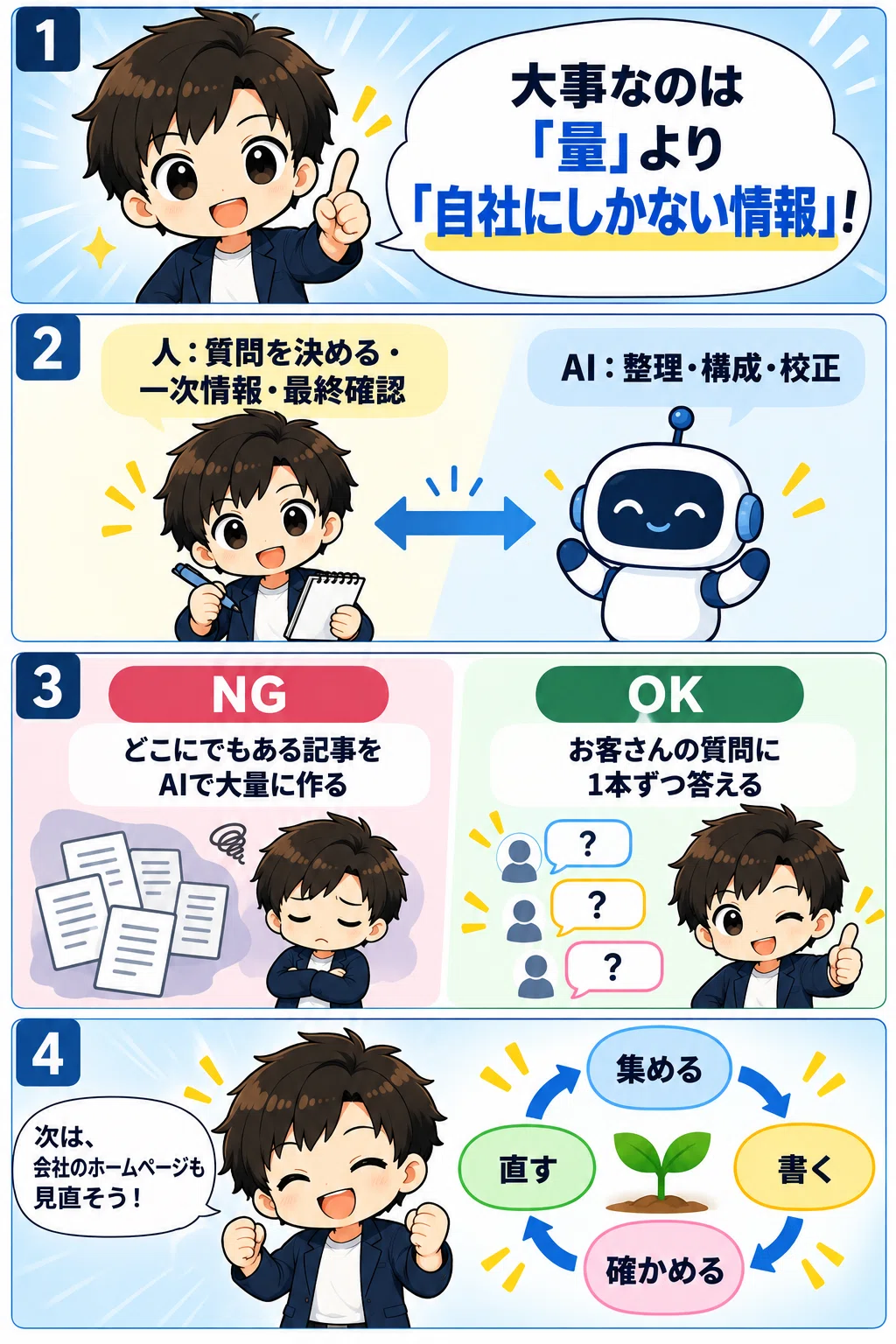
Let’s summarize the key points from this time.
-
① In an era where AI summarizes general answers, ‘what kind of articles are meaningful to write’ has changed
-
② Google does not prohibit writing with AI itself. What is questioned is ‘quality’ and ‘purpose’
-
③ Mass-generating content with AI without adding value may violate Google’s spam policy
-
④ What increases in value is ‘information that is not commonplace.’ Much of that already exists within the company
-
⑤ Humans must decide the questions, provide primary information, and take responsibility. Get help from AI for organizing, structuring, and proofreading
-
⑥ Create a system where your company’s information accumulates the more you continue, through the cycle of ‘collecting -> writing -> verifying -> correcting’
-
⑦ First, try writing down 10 questions you have been asked by customers
The one thing I want you to remember most this time is,
Content marketing in the AI era is not a competition to ‘make AI write.’ It is about building a system to ‘unearth, organize, and continue delivering’ information that only your company possesses, with the help of AI.
—that perspective.
Also, if you have any questions about AIO, GEO, or AEO, such as ‘I want to know this,’ ‘I don’t quite understand this part,’ or ‘What should my company do?’, please let me know in the comments. I will answer as many as possible in the comments, and good questions will be taken up as future article themes.
📌 A word here | This article is free for one week after publication
In this AIO strategy series, to deliver the latest information to as many people as possible, new articles are available to read in full for free for one week after publication. After that, they will be switched to note membership-exclusive articles. If you want to ‘read the latest articles during the free period,’ please follow this note. If you want to read past articles systematically, please also make use of the membership.
For AIO/GEO consultations, go to the official LINE
If you would like to organize how to turn information that only your company can write into articles and content, please send “Content Diagnosis” via our official LINE. We offer free usage explanations and simple consultations.
On our official LINE, we provide information on the following:
Please send “Content Diagnosis” in a message. After you send it, we will reply with further information. Depending on the content, you may also use a 30-minute free consultation.
Click here for our official LINE
We will not send persistent sales messages, so please feel free to reach out just for an explanation of how to use it.
Next Preview: Vol. 40 | How Should Corporate Sites Change in the AI Search Era? (Tentative)
This time, we organized a system for content: “what kind of information to create and how to keep creating it.” Now, is your company site, the “vessel” for that information, okay as it is? Company profiles, service pages, case studies, FAQs—in an era where people come from AI searches, we will specifically organize next time what parts of your corporate site you should review. It will be an episode where you will understand where to place the “10 questions” we wrote out this time on your site, so please continue reading.