


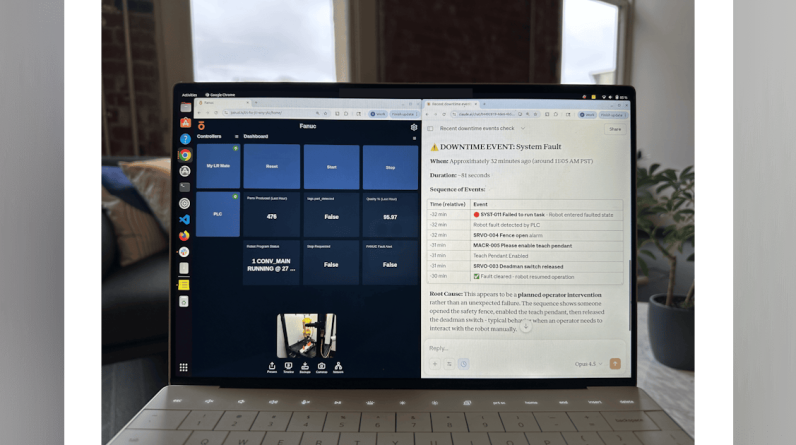
In practice, this means a system that captures everything happening on the robot or in an automation cell. And instead of streaming that raw data to a remote engineer or giving someone VPN access, you simply point your own LLM at the data source.
The agent then diagnoses the problem, flags anomalies, suggests likely root causes and even cross-references the result with your internal KPIs or business goals.
To illustrate how this works, consider a typical data flow using the Olis remote monitoring software to feed structured data such as PLC signals, fault codes, cycle times and video feeds to the LLM. The LLM powers the AI agent to perform specific tasks, such as diagnosing downtime, predicting failures and generating reports. And the AI agent delivers analytics and insights back to human operators.
Automation systems, LLMs and AI agents are each distinct layers, but they work together in sequence. However, without properly structured data from automation systems, the LLM has nothing meaningful to work with, which is why “speaking fluent AI” (providing clean, semantic data) matters.
Giving manufacturers more control
The beauty of bringing your own agent is that it restores control to automation end-users. You can choose the LLM. You can control the depth and cost of analysis and your AI costs. Moreover, you’re not locked into a vendor’s AI roadmap.
When AI is an input that you control, the possibilities grow enormously. For example, you could tie your automation systems to your ERP to combine operational data with business context — all without the risks associated with entrusting such data to a third party.
For plant managers, this is a genuine “take back control” moment. For years they’ve been told that AI must be purchased as a product. But, as discussed earlier, AI is just compute. This means that what matters is less who provides the model and more who controls the data and the workflow.
Moving forward with this mindset requires you to keep two things in mind: First, you’re not supposed to buy AI. You’re supposed to buy software that AI can understand and use without your help.
Second, AI agents aren’t the brain of your factory. They’re compute power that you bring, just as you bring electricity to power your automation and water to wash your hands.
Instead of dealing with traditional chatbots, automation end users should embrace systems that are built to feed AI agents clean, structured, semantically rich data. In this way, any LLM from any vendor can diagnose equipment, generate reports, propose actions and integrate with the rest of your digital ecosystem.