


Artificial intelligence coding startup Zencoder has unveiled a new orchestration tool that it says will help enterprises move away from unproductive “vibe coding” to a more disciplined and verifiable form of AI engineering.
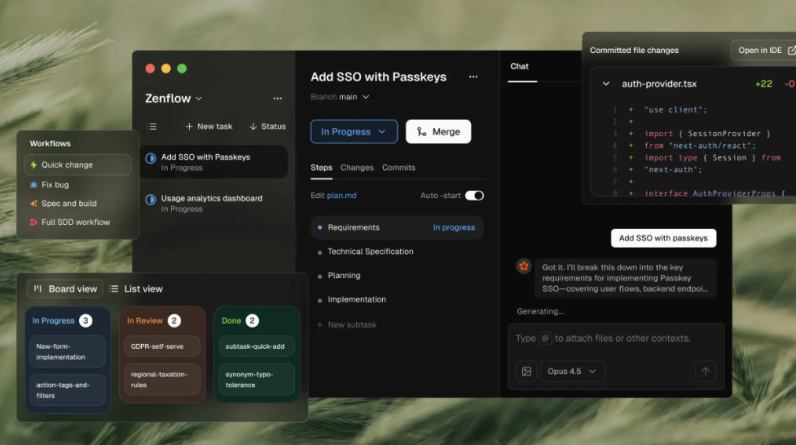
The new tool is called Zenflow and it’s designed to act as an orchestration layer that coordinates multiple third-party coding agents as they plan, implement, test and verify AI-generated code within structured workflows. It represents an effort by Zencoder to differentiate itself from much bigger rivals such as GitHub Inc.’s Copilot and the AI coding agents built by giants such as OpenAI Group PBC, Google LLC and Anthropic PBC at a time when they’re all intensifying their efforts on code automation.
Zencoder Chief Executive Andrew Filev said chat-based user interfaces are fine for copilots, but tend to break down when companies attempt to scale and increase their reliance on AI code. “Teams are hitting a wall where speed without structure creates technical debt,” he explained. “Zenflow replaces ‘Prompt Roulette’ with an engineering assembly line where agents plan, implement, and, crucially, verify each other’s work.”
The startup is launching Zenflow to try and combat the growing frustration some developers have with AI coding bots, which promise to dramatically improve their productivity but haven’t really got there yet. Recent research by Stanford University shows that the average productivity gains by enterprises that have adopted AI coding tools at scale is only around 20% – far below what has been promised by most AI vendors.
Filev told VentureBeat in an interview that the problem primarily stems from the way developers interact with their AI coding tools. They simply enter a prompt and hope that all goes well, but that approach is insufficient when it’s attempted with more complex projects.
A new way to orchestrate AI coding bots
To change this, Zenflow tries to restructure the development process with a “model-agnostic” approach, introducing four key capabilities it says are vital for orchestrating teams of coding agents.
With Zenflow, structured workflows replace ad-hoc prompts, so teams are focused on consistent and repeatable sequences, where AI agents are asked to plan, implement, test and finally review their work. Zenflow also implements “spec-driven development”, where AI agents are required to create a technical specification before they commit to doing any work. This involves creating a step-by-step plan, and they’ll only start writing code once it has been checked and everything adds up. It allows teams to catch errors and bugs at the specification level, eliminating the need to spend hours debugging software later.
In addition, Zenflow relies on what the company calls “multi-agent verification”, where it uses different AI models to critique the work of others. Filev told VentureBeat this is important, because each model has blind spots and cannot be relied upon to verify its own work. By asking Anthropic’s Claude to verify code written by OpenAI’s models and vice versa, mistakes are much more likely to be picked up on. Finally, Zenflow implements parallel execution, where multiple AI agents are set to work simultaneously in isolated sandbox environments, so they can’t interfere with each other.
Zencoder’s head of engineering Will Fleury said Zenflow is not focused on writing code, but rather on understanding models’ intent and maintaining the quality of their work. “By moving to an orchestrated SDD workflow, our internal team now ships features at nearly twice the pace of our pre-AI baseline, with agents handling the vast majority of implementation,” he said.
Verification is key
By putting so much emphasis on verification, Zenflow is much better able to identify instances where AI coding agents generate what has increasingly become known as “AI slop,” where the code looks good enough at first glance, but fails in production environments and degrades over multiple iterations.
Filev said the company’s own research shows that teams who don’t focus on code verification usually fall into a kind of “death loop”, which occurs when developers don’t take the time to check or understand the code written by AI agents. They simply move on, and when problems occur down the line, they lack the context to know where it has gone wrong. In such cases, they inevitably ask the AI that wrote the code to try and fix it, but it struggles to do this because it’s not able to recognize its own errors. “They literally spend more than a day in that death loop,” Filev said.
Zencoder believes its agent-agnostic approach gives it a crucial advantage over much bigger rivals such as OpenAI, Anthropic and Google, because they’re focused on their own models. By mixing and matching models, Zenflow eliminates model bias, Filev said.
The Zenflow app is available now as a free download and comes complete with plugins for popular integrated development environments like Visual Studio Code and JetBrains.
Image: Zencoder
Support our mission to keep content open and free by engaging with theCUBE community. Join theCUBE’s Alumni Trust Network, where technology leaders connect, share intelligence and create opportunities.
- 15M+ viewers of theCUBE videos, powering conversations across AI, cloud, cybersecurity and more
- 11.4k+ theCUBE alumni — Connect with more than 11,400 tech and business leaders shaping the future through a unique trusted-based network.
About SiliconANGLE Media
SiliconANGLE Media is a recognized leader in digital media innovation, uniting breakthrough technology, strategic insights and real-time audience engagement. As the parent company of SiliconANGLE, theCUBE Network, theCUBE Research, CUBE365, theCUBE AI and theCUBE SuperStudios — with flagship locations in Silicon Valley and the New York Stock Exchange — SiliconANGLE Media operates at the intersection of media, technology and AI.
Founded by tech visionaries John Furrier and Dave Vellante, SiliconANGLE Media has built a dynamic ecosystem of industry-leading digital media brands that reach 15+ million elite tech professionals. Our new proprietary theCUBE AI Video Cloud is breaking ground in audience interaction, leveraging theCUBEai.com neural network to help technology companies make data-driven decisions and stay at the forefront of industry conversations.