



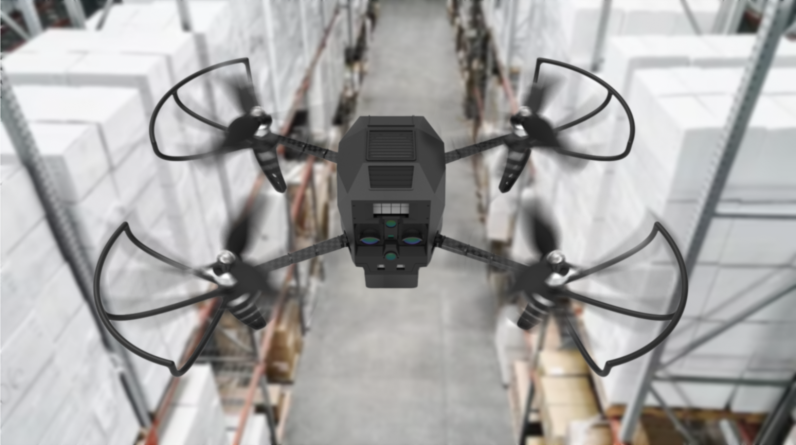
One of Gather AI’s drones doing their job in a warehouse
Gather AI
Despite billions being spent on ERP systems and warehouse software, many businesses still manage inventory the same way they did decades ago: clipboards, spreadsheets and manual counts. AI companies like Gather AI think that’s finally changing.
Gather AI is one of those companies that’s involved in helping their customers better manage the inventories they store in their warehouses and production facilities. I’ve always known Gather AI as a drone company, but that’s not entirely true. The company provides the software and hardware behind autonomous devices (including drones), AI-equipped, cameras, computer vision and AI-agents to help their clients manage their warehouses.
The Need For Warehouse Automation
And there’s a huge need for this automation. When I first started in accounting back in the ’80’s my clients were using paper tags, manual worksheets and clipboards. My year end was filled with auditing the physical counts that their employees were making while operations were shut down. Has this changed? Unfortunately not as much as hoped. Even today, when I visit clients around the country I’m usually seeing the same thing: inventory management like it’s 1986 instead of 2026.
Warehouses remain one of the least-digitized parts of many businesses and Sankalp Arora, the CEO of Gather AI agrees.
“Many warehouses are still operating like it’s the past,” he said. “They’re doing manual cycle counts, annually physical inventories, tracking movements on spreadsheets and still relying on workers to walk the floor in order to locate products. Because of this there’s a huge opportunity for AI and automation in general.”
Arora says that Gather AI’s technology allows businesses to know where their inventory is every 24 hours, reduce “skip picks” and mis-shipments, decrease write-offs, and redeploy employees from counting inventory to revenue-generating work like picking and shipping.
“Our customers achieve 99.9% inventory accuracy, reduce manual counting by up to 80% and improve productivity by 5x,” he said.
Inventory Counts, Workflows And Safety
Leaning into drone technology is one way this is accomplished. Gather AI’s drones operate autonomously, map warehouse environments and learn the best scanning routes to take, oftentimes leveraging GPS navigation. Their cameras are snapping inventory counts using barcodes, monitoring workflows while also checking for potential security and safety issues. Their data is then sent back to accounting systems and other databases for monitoring.
Arora says that people stop walking the floor to just find inventory because “now they go to our dashboard.”
All of this can be done in a setup that takes a few working weeks, with minimal to no changes in infrastructure, lighting and Wi-Fi connections.
Where to next? AI learns the more you use it. And, like any AI model, Gather AI’s model is taking it all in and then using that knowledge to then improve overall productivity inside of the warehouse.
“We’re moving toward AI systems that actively optimize warehouse operations by recommending picking routes, wave planning, task assignments and workflow improvements,” Aurora says. “We can do this because our systems are continuously observing things like inventory movement, forklift traffic, workflow traffic and picking behavior.”
Because of this, recommendations can be made for more efficiently picking inventory, which workers are better suited to handle certain tasks and how certain workflows inside the warehouse can be automated.
Warehouse Workers Are Giving Their Drones Nicknames
Most of my clients aren’t using this kind of technology – or AI in general – as an excuse to lay off workers. That’s because they can’t even find enough workers. Drones and devices like them in the warehouse speed up operations, improve safety and are an aid to workers, not a hinderance.
Arora says that most of Gather AI’s users are excited because “this is a dimension of the job that they never imagined will be a part of their day to day. Many customers even give the autonomous devices nicknames!”
One downside, at least for most of my small and midsized clients, is that the investment remains pretty substantial. To make economic sense, solutions like Gather AI need warehouses that are at least 100,000 square feet with significant inventory and meaningful labor or inventory costs.
Arora says that typical costs for their customers can usually run in the six figures annually per facility. And while he says the payback can be as little just 4.5 months, it’s still a hefty lift for many of my smaller clients. ROI for smaller organizations is still a stretch…for now.
Of course, as the technology becomes more commoditized, we’ll see prices dropping. But that’s a difficult timeline to estimate. However, the opportunity is clear and acceptance is increasing. Gather AI recently closed a $40 million financing round and, according to Arora, has seen a 250% booking growth across industries ranging from aerospace, retail, food and beverage and automotive.
“Supply chain is undergoing a visibility revolution,” Aurora said. “I believe AI agents and the computer vision solutions we provide will eventually function almost like operational supervisors inside warehouses.”