


In the era of AI agents, are prompts still necessary? I verified this through official documents and research papers from OpenAI, Anthropic, and Google.
The voices saying, “Prompts are no longer needed”
Recently, I often see messages that treat prompts lightly.
Since AI has become smarter, there is no need to worry about detailed writing methods. The job of prompt engineer has already disappeared. Prompts will be automatically optimized by machines.
I feel frustrated by this trend.
However, it is meaningless to argue back based solely on feelings of frustration. Therefore, this time, I verified both the grounds for the dismissal theory and the grounds for why prompts are still important, using official documents and papers from the companies building the models.
I will write the conclusion first.
Prompts have not disappeared. Their location and author have changed. And the parts that humans should write have become even clearer.
The dismissal theory has valid grounds
First, I will look at the dismissal theory side fairly. There are three grounds.
The first is that models have become smarter, and old techniques no longer work.
A research team at the Wharton School of the University of Pennsylvania continued to verify prompts and published their findings in 2025. Small tricks like telling the AI you will pay it a tip or threatening it did not have a significant effect on the correct answer rate for difficult problems overall. Instructions to act like an expert also did not consistently improve accuracy. For models with reasoning capabilities, even if you ask them to think step-by-step, the improvement in accuracy was often minimal, while time and token usage increased.
Official documents from each company point in the same direction.
OpenAI writes in its guidelines for reasoning models that instructions to think step-by-step are unnecessary. Google warns in its Gemini 3 developer guide that users may overthink redundant and complex techniques intended for older models. Anthropic recommends returning to normal phrasing instead of strong expressions like “CRITICAL: You MUST” that were included for previous models.
The technique of preparing the beginning of the answer for the model is also no longer accepted by Claude’s new models. The explanation is that the model’s intelligence and adherence to instructions have improved, making it unnecessary for many use cases.
The second is the job title. IEEE Spectrum published an article in March 2024 with the headline that AI prompt engineering is dead. In a survey published by Microsoft in April 2025, the name “prompt engineer” was not in the top 10 AI-related jobs that companies are considering creating.
The third is automation. In research by Google DeepMind, prompts optimized by the AI itself outperformed human-written prompts by up to 8% in math word problems and up to 50% in difficult problem sets. A 2024 paper by researchers at VMware also reported that automatic optimization was the most effective.
Up to this point, this is where the dismissal theory is correct. Memorizing small tricks is no longer of much value.
I myself also mentioned in an interview for the August 2026 issue of Nikkei Trendy that the era where humans build long prompts from scratch is over.
Official documents have not abandoned prompts
So, are these companies saying that prompts are unnecessary?
When I read through their documentation, it was the opposite.
OpenAI’s developer documentation states that the quality of output is often dependent on the quality of the prompt. The same document asks developers to treat prompts as application code and to run tests and evaluations every time they are published.
OpenAI has announced that starting in June 2026, it will begin scaling back the mechanism for saving prompts on its API, with a full shutdown on November 30. This is also not about discarding prompts. It is about moving them to a place where they can be version-controlled within code and protected by tests.
A guide for ChatGPT Enterprise published in April 2026 states that a prompt is not a technique for tricking a model, but a way to clarify the content of the work, the context, and the criteria for success.
In September 2025, Anthropic positioned context engineering as a natural evolution of prompt engineering.
This term became widespread in June 2025. Shopify CEO Tobi Lütke posted that he preferred this term over prompt engineering, and Andrej Karpathy agreed a few days later. Karpathy’s point was this: The word ‘prompt’ evokes short, everyday instructions. However, what is being done in serious applications is a delicate task of filling the context with only the information necessary for the next step.
Google also explicitly stated in its updated prompt design guide in October 2026 that prompt engineering is an iterative process. It also writes that for agent use cases, specific instructions are often needed to control the reasoning, planning, and execution methods.
Where have prompts moved to?
The location of prompts has shifted from the chat box to system prompts, tool descriptions, skills, instructions, and evaluations.
In current AI agents, prompts are not just in the chat box.
System prompts. Tool descriptions. Instruction files called skills. Instructions kept in the workspace, such as AGENTS.md. And evaluation tests to determine performance.
In a September 2025 article, Anthropic cited refining tool descriptions as prompts as one of the most effective improvement measures. It writes that by precisely revising the descriptions, Claude 3.5 Sonnet reached the highest level at the time on the SWE-bench Verified software correction benchmark.
In a September 2026 article, OpenAI writes that skills are essentially prompts saved in Markdown files.
Prompts have not disappeared. They have become files, descriptions, and tests.
The smarter the model, the more faithful it is to what is written.
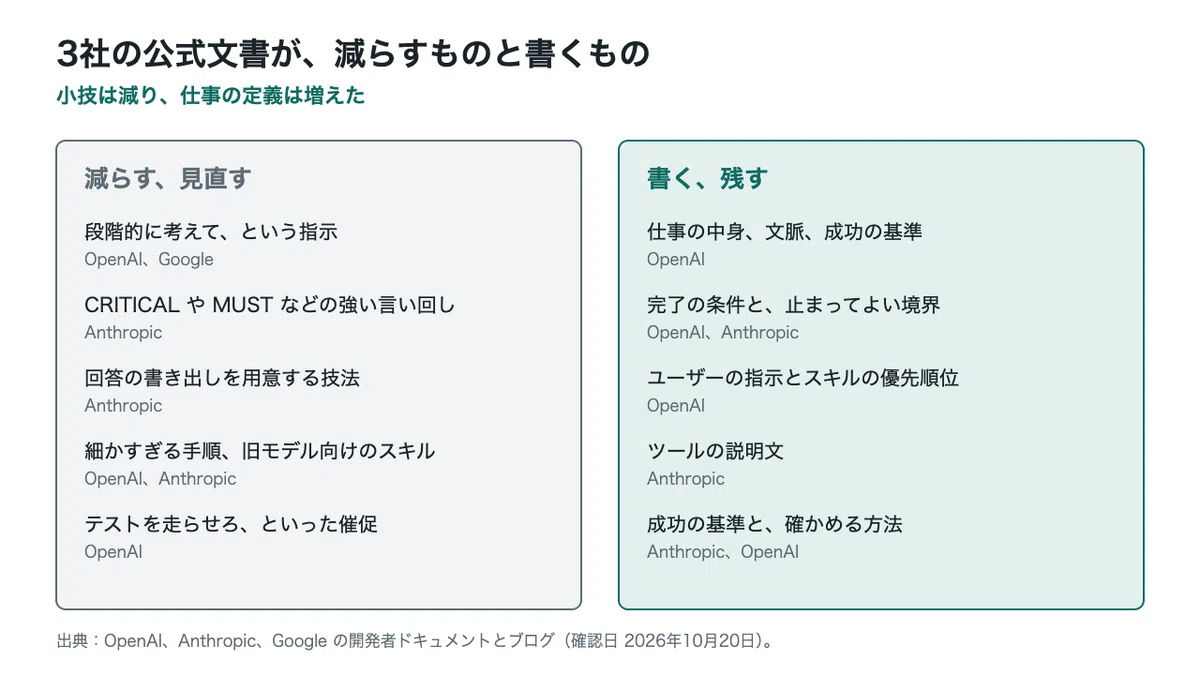 What three companies’ official documents say to reduce and what to write.
This is a point that those who downplay prompts often overlook.
OpenAI explains that GPT-6 Astra has a stronger ability to follow instructions than previous models and has become more sensitive to instructions written in skills or AGENTS.md. Furthermore, it strongly recommends inspecting the skills and configuration files that the model can read.
In the same September 2026 article, it also writes that overly detailed procedures that were useful in the past can now hinder results. It notes that while previous models needed to be prompted to run tests, Astra verifies things itself, so the same instructions now generate redundant tests.
Anthropic also writes in its Claude Fable 5 guidelines that skills created for previous models often contain instructions that are too detailed, which can lower the quality of the output.
The smarter the model, the more literally written instructions are followed. Old instructions will also be followed just as literally. That is why someone is needed to rewrite them.
There are numbers as well. However, these are all reports from slightly older models.
In its April 2025 GPT-4.1 guide, OpenAI reported that by including three short instructions for agents, the internally measured SWE-bench Verified score improved by nearly 20%. It also states that instructions for planning improved success rates by 4%.
A 2023 study found that in a setting where a few examples were shown to solve a problem, there were models where the accuracy rate changed by up to 76 points based solely on the format of the prompt. A verification by the Wharton School also concluded that while the average effect of small tricks is small, the results can fluctuate significantly when viewed on a per-problem basis.
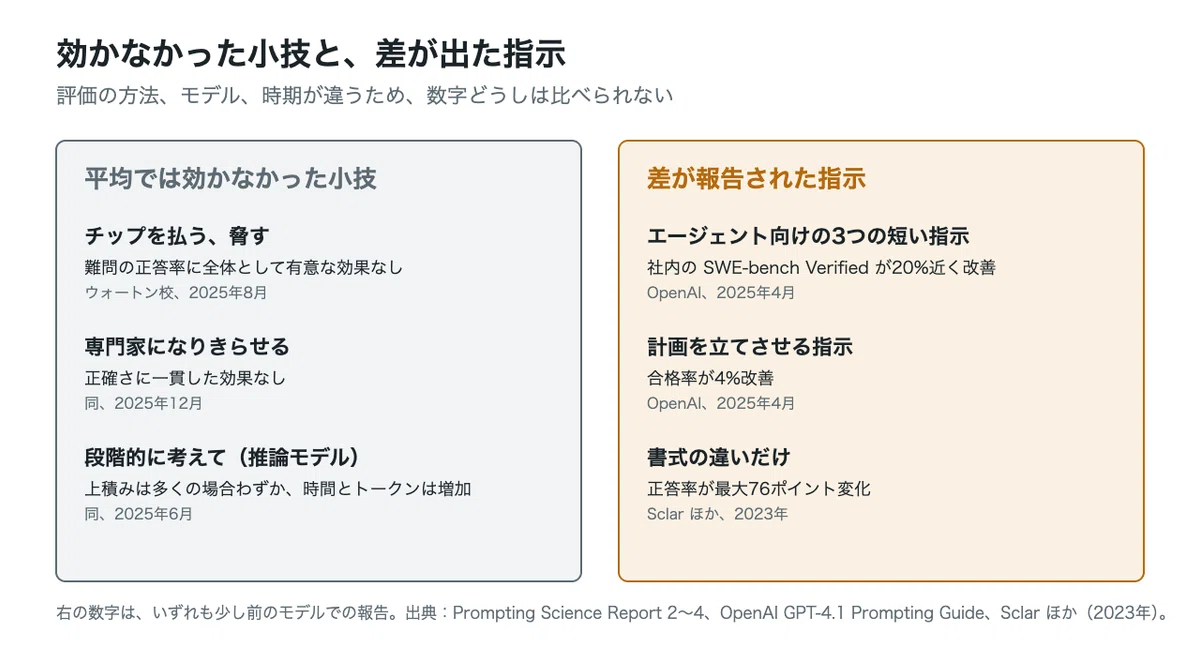 Small tricks that did not work on average versus instructions where differences were reported
However, the evaluation methods and conditions vary. You cannot simply line up the numbers and compare them. What can be said is that it is still officially reported that differences in how things are written can influence outcomes.
Automatic optimization also requires a yardstick
Will automatic optimization eliminate human work?
In an IEEE Spectrum article, researchers pushing for automatic optimization say that the system itself should be able to create scoring criteria to determine which prompts are good. In other words, someone must decide on the scoring criteria.
Anthropic’s guide asks that as a prerequisite for fixing prompts, you first prepare success criteria and a way to verify them. OpenAI also recommends creating evaluations and checking them repeatedly.
Small tricks can be left to machines. What constitutes success cannot be left to them.
I will also touch upon the strongest form of the dismissal argument. This is the claim that as models become smarter, the amount humans write will continue to decrease. OpenAI explains that for GPT-6 Astra, if there is room for interpretation in an instruction, it will fill in the daily gaps with the context at hand and ask questions focused only on points that could change the result. Instead of humans writing, they answer questions asked by the AI. This is also a new form of prompting. Even if the amount of writing decreases, it is still humans who decide what to answer.
Many of the dismissal arguments use the word ‘prompt’ in the narrow sense of tweaking the phrasing typed into a chat. In that sense, the dismissal argument is almost correct. What is off is not the conclusion, but the definition of the word.
In Japan, the entry-level problem is still significant
According to the Ministry of Internal Affairs and Communications’ 2026 Information and Communications White Paper (published in July 2026), 58.8% of people in Japan have used generative AI. In the previous year’s survey, it was 26.7%. Since 15 to 19-year-olds were added to this survey, the figure is 52.2% when limited to those 20 and older, but it is still a significant increase.
On the other hand, when asked why they do not use generative AI, 38.8% of people said they do not know how to use it. The white paper notes that this percentage is the highest among the countries compared.
Even in the second edition of the government’s Generative AI Utilization Guidelines, formulated by the Digital Agency in June 2026, rules regarding input data or prompts are listed as one of the rules during use.
Communication that treats prompts lightly may stop people who are standing at the entrance from moving forward.
Questions for verifying it yourself
Question 1: When, by whom, and for which model were the instructions written in your company’s AI?
Question 2: Are there any instructions left in those prompts that are no longer needed or that contradict each other?
Question 3: What do you use to judge the quality of the AI’s output? Are those criteria written down?
Question 4: When you read claims that prompts are unnecessary, is the person referring to minor tricks, or to the instruction manual for delegating work?
A step in practical work
There is one thing you can do today.
Open one of the custom instructions or skills you are currently using and check if the following three things are written in it:
The objective and the conditions that define completion.
The boundaries of what must not be done.
The criteria for judging quality.
If they are not written, add them. Conversely, try deleting words that only encourage the model or detailed procedures intended for older models.
Prompts have evolved from memorized techniques into instruction manuals for delegating work. The author is gradually shifting to the AI itself.
Even so, it is humans who determine the premises.
Related articles
Humans confirm the objectives, premises, and failure conditions, while letting the AI write the draft. I discussed this division of roles in an interview.
The three layers of prompt elements—essential, optional, and formal—are organized in this interview.
This is an example of applying the concept of creating evaluation criteria first to a decision-making prompt.
Reference materials
OpenAI Prompting (Developer Documentation) https://developers.openai.com/api/docs/guides/prompting
OpenAI Using GPT-6 https://developers.openai.com/api/docs/guides/latest-model
OpenAI Rethinking skills and prompts for GPT-6 Astra (September 11, 2026) https://developers.openai.com/blog/rethinking-skills-and-prompts-for-gpt-6-astra
OpenAI GPT-4.1 Prompting Guide (April 14, 2025) https://developers.openai.com/cookbook/examples/gpt4-1_prompting_guide
OpenAI ChatGPT Enterprise Prompt Guide (April 27, 2026) https://developers.openai.com/cookbook/examples/chatgpt/chatgpt_prompt_guide/chatgpt_prompt_guide
OpenAI Reasoning best practices https://developers.openai.com/api/docs/guides/reasoning-best-practices
Anthropic Effective context engineering for AI agents (September 29, 2025) https://www.anthropic.com/engineering/effective-context-engineering-for-ai-agents
Anthropic Writing effective tools for agents (September 11, 2025) https://www.anthropic.com/engineering/writing-tools-for-agents
Anthropic Prompting best practices https://platform.claude.com/docs/en/build-with-claude/prompt-engineering/claude-prompting-best-practices
Anthropic Prompting Claude Fable 5 https://platform.claude.com/docs/en/build-with-claude/prompt-engineering/prompting-claude-fable-5
Google Prompt design strategies (Updated October 13, 2026) https://ai.google.dev/gemini-api/docs/prompting-strategies
Google Gemini 3 developer guide https://ai.google.dev/gemini-api/docs/gemini-3
Prompting Science Report 2, 3, 4 (Wharton School) https://arxiv.org/abs/2508.00614
Sclar et al. (2023) https://arxiv.org/abs/2310.11324
Large Language Models as Optimizers (Google DeepMind) https://arxiv.org/abs/2309.03409
Microsoft Work Trend Index 2025 https://www.microsoft.com/en-us/worklab/work-trend-index/2025-the-year-the-frontier-firm-is-born
Ministry of Internal Affairs and Communications 2026 Information and Communications White Paper https://www.soumu.go.jp/johotsusintokei/whitepaper/ja/r08/pdf/n1110000.pdf
Verifying from the basics of prompts
Prompts as instructions for delegating work are covered from the basics in my book, ‘ChatGPT: First Steps in Prompt Engineering’.