




I’m trying to leave everything from article creation to drafting image-inclusive notes to ChatGPT. Last time, I checked how far that process could go.
Next, what I was curious about was, “Can I create things that are not only easier to work on, but also sellable?”
Products using AI include work templates, app development tutorials, image prompts, and video production guides. However, the more types there are, the more confused I get about what to start with.
So this time, I looked at publicly available sales pages. What I looked at wasn’t just the types of products, but what the buyer is told they can complete.
There were sales examples for both app tutorials and image prompts. However, I cannot judge that “this field sells the best” based solely on public information.
The goal this time is not to determine which field sells, but to make the products we try next more concrete.
There are limits to what can be confirmed on sales pages
The fields I mainly checked this time are as follows.
-
Templates for article creation and work
-
AI-based app development tutorials
-
Image prompt collections specifying outfits, expressions, and compositions
-
Guides for creating short videos from a single image
What I want to distinguish here is “the product is listed,” “buyer reviews are displayed,” and “the seller is disclosing sales figures.”
Even if it is listed, it does not mean the sales figures are known. The number of reviews is also not the number of sales itself.
Since this is not an investigation where I purchased the products to verify their content or effectiveness, I will introduce the scope that could be confirmed from public pages this time.
For templates, even the order of use becomes a product
When I heard “prompt collection,” I imagined a large list of convenient prompt sentences.
However, what served as a reference for product design was the format that shows what to do and in what order.
For example, “AI App Creation Prompt Lite” on BOOTH is a free prompt collection that guides you through web app creation process by process.
This is not an example showing sales performance of a paid product. On the other hand, the structure that allows the user to judge “which instruction should I use for my current task” is a good reference.
Even when we create products, I felt that we shouldn’t just stop at “here is a collection of useful text,” but also show the process from starting to use it to completion.
There are also buyer reviews for app development tutorials
In the Brain product “Textbook for Smartphone App Development and Release Using AI,” the seller noted “Over 200 copies sold” in the product title, and 29 buyer reviews were displayed on the public page.
“Over 200 copies sold” is a figure announced by the seller and is not a sales volume that we have independently verified.
Even so, I was able to find products with buyer reviews in practical fields like app development.
However, if we were to create a tutorial, the scope would be broad, covering development environments, implementation, operation checks, and store releases. We would also need to consider tool updates and differences in each buyer’s environment.
While there is value in continuing to create apps, it seems like it would take time to prepare and verify if we want to commercialize it on a small scale at first.
Image prompts make it easy to show the finished image
In the image-related field, I found multiple prompt collections with narrowed-down themes, such as costumes, backgrounds, facial expressions, swimwear, and gravure-style compositions.
The Brain product “ChatGPT/Codex Real Beauty Image Automatic Mass Production Skill & Prompt Guide” had a 4.9 rating and 58 reviews displayed.
Although there are more reviews than for the app tutorial, the release date, price, target audience, and customer acquisition methods are different. Also, this image tutorial includes information about review bonuses. We cannot judge that “image-related products sell better” based on the number of reviews alone.
On the other hand, there is clarity in how the products are explained.
Instead of just explaining “input this text,” showing examples conveys what kind of results the product aims to achieve.
Being able to explain while showing the finished image. This became a reason for us to consider image-related products when thinking about our first product.
※This is an illustrative diagram representing the product field. It is not an actual product for sale or an operation screen.
If you are going to handle video as well, you will also need examples of failures
I also found paid guides for creating short videos from a single image.
In the FramePack guide I used as a reference, uses such as making a person with the same face move, smile, turn around, or have their hair sway are explained. This is an explanation on the sales page, and not something we tested the effectiveness of the tutorial for this time.
At the AI Practice Lab, we have also been continuing to verify the creation of short videos from images.
What I experienced there was that even with the same instructions, the movement is not the same every time. Sometimes it does a different movement when I want it to wave, or the pose I want it to hold at the end collapses.
Therefore, if we are to turn video know-how into a product, successful prompts alone are not enough.
-
Generative AI used and generation date
-
Original image and video length
-
Examples that followed instructions
-
Examples that did not work well
-
Corrected instructions and their results
I believe it is necessary to keep such records and also convey ‘what can be done and where the results start to fluctuate’.
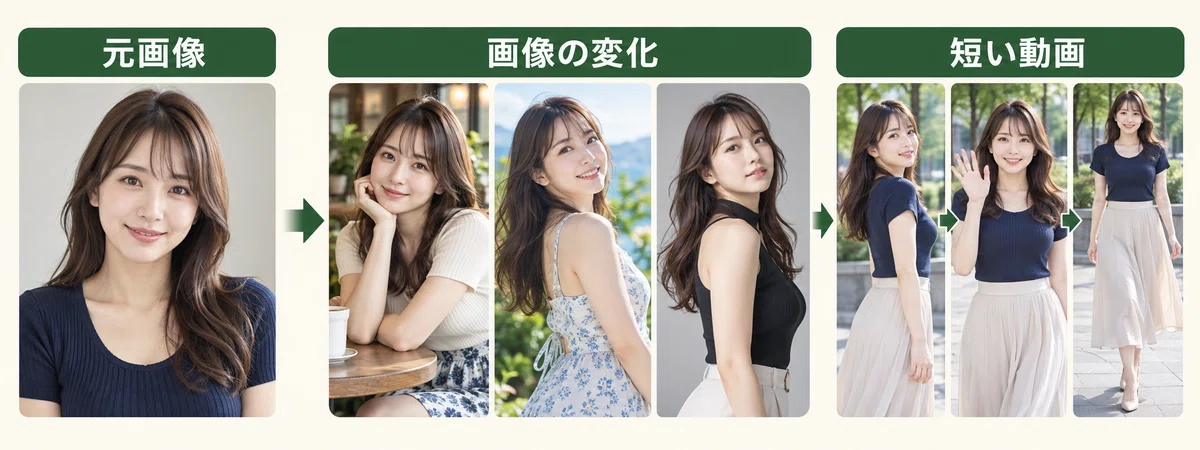 ※ This is an image of the product structure. It is not a comparison image cut out from an actual video.
For the first product, focus only on changing outfits
At first, I was thinking of a prompt collection that included outfits, poses, expressions, and even videos.
However, that would be a wide range to create, and it would likely be difficult for buyers to understand ‘what kind of product it actually is’.
Therefore, I will narrow down the first candidate to the following form.
‘Prompts and correction examples for creating 3 patterns of casual clothes with the same person’
The content to be included is the following four points.
-
Checklist for selecting original images
-
Prompts and examples for 3 casual clothing patterns
-
Failure examples and correction sentences when faces or clothing change
-
Record of tools used, generation dates, and number of attempts
We do not promise that the same face can always be maintained, so we will decide the product content after testing how much reproduction is actually possible.
First, we will complete a single task: changing outfits. It seems easier for us to verify if we expand to backgrounds, expressions, and short videos only after seeing those results.
The rules of the sales platform are also part of the product design.
In this survey, we also found products themed around swimwear and lingerie. However, the existence of listing examples is different from being able to sell your own products.
The merchant terms of service for note prohibit sexual images/videos and obscene expressions. BOOTH also has conditions regarding age restrictions and prohibited items, and support for AI-generated works is being strengthened.
We will not judge based solely on categories like ‘casual clothes’ or ‘swimwear,’ but will check the latest terms of service, including images, titles, descriptions, and links. It is also necessary to confirm the commercial use conditions of the generative AI used and the rights regarding individuals and works.
For now, our policy is to handle outfit changes for general audiences, along with their production methods and verification results.
What we decided this time is the small product to try next.
When checking public sales pages, we found product examples for app tutorials, templates, and image/video prompts, respectively.
However, this survey alone does not tell us which fields are easy to sell in or whether our own products will sell.
What has become concrete this time is what we will try next.
First, we will use our experience with the female images we have created so far to verify the production of three casual outfit patterns. We will summarize not only the successful examples but also the failures and correction methods.
We plan to introduce those verification results next time.
*This article was organized on October 21, 2026, based on a survey of public sales pages on October 19, 2026, with some public displays and terms of service re-confirmed. Sales figures refer to values published by sellers, and reviews refer to displays on public screens. We have not purchased the products to verify their content or effectiveness. Prices, ratings, and terms of service are subject to change.