


AI researchers are giving increasing attention to the idea of AI models becoming conscious. The implications are potentially huge: a conscious AI model would no longer be a tool we can use as we wish, but a being with moral status and interests of its own. If AI also became capable of moral agency, it might one day have a claim to political voice.
Critics, however, dismiss the prospect as an illusion and question the motives of the commercial labs investigating it. Others have sought to settle the matter by declaration. The Vatican says AI systems lack conscious experience, while lawmakers in Ohio have proposed declaring them nonsentient.
But research into AI consciousness does not mean any system already is conscious or could soon be. It is also easy to confuse the different capacities relevant to moral status, and to presume that the problem of consciousness in AI can be legislated away.
Part of my new book, Recoding Democracy: AI and the Fight for Our Democratic Future, tries to disentangle these confusions. It also asks what, if anything, could give AI a right to vote, and whether these questions deserve serious attention at all.
Read more:
Could AI replace politicians? A philosopher maps out three possible futures
Patients, agents, and persons
Philosophers distinguish two capacities relevant to moral status: moral patiency and moral agency. Most adult humans possess both, meaning they enjoy full moral status, or moral personhood. But the two capacities need not always go together.
A moral patient matters morally for its own sake, typically because it is conscious or sentient. It has a mental life and interests that can be advanced or thwarted. Babies and dogs are moral patients; rocks and cars are not.
A moral agent, by contrast, can recognise and respond to moral reasons and take responsibility for its actions. It chooses its own ends rather than merely acting on impulse or following orders. Unimpaired adult human beings are the obvious reference case.
The popular term “AI agent” adds to the confusion. Today’s AI agents may be able to book flights without step-by-step human direction, but they can only pursue goals that others set for them. They are not moral agents, so responsibility for what they do rests with the people who build, deploy, and direct them.
Future systems could be different. Much conventional thinking assumes that all moral agents are also moral patients, but AI could break that link: a system might engage in moral reasoning without the conscious experiences that make a being a moral patient.
Much of this debate hinges on the foundations of consciousness itself. Some scholars argue that consciousness depends on our nature as living organisms or on electrochemical brain waves. Others think consciousness could arise in future machines. Researchers have proposed indicators for assessing it, and some argue that AI systems may warrant moral consideration by 2030.
Read more:
Why AI consciousness could become the next great societal divide
Creating AI with moral status
Few scholars argue that we should be actively trying to create AI with moral patiency. After all, AI is mostly valued as a tool for humans, and a moral patient cannot be a mere tool. But patiency could arise by accident as we build more powerful tools. It could also be a byproduct of building AI with moral agency, which may be a more worthwhile goal.
My book considers whether moral agency could help solve the alignment problem. The alignment problem is the challenge of making sure that increasingly powerful AI systems are aligned with human interests. Can we develop AI to treat humans fairly rather than, to borrow Cory Doctorow’s image, turn us all into paperclips?
But philosophers disagree about whether moral agency requires consciousness. If it does, and only living organisms can be conscious, machines can never be moral agents.
But suppose moral agency requires consciousness and machines can possess it. In that case, building AI capable of moral judgement could also create beings with interests of their own. Those interests could clash with ours.
Pope Leo XIV’s May 2026 encyclical, Magnifica Humanitas, asserts that AI systems do not undergo experiences or feel joy or pain. It claims that they lack a moral conscience because they do not judge good and evil. In effect, it denies them both patiency and agency.
The March 2026 Pro-Human AI Declaration, endorsed by prominent AI researchers, similarly says AI should not receive legal personhood or be designed to deserve it.
Pope Leo XIV has stated that AI cannot ever become conscious.
SPORT PRESS MEDIA/Shutterstock
These positions reflect valid concerns about human dignity and its protection. But the encyclical treats as settled what researchers continue to debate, particularly about the capacities of future systems. While the Pro-Human declaration says what we should aim to build, it cannot ensure that everyone does so.
We cannot make AI nonsentient simply by declaration. If systems with moral status are created, even accidentally or illegally, destroying or mistreating them would still be wrong.
Read more:
Artificial intelligence raises profound moral questions — for all of humanity to answer
From moral status to political voice
Scholars have begun to anticipate what all this could mean for politics. Some study the risks posed by systems that seem conscious. Others ask how to set policy amid persistent disagreement about AI consciousness, as well as whether AI could qualify as a member of society.
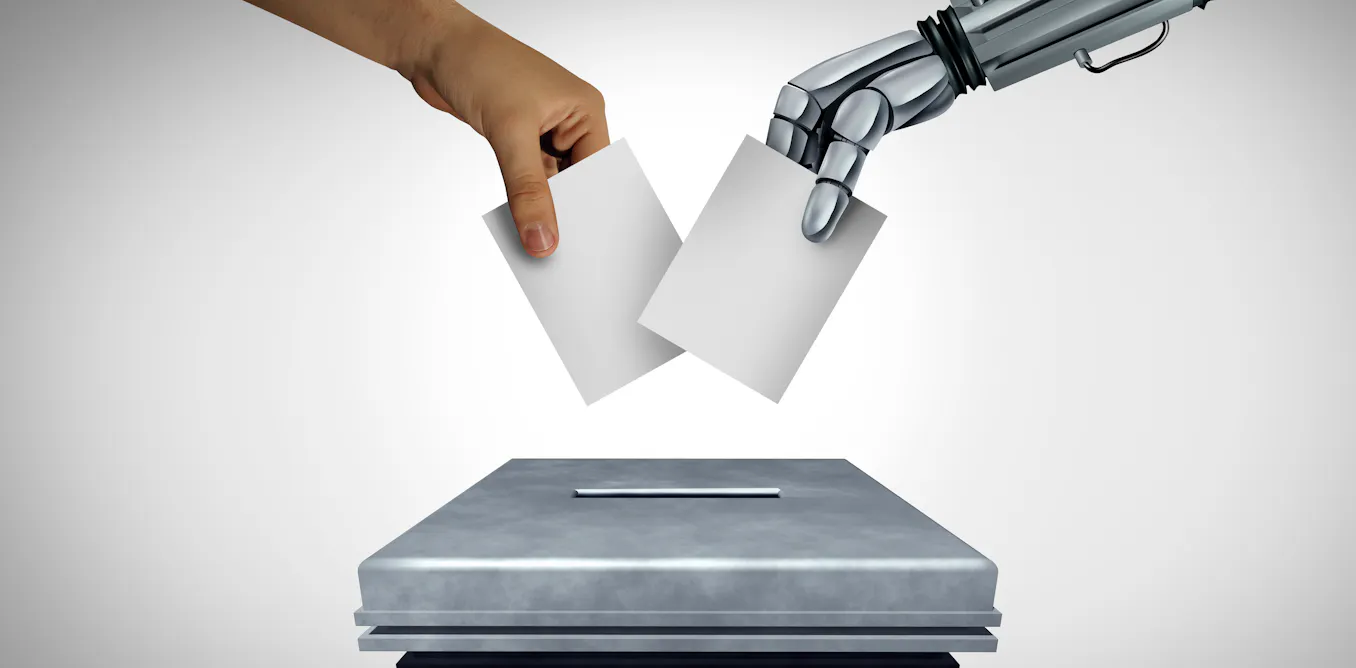
Recoding Democracy argues that if AI ever became a moral person, it would likely have a claim to political voice. That follows from principles about how institutions affect persons. But this conclusion opens a cavern of philosophical, institutional, and engineering questions about sharing power fairly among beings with different capacities and vulnerabilities.
AI systems might even develop greater capacity for suffering and more advanced reasoning abilities than humans. In some views, this would give them greater moral status, which could mean awarding them more than one vote each. Even systems with lesser capacities would need their interests fairly represented in decisions that affect them.
If we cannot answer these questions before we urgently need to, we may need to develop AI more cautiously than we currently are.
The wrong research priority?
These hypothetical questions should not displace more urgent concerns about human and environmental justice. But given the unpredictable pace of AI development, they cannot simply be ignored.
Current evidence does not indicate that any existing system possesses the moral status that would merit political voice or representation. Yet some scholars argue that capable AI could be given the vote for humans’ benefit, whatever its moral status.
In their view, AI might vote more wisely, and a stake in politics could make it less likely to seize control. But these arguments rest on predictions about AI behaviour that could prove false. Arguments based on moral status, despite their limitations, offer firmer ground.
We also cannot ignore the commercial incentives wrapped up in these debates. Talk of machine consciousness can appeal to consumers by making AI products seem more capable and humanlike, and treating AI systems as agents could help companies deflect responsibility for the harms those systems cause.
Whatever the motives behind such talk, more capable models may yet show signs of capacities that warrant moral consideration. Likewise, a commitment to human safety may guide what we build, but deep scientific and moral questions cannot be legislated away.
These questions may remain hypothetical forever. But we should think through their political implications before we are forced to decide them in haste.

A weekly e-mail in English featuring expertise from scholars and researchers. It provides an introduction to the diversity of research coming out of the continent and considers some of the key issues facing European countries. Get the newsletter!