


Introduction 💡
A few years after the arrival of ChatGPT in 2022, our approach to engaging with LLMs has changed many times. 🌊
The era where “writing good prompts” was the only source of competitiveness is over. Now, the scope of what developers must address is expanding rapidly, from preparing context and setting up execution environments to designing the very mechanisms themselves.
An article that organizes this transition as the “4 Generations of the AI Paradigm” is Stop Writing Prompts—The True Nature of the New Paradigm Called “Loop Engineering” (Across Studio Blog).
For example, even for the same task of “fixing a CI test failure,” our actions change significantly depending on the generation. 👇
# 第1世代(Prompt Engineering): 1回きりの指示を磨き込む
$ claude “このテストが失敗する原因を直して”
# 第4世代(Loop Engineering): 条件を決めて仕組みに任せる
$ claude cron create
–schedule “*/30 * * * *”
–prompt “CIが赤くなっていたら原因調査→修正→PR作成。証拠(テストログ)がない修正はマージしない”
I think you can see that even when “having AI fix code,” the content of what humans do is completely different. ✨
Tracing the 4 Turning Points of LLM Utilization in Development Sites 🕰️
First, here is the big picture. The generations can be summarized as follows.
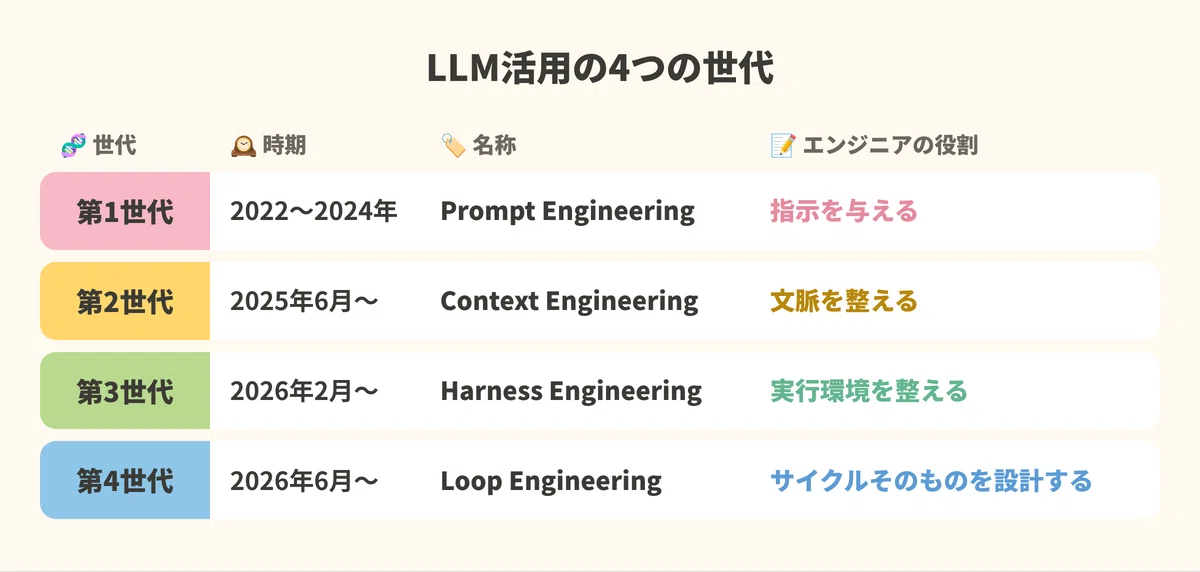
We will look at how each has appeared in development sites. 👀
1st Generation: Prompt Engineering (Giving Instructions) ✍️
-
Period 🕰️: 2022–2024
-
Representative Tools 🧰: ChatGPT, GitHub Copilot, OpenAI Playground
Background
There is no specific proponent for the term “Prompt Engineering”; it emerged spontaneously among practitioners who began using the GPT-3 API around the time of ChatGPT’s release (November 2022).
How to use the tools
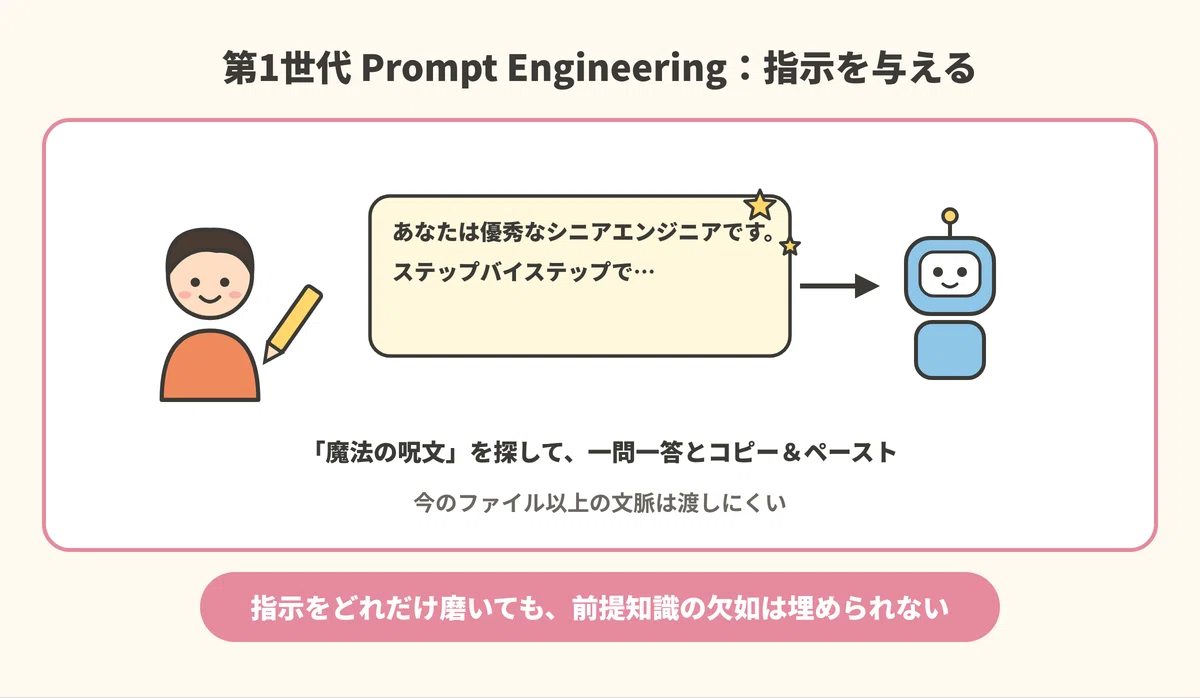
It was an era of searching for “magic spells.” The output quality changed significantly depending on the presence or absence of a single sentence like “Think step-by-step” or “You are an excellent engineer,” and articles and cheat sheets summarizing prompt tips were mass-produced. 📜
あなたは優秀なシニアエンジニアです。
以下の要件に従って、ステップバイステップで実装してください。
(要件を1つのメッセージに詰め込む)
ChatGPT was primarily used by pasting error messages or code into a browser for repeated Q&A, and manually copying and pasting the returned code into an editor.
GitHub Copilot was used to complete code being written in the editor, which is more like inline completion than a dialogue.
Both had limited means of passing context beyond the “current file” to the model, and there was a limitation that no matter how much you polished the instructions, you could not bridge the lack of “background knowledge” held by the model. Context and agent-like behavior were not yet the main characters.
2nd Generation: Context Engineering (Organizing Context) 📚
-
Period 🕰️: June 2025–
-
Representative Tools 🧰: Cursor (.cursorrules), Claude Code (CLAUDE.md)
Background
This term originated on June 18, 2025, when Shopify CEO Tobi Lütke proposed it on X (relevant post), and it spread rapidly about a week later when Andrej Karpathy reinforced it with the metaphor, “LLMs are a new kind of OS, and the context window is RAM” (relevant post). 🚀
How to use the tools
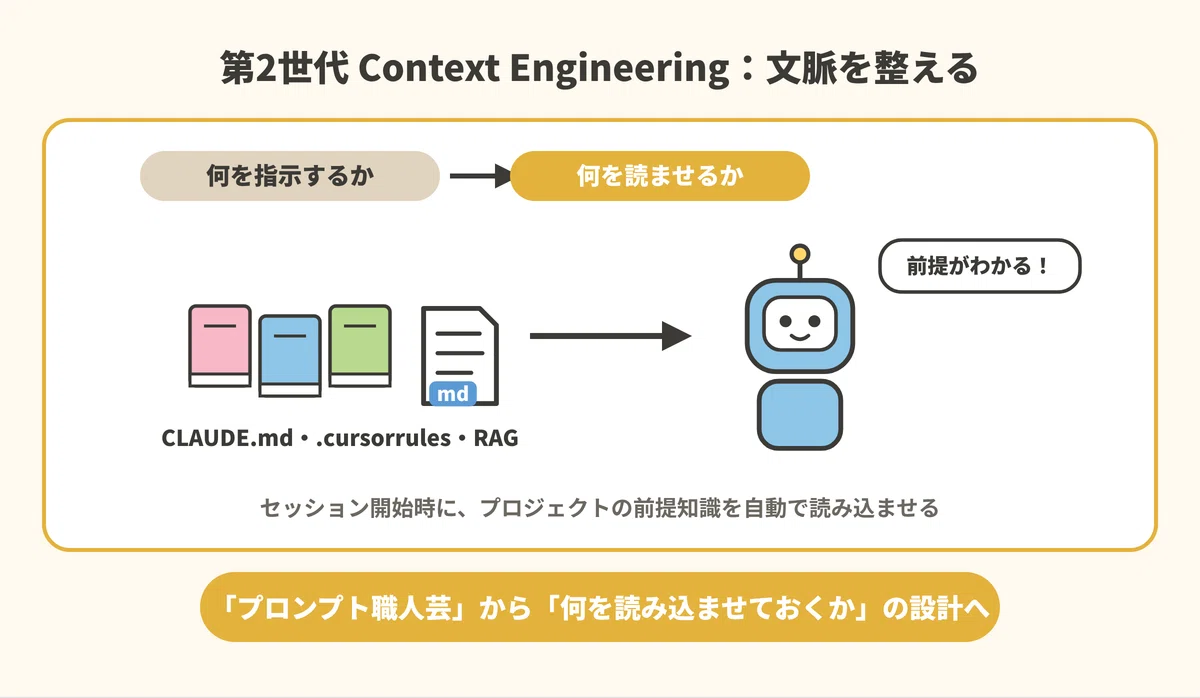
What became important then was not “what to instruct,” but “what to have it read.” The spread of RAG, the practical application of long context windows, and the establishment of project configuration files like CLAUDE.md are the manifestations of this trend in terms of implementation.
# コーディング規約
– テストは Jest を使用し、カバレッジ100%を維持する
– コミットメッセージは日本語で記述する
– API呼び出しは必ず `src/lib/api.ts` 経由で行う
In terms of how tools are actually used, the construction of RAG pipelines has become widespread, where documents or codebases are vectorized in advance using LangChain or LlamaIndex, and only the relevant parts are searched and injected into the context for each question. 🧰
On the editor side as well, the practice of writing project prerequisite knowledge into files that are automatically loaded at the start of a session, such as .cursorrules in Cursor, has become established.
Claude Code is used in a similar way by placing CLAUDE.md directly under the project root, allowing coding standards, directory structures, commit message rules, and more to be automatically loaded at the start of every session. Because it can be placed hierarchically by user and by project, it is also characterized by the ability to pass on both individual preferences and team rules.
Thus, the effort required to get good answers has shifted from “prompt craftsmanship” to the problem of designing “what to have it read in advance.”
3rd Generation: Harness Engineering (Setting up the execution environment) 🛠️
-
Period 🕰️: February 2026–
-
Representative Tools 🧰: Claude Code (Sub-agents), OpenAI Codex CLI (sandbox), Cursor (Agent mode), Devin (Autonomous execution)
Background
The formula “Agent = Model + Harness” was first presented on the LangChain blog, and it was Mitchell Hashimoto, co-founder of HashiCorp, who systematized this as a discipline called “harness engineering” (February 5, 2026, “My AI Adoption Journey”). After Ryan Lopopolo of OpenAI published a practical example six days later 🤖, it quickly became established in the industry.
How to use the tools
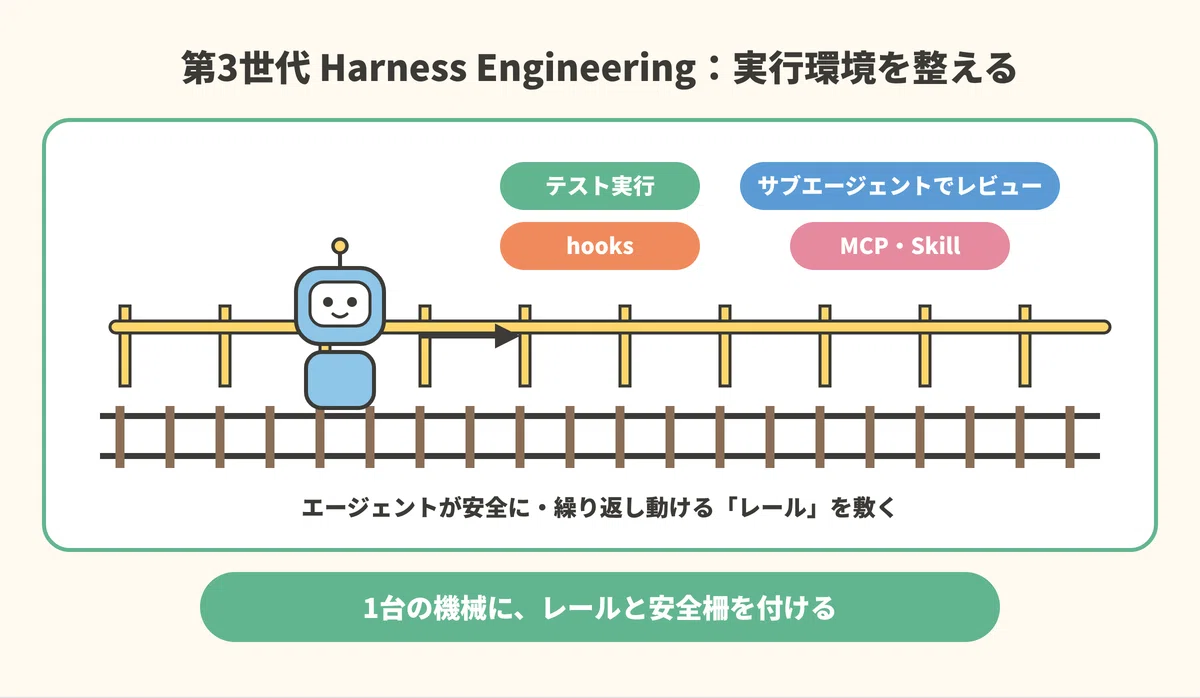
Furthermore, as LLMs evolved from entities that simply “answer” to entities that “work using tools” (agents), it became important to set up an environment where they can be executed safely and repeatedly (Harness). The original article compares this phase to “putting rails and safety fences on a single machine.” 🚧
This is the process of laying “rails” so that agents can move around safely, including editors, terminals, test execution, and verification by sub-agents. In the case of Claude Code, this corresponds to providing project knowledge through Skills and review/verification by sub-agents (Agent tools).
# サブエージェントで実行結果を検証させる(Harnessの一例)
「実装が終わったら code-reviewer サブエージェントでレビューさせてから報告して」
In terms of actual usage, Claude Code combines post-implementation reviews by sub-agents, automatic formatting and test execution via hooks, and external tool connections via MCP to build a “mechanism that ensures the same mistake is never made twice.” 🧰
OpenAI Codex CLI also uses a similar approach by combining a sandbox environment with automated testing, but it is valued for the breadth of its supported surfaces.
Cursor uses an agent mode within the editor, while Devin focuses on more autonomous task execution; they each differ in where they apply the ‘depth of the harness’.
It is becoming a tool choice based not on which one to pick, but on ‘what kind of workflow you want to align yourself with’.
4th Generation: Loop Engineering (Designing the cycle itself) 🔁
-
Period 🕰️: June 2026–
-
Representative tools 🧰: Claude Code (/goal, /schedule), OpenAI Codex (automations)
Background
The catalyst was a statement by Boris Cherny, head of Claude Code. 🔍 On June 2, 2026, at ‘Acquired Unplugged’ hosted by WorkOS,
I don’t prompt Claude anymore. I have loops that are running…My job is to write loops.
(I don’t write prompts anymore; my job is to write loops.)
He said this, and developer Peter Steinberger was making similar claims around the same time.
Following this, on June 7, 2026, Addy Osmani of Google gave this practice a name and defined its components (automations, worktrees, skills, etc.) in his essay ‘Loop Engineering’. 💡 In other words, the person who named it is Osmani, not Cherny.
Note that the anecdote about ‘Claude Code writing 100% of PRs itself in 30 days’ comes from a Threads post on December 27, 2025, and the anecdote about ‘not having opened the IDE since deleting it’ comes from an X post on June 9, 2026.
How to use the tools
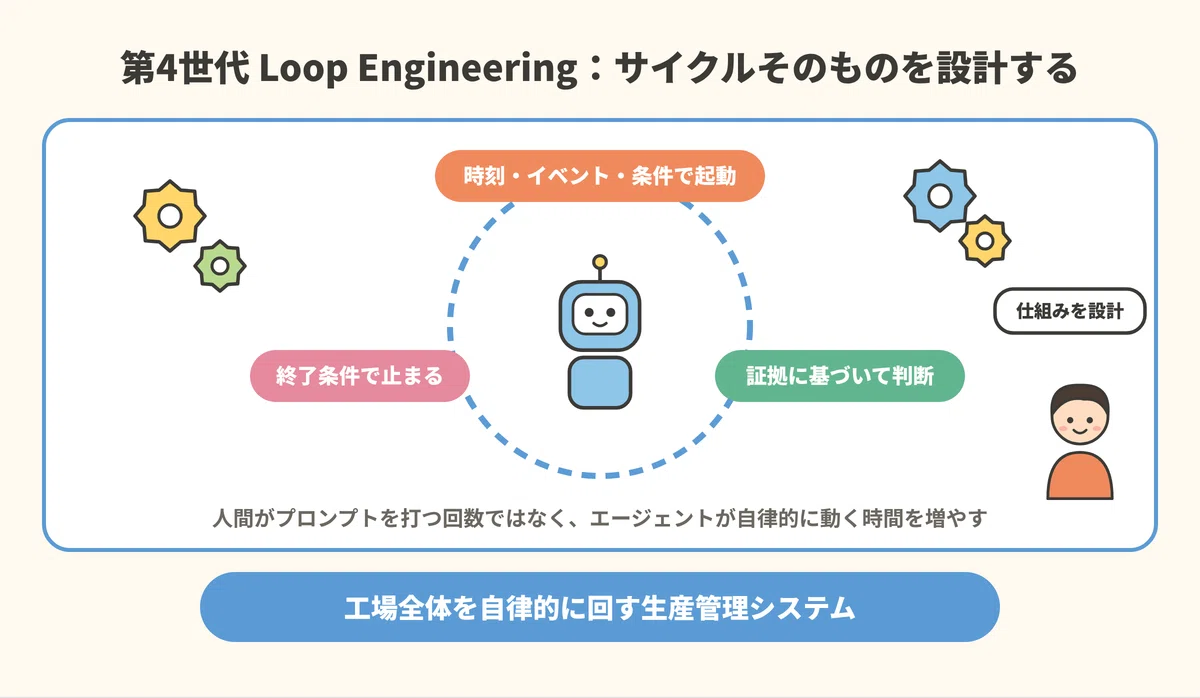
And our current location is the 4th generation, Loop Engineering. If a harness is a ‘safety device for a single machine,’ a Loop is equivalent to a ‘production management system that autonomously runs the entire factory‘. 🏭
Instead of starting every time a human types a prompt, the agent starts autonomously according to time, events, and conditions, makes decisions based on evidence, and stops according to termination conditions—Loop Engineering involves designing up to that point.
What actually supports this design are Claude Code’s /goal (a command that keeps the agent running until success conditions are met) and /schedule (periodic execution on the cloud), as well as OpenAI Codex’s automations feature. 🧰
In actual usage, this means passing only the success conditions to /goal, such as ‘fix it until all tests pass,’ and leaving it alone, or using /schedule or Codex’s automations to periodically execute tasks like ‘investigate CI failures every morning and submit a fix PR’.
Both share the common feature of increasing ‘the time the agent moves autonomously’ rather than ‘the number of times a human types a prompt’.
In conclusion 🎯
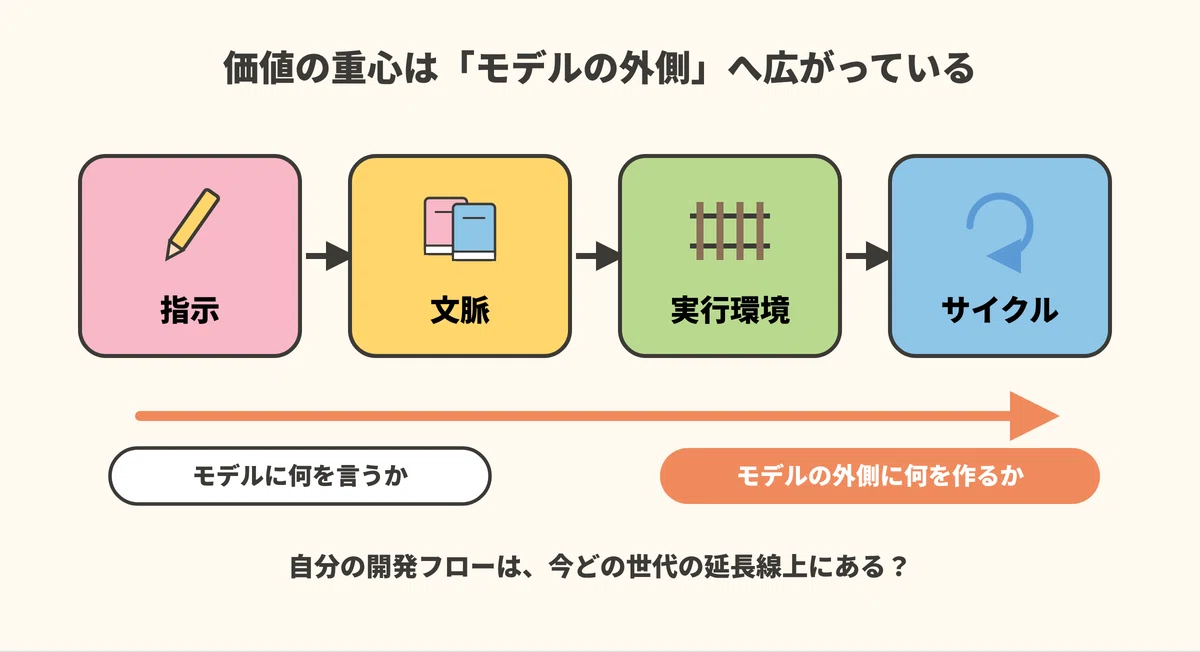
The important thing is not to memorize the names, but to grasp the structure itself where, from instructions → context → execution environment → cycle, the center of gravity of value has consistently continued to expand from ‘what to tell the model’ to ‘what to build outside the model’.
-
LLM utilization has evolved through four generations: Prompt → Context → Harness → Loop.
-
Loop Engineering, where we are now, is an era that demands the skill to design ‘good systems (cycles)’ rather than ‘good instructions’
If you take a moment to inventory which generation your current development flow is an extension of, you might see the skills you should invest in next. ✨