


Hello, this is Kakeru.
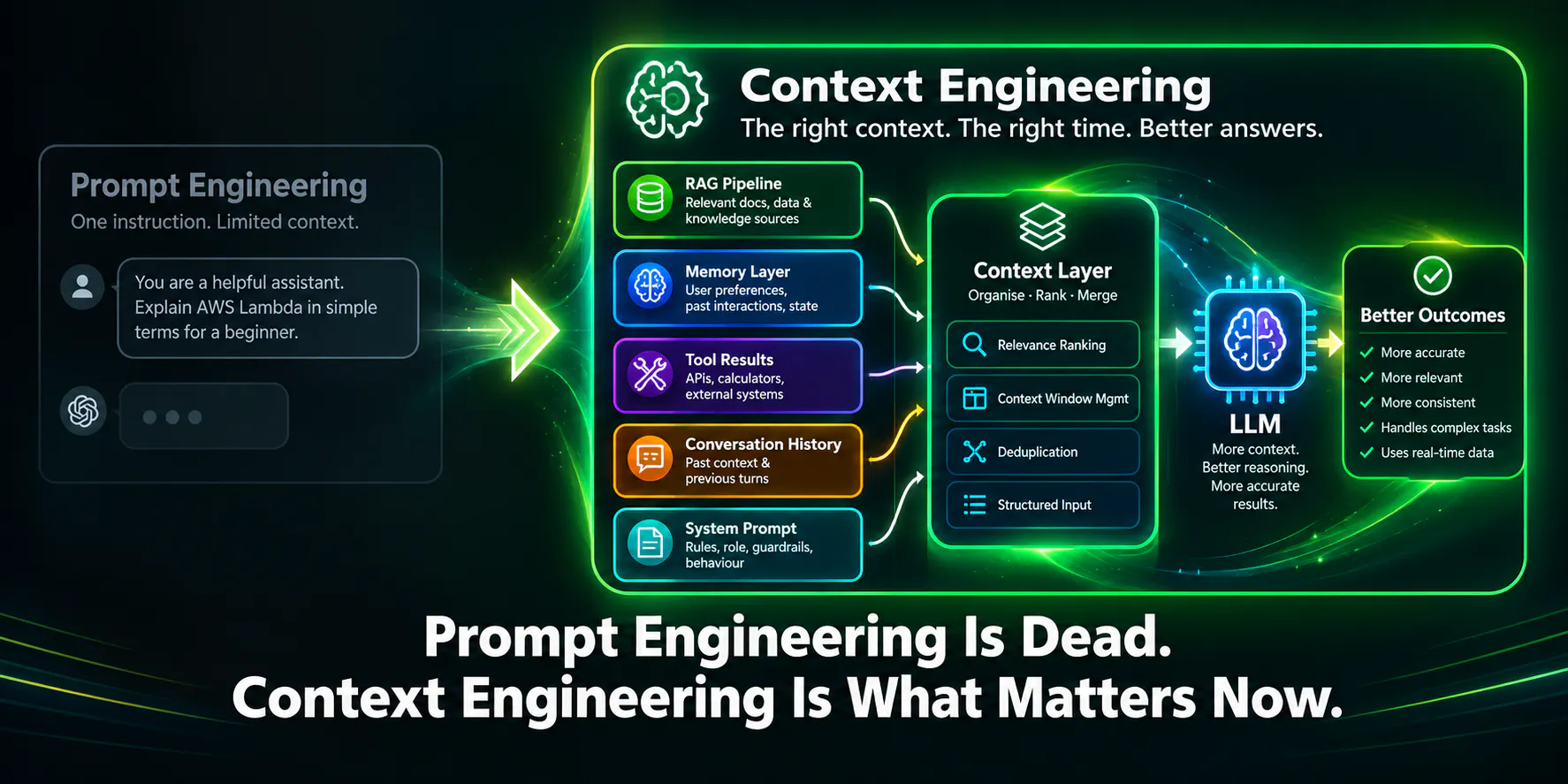
I believe prompt engineering is a field that is changing truly rapidly.
Even though techniques were introduced as ‘the correct answer’ until last year, when I look at them this year, there are many instances where I think, ‘Oh, that method is already outdated.’
Conversely, there are also techniques that ‘remain effective.’
Today, I would like to summarize ‘what I have actually tested, what has changed, and what has not’ over the past year.
If you are using prompt technology for a side job or are planning to start using it in earnest, please use this as a reference.
Major changes over the past year
First, what has changed the most in the world of prompt engineering?
Simply put, because the ‘intelligence of AI’ has increased, the effort of ‘forcing results out through techniques’ has gradually become unnecessary.
Let me give you a concrete example.
1. The decline in the importance of Chain of Thought (CoT)
Chain of Thought is a technique that ‘makes AI think step-by-step.’
For example, when there was a complex calculation problem, in the past, I would give step-by-step instructions like ‘think about this first, then think about this, and finally do this.’
The theory was that by doing so, the habit of ‘thinking step-by-step’ would be instilled in the AI, thereby increasing accuracy.
However, recent AI has shown a strong tendency to ‘think step-by-step even without being told.’
In fact, it is often more efficient to just instruct it to ‘give me only the final answer’ because there is no unnecessary explanation.
I also used to include detailed instructions like ‘for this kind of calculation, think in these steps,’ but recently, just saying ‘please calculate’ usually yields good results.
I actually tested this. When I compared the old way (step-by-step instructions) and the new way (simple instructions) regarding complex household budget calculations, the accuracy was almost the same.
In fact, the simple instructions were ‘faster because there was no unnecessary explanation.’
However, there are exceptions. In cases of ‘super complex problems’ or ‘calculations that AI is not good at,’ step-by-step instructions are still effective.
So, it’s not that it’s “completely unnecessary,” but rather that “its necessity has changed depending on the situation,” which is the more accurate way to put it.
2. Few-shot Learning is weakening
Few-shot Learning is a technique where you say, “I’ll show you three or four examples like this, so create something in the same pattern.”
In the past, it was said that this was “extremely effective.”
For example, when asking it to “write a blog post in this format,” you would give instructions like, “Here are three examples of existing articles, so follow the same pattern.”
However, recent AI has improved its ability to “understand that ‘pattern’ just through verbal explanation.”
Therefore, you don’t have to go out of your way to show three examples; you can now sufficiently handle it just by explaining the structure in words, like “Write a blog post with this structure.”
Of course, for super complex formats (for example, “in JSON, with this structure, and these items”), it is more reliable to show examples.
But for “normal text formats,” it feels like “verbal explanation” is enough.
In fact, when I have it write articles, my approach has changed from “I used to attach three examples of existing articles” to “now, just a verbal explanation is fine.”
3. Role prompting (character setting) remains effective
This is a technique where you set a persona, such as “You are a person with this profession and experience,” and have it answer from that perspective.
This “remains effective.”
For example, the instruction “You are a marketer. What should be done to increase sales for this product?” and the instruction “What should be done to increase sales for this product?” will produce completely different answers.
The former is more likely to produce ideas from a “marketer’s perspective.”
This hasn’t changed over the past year. If anything, it feels like it has become even more precise in its functionality.
I also make an effort to set a persona, such as “Kakeru,” to ensure that the perspective of being “beginner-friendly and approachable” remains consistent.
Techniques that remain effective
Now, I will summarize the techniques that have “remained effective” over the past year.
1. Clear instructions
Write ‘what you want it to do’ as clearly as possible.
This is more of a ‘basic’ than a technique, but it is truly important.
Instead of ‘Please write a blog post,’ saying ‘Please write a 1,500-character, helpful article for beginners in side hustles’ will definitely yield results closer to your expectations.
Even as AI evolves, the importance of this ‘clarity’ has not diminished at all.
If anything, it feels like ‘because AI has become smarter, our instructions must also be more precise.’
2. Specification of Constraints
Clearly state constraints such as ‘between X and Y characters,’ ‘in this format,’ or ‘do not include this information.’
This remains effective as well.
In fact, because ‘AI can now handle advanced tasks,’ it feels like the framework of ‘how far it is allowed to go’ has become even more important.
3. Feedback Loop
The approach of ‘have it write something, see my reaction, and then revise it.’
This is truly important as a way of ‘interacting with AI.’
Instead of seeking perfection on the first try, it’s more like ‘tried writing it -> hmm, let’s adjust it a bit more -> okay.’
This trial-and-error process does not disappear even as AI capabilities improve.
Rather, because projects are becoming more complex, the flow of ‘revising multiple times’ is becoming even more important.
4. Detailed Explanation of Context
Write detailed context such as ‘about you,’ ‘your background,’ and ‘your purpose.’
This is truly effective.
For example, the quality of the answer is completely different when you explain your background in detail—such as ‘I just started a side hustle, I don’t have much time, but I want to earn 50,000 yen a month’—and ask ‘which side hustle is good for someone like this,’ compared to simply asking ‘please tell me about side hustles.’
Even as AI evolves, I feel that the importance of ‘context’ is actually increasing.
5. Specifying Persona, Tone, and Format
Explicitly state the “output style,” such as “for a female audience,” “casual,” or “in bullet points.”
This is truly basic, but it is genuinely effective.
It is a technique that allows you to specify a “human-like nuance” that AI’s evolution cannot compensate for.
Techniques that have recently increased in importance
So, what are the techniques that have “increased in importance” over the past year?
1. “Strict Specification of Output Format”
As AI has become capable of complex tasks, it has become necessary to specify its output in a “format that is easy for programs to process.”
For example, “Output in JSON format” or “Output in a Markdown table.”
In the past, it was fine if it just “explained it in text,” but recently, there are more situations where the output is “processed by other tools later,” so it has become necessary to strictly specify the output format.
2. “Explicit Error Handling”
It has become necessary to explicitly state “exception handling,” such as “If X happens, do this.”
Because AI has become agentic (autonomous), instructions on “how to judge” in unexpected situations have become necessary.
For example, instructions like “When writing an article, if you cannot determine the reliability of the information, ask me instead of writing it for now.”
This wasn’t that important before, but it feels “super important now.”
3. “Clear Specification of Multiple Steps”
As tasks have become more complex, it has become important to clearly specify “the order in which to proceed.”
Like “Step 1: Do X. Step 2: Do Y. Step 3: Do Z.”
4. “Instructions for Self-Evaluation”
The habit of asking the AI, “How reliable do you think your answer is?”
This is a recent technique that takes advantage of the fact that AI has a tendency to be overconfident.
AI actually has the ability to determine how reliable its own answers are.
Therefore, by giving instructions such as ‘please check the parts with low reliability particularly carefully,’ you can clarify the areas that humans should verify.
Techniques that have become completely unnecessary
So, what are the techniques that have become ‘completely unnecessary’ over the past year?
1. Excessive politeness
In the past, it was recommended to treat AI politely, like saying ‘please’ and ‘thank you’.
However, it has become clear that this is no longer particularly effective.
Whether you speak politely or bluntly, the results are almost the same.
Therefore, the current trend is to prefer ‘giving concise instructions’.
2. ‘Expressions that worry about token counts’
In the past, there was advice to ‘keep instructions as short as possible because AI has a limit on input token counts’.
However, recent AI models have significantly increased context lengths, so there is no longer a need to prioritize ‘brevity’ at all costs.
In fact, there is a strong trend that ‘explaining in detail improves accuracy’.
Therefore, the balance between ‘detail and brevity’ has shifted toward ‘prioritizing detail’.
3. Excessive use of ‘techniques’
Using many ‘tricks’ like forcing step-by-step thinking with Chain of Thought or providing many examples with Few-shot.
Honestly, recent AI models have a strong tendency to perform well just by giving normal instructions without needing those tricks.
In fact, it has become clear that ‘simple instructions’ take less time and yield better results.
What I have actually changed
Now, I will write down specific examples of what I myself have changed over the past year.
Instructions for writing articles
Last year:
Please write a blog post based on the following conditions.
-
The theme is XX.
-
The target audience is beginners in side hustles.
-
The writing style should be polite (desu/masu).
-
The structure should be: Introduction -> Body -> Conclusion.
-
Each article should be around 2,000 characters.
-
Below are examples of existing articles. (3 examples)
This year:
Please write an article of about 2,000 characters on the theme of XX for side hustle beginners. Write as a persona named Kakeru, using a friendly, polite tone.
It has become quite simple. Even so, the results are almost the same. In fact, I feel that a simpler prompt makes my intentions easier for the AI to understand.
Instructions for complex tasks
Last year:
For ‘complex tasks,’ I used to give detailed instructions for each step.
Step 1: First, decide on a theme. Step 2: Next, create an outline. Step 3: Now, write the body text. …and so on.
This year:
Proceed with this entire task in the following flow:
-
Decide on a theme (-> ask for my confirmation)
-
Create an outline
-
Write the body text
-
Final check
In this flow, please let me know ‘Ready’ after each step.
In other words, I have started to instruct only the ‘overall flow’ and leave the ‘fine-tuning’ of each step to the AI.
Instructions for handling errors
Last year:
The concept of an “error” didn’t really exist, so I didn’t give any specific instructions.
This year:
I have started including instructions in advance, such as “If you cannot determine the reliability of the information, please ask me instead of writing it down” or “If you find contradictory information, please state that clearly.”
These instructions are intended to support the transition to “agentic” workflows.
Changes seen in numbers
I have actually tried measuring the effects using numbers.
Test: Efficiency of article writing
Last year’s method (step-by-step + examples) vs. This year’s method (simple + persona)
-
Last year: 15 minutes to create instructions, 1 revision
-
This year: 3 minutes to create instructions, 0.5 revisions (out of 5, about 2.5 required revisions)
Looking at the total time, “last year was 15 + (10 minutes revision time) = 25 minutes” and “this year is 3 + (5 minutes revision time) = 8 minutes,” resulting in more than a 3x increase in efficiency.
Test: Complex tasks
Comparison for a task generating 100 pieces of content:
-
Last year’s method: 20 minutes for the first instruction, 5 minutes average per item for subsequent revision costs (such as questions about unclear points)
-
This year’s method: 25 minutes for instructions (because it is complex), 2 minutes average per item for subsequent revision costs
The result was that “instructions increased, but running costs decreased.”
Calculating for all 100 items, “last year was 20 + (100 x 5) = 520 minutes” and “this year is 25 + (100 x 2) = 225 minutes,” cutting the time to less than half.
Priority of techniques to learn from now on
So, what should people who are going to learn prompt engineering from now on start with?
Here is the priority:
Priority 1 (Essential)
-
Clear Instructions: The ability to accurately write ‘what you want done’
-
Context Explanation: The ability to explain ‘background’ and ‘conditions’ in detail
-
Persona and Tone Specification: The ability to specify ‘what kind of feel’ is needed
These three are the fundamentals that will not become unnecessary even with the ‘evolution of AI’.
In practical terms, these three alone can handle ‘80% of general tasks’.
Concrete example:
-
Just by giving the instruction, ‘Write a 1000-character explanation about XX for beginners,’ you get 80% of the expected results
-
Adding ‘in a friendly tone’ brings you to 95% of the expected value
-
With just this, you get an article that can be used with almost no revisions
Priority 2 (Important)
-
Explicit Constraints: Specifying things like ‘at least XX characters’ or ‘in this format’
-
Feedback Loop: The habit of trial and error by ‘making revisions’
-
Output Format Specification: Specifying things like ‘in JSON’ or ‘in a table’
These become necessary for complex tasks.
Practically speaking, these become important when ‘multiple tasks’ are ‘in progress simultaneously’ or when considering ‘automation’.
Priority 3 (Convenient)
-
Error Handling Instructions: Exception handling for ‘in cases like this’
-
Explicit Multi-step Instructions: A flow of ‘Step 1, Step 2’
-
Self-Evaluation Instructions: Asking ‘What is the reliability of your answer?’
It is important if you are using agents, but it is not that essential for ‘normal interactions with ChatGPT’.
However, it is ‘Priority 1’ level important when proceeding with ‘complex projects’ using ‘near-automation’.
Priority 4 (For reference only)
-
Chain of Thought: Making it think step-by-step
-
Few-shot Learning: Teaching by showing examples
-
Technique-based: Various tricks
It is just ‘good to know’. In fact, prioritizing ‘simplicity’ is more efficient now.
When comparing people who ‘know all the techniques’ with those who ‘master only Priorities 1 and 2’, those who ‘master them’ often have higher ‘practical efficiency’.
The reason is that ‘simplicity reduces waste’.
Learning schedule by priority
So, here is a suggested schedule for ‘how you should learn’:
Weeks 1-2: Focus on Priority 1
Weeks 3-4: Priority 1 + Priority 2
Month 2: Priorities 1, 2 + part of Priority 3
-
Try multi-step tasks
-
Design error handling
From the 3rd month onwards: All priorities, advanced usage
-
Take on practical, complex tasks
-
Hone your judgment on ‘which technique is needed, and when’
Implementation review: Changing ‘old methods’ to ‘new methods’
So, how should you actually go about updating your ‘past prompts’ to the ‘latest methods’?
Step 1: Collect your ‘old prompts’
Gather the prompts you ‘use every time’ and the ones you have ‘saved’.
Step 2: Check ‘what is old’
Look through the list and identify parts where you think, ‘Oh, this technique is unnecessary now.’
Specifically:
-
Does it include CoT? (Only truly complex calculations require it)
-
Are there 3 or more examples? (Try to see if a verbal explanation is sufficient)
-
Is it overly polite? (Rewrite it to be simpler)
Step 3: Try ‘simplification’
Try the ‘same task’ using both the ‘old prompt’ and the ‘simple version’.
Compare the results:
-
Are the results the same?
-
Is the simple version faster?
-
Has the need for revisions decreased?
Step 4: Add “new elements”
Try adding “latest techniques” such as “error handling” and “explicit multi-step instructions.”
Check if these additions “further improve the results.”
Actual case study: Updating a “product review article”
Old prompt (2023 version, 1000 characters):
“Please write a product review article. Below are examples of reference articles. (3 article examples) Step 1: Understand the product features. Step 2: Compare the pros and cons. Step 3: Write the final evaluation. Use polite Japanese, with an introduction of under 100 characters and a main body of 2000 characters.”
New prompt (latest version, 500 characters):
“Please write a product review article. The reader is at the stage of ‘hesitating to purchase.’ The writing style should be friendly and use the ‘desu/masu’ form. Please follow this structure: ‘Introduction (100 characters) -> Pros (800 characters) -> Cons (800 characters) -> Conclusion (200 characters).”
Changes made:
-
Removed CoT (Steps 1, 2, 3)
-
Removed the 3 example articles (changed to verbal descriptions)
-
Changed “polite Japanese” to “friendly desu/masu style”
-
Changed the explanation to a “specific structure”
Results:
-
Instruction length: 50% reduction
-
Revision frequency: 1 time -> 0.3 times (about 1.5 times out of 5 articles)
-
Output quality: Actually improved
In other words, the result is that “simplifying it did not change the quality; in fact, it improved it.”
A shift from “techniques” to “judgment”
I think this is the most important part.
Old prompt techniques were labeled as “techniques.” It felt like, “If you use this trick…”
However, what is needed for current prompt technology is “judgment.”
The “selection ability” to know “which technique is needed for this task.”
For example:
-
“Complex reasoning?” → Chain of Thought is needed
-
“Simple question?” → A simple instruction is fine
-
“First-time task?” → You might need to provide examples
-
“Repetitive task?” → Use templates
I believe that someone who can make this “judgment” is a “true prompt engineer.”
They are people who know “when to use” a technique.
Conversely, I think someone who “knows all the techniques” but “doesn’t know when to use them” is “not yet a professional.”
Therefore, if reading this note makes you realize, “Oh, this technique is unnecessary right now,” it means “you are growing.”
Predictions for prompt technology over the next year
I will make an honest prediction.
What will happen to “prompt technology” in the next year:
-
Acceleration of simplification
-
A shift from “techniques” to “thought processes”
-
Standardization of multi-model collaboration
-
Obsolescence of the term “prompt”
In other words, the “technical term” “prompt engineering” will become a “general skill.”
In that era, the people who will “have value” are not those who “earn through techniques,” but those who “earn through thought processes.”
Future Outlook
Finally, I will write a prediction on “what will happen to future prompt technology.”
To be honest, there is a possibility that as AI evolves further, “prompts themselves will become unnecessary.”
It might become an AI that understands your needs and proceeds with the flow just from a natural instruction like, “Oh, I want you to do this.”
However, at least for the “next 1-2 years,” I believe the importance of “prompt technology” will actually increase.
This is because as AI capabilities become more complex, we will start entrusting it with “complex tasks.”
And because a “blueprint” called a “prompt” is essential to carry out “complex tasks” accurately.
Therefore, I think “learning prompt technology” is “definitely a valuable investment” for those starting a side hustle now.
However, it means that instead of using “last year’s technique books” as they are, you need to relearn based on the “latest trends.”
Summary
Over the past year, prompt technology has shifted from “technique-oriented” to “simplicity-oriented.”
Techniques that are no longer needed: excessive politeness, prioritizing short token counts, complex techniques
Still effective: clear instructions, constraints, feedback loops, detailed context, persona specification
Techniques that have increased in importance: strict specification of output format, error handling, explicit multi-step processes
What is important is not knowing “techniques,” but the “ability to accurately convey your tasks to the AI.”
No matter how AI evolves, I think that fundamental principle will not change.
Well then.
If this note was helpful, please like, follow, and share on X.
Comments like “I also feel these changes” or “I’ve been using this technique recently” are also welcome.
Prompt technology will definitely evolve faster if we “share information with everyone” rather than “learning alone.”
See you in the next article.
Thank you for reading.
I am Kakeru.
I share information to help you gain ‘freedom of time and money’ through AI utilization.
If you found this article even slightly helpful, it would be a great encouragement if you could press the Like (♡) button.
I have prepared magazines tailored to your ‘next step’.
For those who feel that ‘buying articles one by one is a waste.’
I have compiled magazines by purpose. It is overwhelmingly more cost-effective than buying them individually.
If there is a theme that interests you, please take a look.
Start here | Grasp the big picture of side hustles and AI utilization
AI Side Hustle Mastery Complete Magazine | All Practical Know-How Included
→ Covers all AI side hustles, including video, social media, writing, and automation. Start here if you are not sure which one is right for you.
AI x Side Hustle Startup Complete Package
→ Kindle publishing, AI images, video, and writing. Everything you need from how to start a side hustle to monetization.
The [First 10,000 Yen] Roadmap for Side Hustle Beginners
→ For those who do not know where to start. Carefully selected steps to earn your first 10,000 yen.
Textbook on AI Utilization | Innovative AI Usage Techniques
→ From AI basics to applications. For those who want to improve their AI utilization skills in general, not just for side hustles.
Mastering AI | Prompt and Tool Utilization
AI Prompt Encyclopedia | Template Collection to Speed Up Work and Side Hustles by 10x
→ Carefully selected prompts you can copy and paste, organized by purpose. It will dramatically change the AI’s responses.
AI Prompt Practice Collection | Complete Guide to Purpose-Specific Templates
→ A collection of templates ready to use for various situations such as writing, planning, and marketing.
Complete AI Tool Utilization | Generative AI Mastery Techniques
→ ChatGPT, Claude, Gemini, and image generation AI. How to use each tool and practical techniques.
Introduction to AI Programming | Building Apps and Bots with Zero Code
→ No programming experience required. How to build apps and bots with AI to monetize them.
Earning with Social Media and Customer Attraction
Textbook on AI x Social Media Monetization | All-Platform Compatible Practical Edition
→ Instagram, TikTok, YouTube, Threads, and X. All AI strategies for social media in one book.
X Follower 0 to 1000 Complete Strategy Magazine
→ All steps from zero followers. From profile design and post templates to lead generation for Note.
Video, Image, and Music | Earning by Creating Content with AI
Earning with AI Videos | A Short Video Monetization Magazine for Beginners
→ YouTube Shorts, TikTok, and Reels. A video side hustle you can start with just one smartphone and no need to show your face.
AI x Content Creation Complete Guide | Turning Creation Skills Directly into Revenue.
→ AI images, videos, music, e-books, and LINE stickers. Professional-level production techniques starting from zero skills.
Earning with AI x Image Generation | LINE Sticker and Illustration Sales Techniques
→ No artistic talent required. How to start selling LINE stickers and illustrations using AI images.
Earning with Writing, Blogging, and Publishing
The Textbook for AI Writing Side Hustles | A Complete Guide to Earning 50,000 Yen a Month Through Writing
→ An introduction to Web writing using AI. Steps to go from a complete beginner to earning 50,000 yen per month.
Affiliate and Blog Monetization Techniques Starting with AI
→ How to efficiently write SEO articles with AI and automate blog revenue.
Creating Royalty Income with AI x Kindle and E-book Publishing
→ Once created, it earns money while you sleep. How to build royalty income with AI and e-books.
Reclaiming Your Time Through Automation and Efficiency
Building “Passive” Income Systems with AI | Automation Manual
→ How to create a system where revenue continues even when you stop working. Methods to reduce work time from 3 hours to 30 minutes.
The Textbook for AI x Business Efficiency and Automation | Reclaim 2 Hours a Day
→ Automate daily tasks with ChatGPT x GAS, Zapier, and Claude. Useful for both your main job and side hustles.
Mindset | The “Way of Thinking” You Need to Prepare Before You Start Earning
AI x Mindset | Thinking Methods to Gain Freedom of Time and Money
→ You know how to earn money, but you can’t take action. The shift in thinking necessary for people in that situation.
The Essential Mindset for Utilizing AI
→ Using AI blindly won’t yield results. A free magazine summarizing the thinking methods to see the essence of things. Free
If you are unsure where to start, please begin by reading the free magazine “The Essential Mindset for Utilizing AI.”
That alone should change how you approach AI.
Thank you for reading until the end.
In this note, I share know-how for realizing a lifestyle where you can “work from anywhere and spend your time on what you love” by utilizing AI.
If you follow me, you will be the first to receive new articles.
I would be happy if this could be of any help in your AI utilization journey.
Kakeru | AI Utilization Life Creator