



👺𝑚𝑒
When creating a Q&A for a shareholder meeting, is it possible to use AI to generate this year’s Q&A based on last year’s Q&A and data from actual questions asked?
🖥️𝐶𝘩𝑎𝑡𝐺𝑃𝑇
Yes, it is absolutely possible. In fact, I think this use case is a very good fit for AI.
In practice, shareholder meeting procedures often involve “reviewing the company’s previous year’s Q&A and adding new question items based on legal amendments or changes in circumstances.”
However, it becomes more interesting if you use AI not just as a “Q&A generator,” but as an analytical tool to predict this year’s questions based on the previous year’s results.
For example, you can provide data such as this:
① 2025 Q&A document
・Questions
・Draft answers
・Question categories
・Importance, etc.
② 2025 actual shareholder meeting records
Questions actually asked
・Answers
・Whether it was in the Q&A or not
・Follow-up questions from the questioner
・Order of questions
③ 2026 company information
・Financial results
・Medium-term management plan
・New products/businesses
・Personnel
・Dividends
・Stock price
・Governance
・Scandals/risks
・Changes from the previous year
Then, you can instruct the AI, for example, to “analyze the difference between the previous year’s Q&A and the actual questions asked, and extract new questions that should be anticipated for this year.”
This will produce a very interesting table.
In other words, you can create a learning cycle of:
Previous year’s Q&A
↓
Actual shareholder reactions
↓
Analyze what was “anticipated/not anticipated”
↓
Input this year’s company changes
↓
This year’s Q&A version.
This approach is already being put into practice in corporate AI services, where AI generates Q&A from past Q&A and IR materials.
What is even more important is to look not just at the “questions,” but at the “changes in questions.”
For example, if a question changes from “How much is the dividend?” to “Why is the dividend payout ratio set at this level despite this profit level?”, it is not just an addition of a question item.
You can have the AI analyze that shareholder interest has shifted from “results” to “reasons for management decisions.”
And for this year, you can ask, “Given last year’s question trends and this year’s business environment, what are shareholders most likely to press the company on?”
Once you reach this point, the Q&A document becomes not just a “collection of answers,” but a “database recording changes in shareholder interest at the shareholder meeting.”
In fact, the 2026 edition of the Shoji Homu Q&A also updates question examples according to changes in the business environment, such as capital efficiency, interest rates/exchange rates, cyber defense, human capital, diversity, and sustainability. And this is also interesting as an experiment in your “semantic processing by AI.”
The flow we discussed previously—data → extraction of relationships → semantic integration → narrative—can be used almost exactly as is. For example, by giving the AI 100 questions of data from the previous year, you can create a process that goes beyond just “make 100 questions for this year”:
① Classify last year’s questions
② Check for consistency/inconsistency with actual questions
③ Extract “missed anticipations”
④ Analyze follow-up/re-questions
⑤ Estimate changes in shareholder interest
⑥ Add this year’s business environment
⑦ Generate this year’s anticipated questions
⑧ Create draft answers
⑨ Attach supporting documents
・⑩ Final confirmation by the person in charge.
⑨ is particularly important.
Instead of having the AI “create” answers, you can link:
Question
↓
Draft answer
↓
Financial statements, annual reports, medium-term plans, board materials, etc., that serve as the basis for the answer.
If you do this, the AI becomes not a “thinker of answers,” but an assistant for the meeting coordinator to predict questions, search for materials, and draft answers.
If you were to actually try this, if you upload last year’s “Q&A document” and “actual shareholder meeting question records,” we could start by analyzing “how accurate the previous year’s anticipations were” before creating this year’s version. I think this would be a very interesting experiment.
👺𝑚𝑒
I’m sure this is already being used in practice, but information such as questions to IR (Investor Relations), opinion information, and financial bulletin boards like Yahoo! Finance is also important as input information. Please create a list of the main information sources.
🖥️𝐶𝘩𝑎𝑡𝐺𝑃𝑇
Yes. In fact, if you are creating a shareholder meeting Q&A with AI, the “voices of shareholders and investors” that the IR department accumulates on a daily basis would be very important input data.
The Tokyo Stock Exchange also emphasizes continuous communication with individual and institutional investors, not just on the day of the shareholder meeting. In fact, there are examples of listed companies disclosing that they feed back questions, opinions, and concerns obtained during IR meetings to the Board of Directors.
To organize this, the following “Shareholder Meeting Question Prediction Database” can be considered:
1. Past shareholder meeting data [Most important]
・Previous years’ Q&A documents
・Questions actually asked at the meeting
・The company’s actual answers
・Follow-up/re-questions
・Attributes of the questioner, if known
・Order of questions
・Time spent on questions
・Whether it was in the Q&A or not
・Internal evaluation of whether the answer was sufficient/insufficient
From here, we extract “what could not be anticipated.”
2. Direct questions/opinions to IR [Very important]
This is exactly as you say.
・IR inquiry forms
・Emails to IR personnel
・Telephone inquiries
・Questions from individual investors
・Questions from institutional investors
・Questions from analysts
・Questions at financial results briefings
・Questions at individual investor briefings
・Records of IR meetings
・Questions from roadshows
・Requests/concerns from investors
・Critical questions such as “Why don’t you do X?”
What is particularly important is not just the questions themselves, but the “investor concerns” recorded by IR personnel.
In fact, some companies feed back the opinions and concerns grasped through dialogue with investors to the Board of Directors.
3. Financial results/IR briefing related
・Q&A at financial results briefings
・Earnings reports (Kessan Tanshin)
・Financial results briefing materials
・Supplementary materials
・Medium-term management plan briefings
・Business briefings
・Briefings for individual investors
・Comments/questions on IR videos
・Inquiries after briefings
Here, “what was not understood despite being explained” is more important than “what the company explained,” because it is highly likely to become a question at the next shareholder meeting.
4. Stock market/investor reactions
・Yahoo! Finance bulletin boards
・Investor comments on sites like Kabutan
・SNS
・Investor blogs
・Comments on individual investor YouTube videos
・Posts on X, etc.
・Comments during sudden stock price changes
・Market reactions during sudden volume spikes
Since these are “not official questions,” it is better to treat them separately from IR inquiries.
For example, if there are many posts on a bulletin board asking, “Why does this company have so much cash?”, you can detect it as a “potential shareholder question” even if there are no actual inquiries to IR yet.
However, bulletin board information contains a lot of noise, so it is better not to have the AI treat it as “fact,” but as “data on market interest, hypotheses, and sentiment.”
5. Shareholder composition/voting rights related
・Shareholder composition
・Major shareholders
・Institutional investors
・Foreign shareholders
・Individual shareholders
・Cross-shareholdings
・Number of shareholders
・Status of voting rights exercise
・Approval rates by proposal
・Proposals with many dissenting votes
・Shareholder proposals
・Reactions to shareholder proposals
In particular, “proposals that were approved last time but received many dissenting votes” are important material for predicting questions. The Tokyo Stock Exchange’s dialogue guidelines also indicate that companies should explain the reasons, cause analysis, and responses to company proposals that received a significant number of dissenting votes in their dialogue with shareholders.
6. The company’s own disclosure information
・Annual Securities Reports
・Convocation notices
・Business reports
・Corporate governance reports
・Earnings reports
・Timely disclosures
・Medium-term management plans
・Integrated reports
・Sustainability reports
・Human capital disclosures
・Corporate governance-related materials
・Press releases
These are primary materials that serve as the “basis for answers.” The Tokyo Stock Exchange also requires companies to incorporate answers to anticipated questions into their disclosures from the perspective of providing fair information to investors.
7. Competitor/industry information
・Competitors’ financial results
・Competitors’ shareholder meeting questions
・Competitors’ IR materials
・Competitors’ medium-term management plans
・Industry statistics
・Industry news
・M&A
・Industry restructuring
・Regulatory changes
For example, a comparative question like “Company A has a dividend payout ratio of 40%, so why is ours 25%?” is difficult to predict with only the company’s own materials. By including competitor information, the AI can discover it.
8. External environment
・Legal amendments
・Tax systems
・Interest rates
・Exchange rates
・Raw material prices
・Labor costs
・Geopolitics
・Economic conditions
・Policies
・Regulations
・Technological changes such as AI/DX
・Cybersecurity
・ESG/Sustainability
In other words, this is data to input the “reasons why it wasn’t asked last year but will be asked this year.”
And it is very interesting to divide these into four layers.
For this topic, I think it is easier to feed into the AI if you classify them as follows.
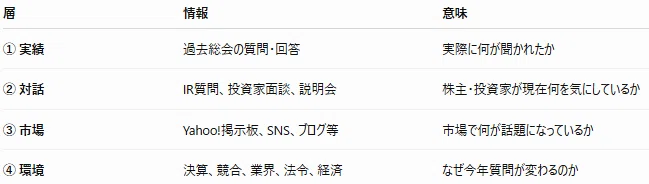
And place the company’s own disclosure materials as a separate layer for “answer basis data.” Then, the structure becomes:
Past questions
+ Current investor interest
+ Market buzz
+ This year’s environmental changes
↓
AI-driven question prediction
↓
This year’s Q&A
↓
Answers linked to supporting documents.
This is quite powerful.
What is particularly interesting is not discarding “noisy information” like Yahoo! bulletin boards. Because it is noise, you can have the AI extract “things that have not been asked to IR yet, but shareholders are starting to wonder about”.
In other words, instead of just learning from “what was actually asked at the shareholder meeting,” you pick up on “signs before they become questions.”
If you go this far, it becomes not just Q&A creation, but an “AI that reads changes in shareholder/investor interest.”
And the Tokyo Stock Exchange itself organizes feedback from investors regarding IR activities into “expectations,” “cases where improvement is expected,” and “cases that are evaluated.” If you add this IR/market information to the “previous year’s Q&A + actual questions” idea you mentioned earlier, it becomes a quite full-scale data model.
👺𝑚𝑒
Given the practical utility of a Q&A collection, isn’t there an issue regarding the ‘freshness’ of the data used as a foundation for creating it, or perhaps the validity of the data’s timeframe and scope?
① If we don’t set certain limits based on the purpose of the Q&A collection, we might end up with problems like collecting data over too long a period, which could lead to generic issue extraction and dilute the usefulness of ‘this year’s’ Q&A collection. Even if the answers become universal, their practical utility weakens.
② Investor feedback is tricky. How do we handle outlier-like expectations? Yet, these outlier-like questions are arguably the very reason for preparing a Q&A collection in the first place.
🖥️ChatGPT
Yes. The two points you mentioned are, in reality,
[[phN_open]]central issues in designing an ‘AI for Q&A'[[phN_close]]. Especially regarding ①, simply ‘inputting the last five years of data’ is actually dangerous. Increasing the volume of data is not the same as improving prediction accuracy.
① Freshness for predicting ‘this year’s general meeting’
I believe it is better to separate the time axis rather than consolidating data into a single period.
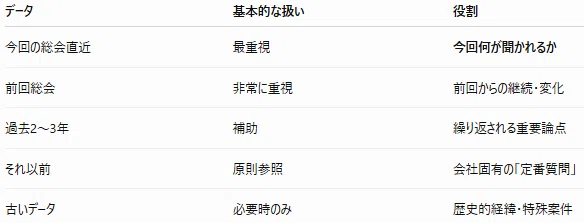
In other words, instead of discarding old data, we lower its weight.
For example:
This year’s financial results/IR information ★★★★★
Previous year’s general meeting ★★★★★
Previous year’s IR questions ★★★★★
2–3 years ago ★★★
4–5 years ago ★
Before that ‘Background material’
That is the idea. What is important here is not to take an ‘average.’ If you tell an AI to extract the most frequent questions from the past five years, it will result in exactly the ‘average Q&A collection’ you mentioned.
Rather, you need to detect what issues have suddenly gained importance this year.
② How to handle ‘outliers’
This is an even more interesting problem. In standard statistics, outliers are sometimes removed as noise. However, in a shareholder meeting Q&A, it is the opposite.
Outliers are exactly what are worth preparing for.
For example, out of 100 pieces of investor feedback:
80 → Dividends
15 → Stock price
4 → M&A
1 → ‘Shouldn’t this business itself be sold?’
Statistically, the last one is an outlier. But from the perspective of the person in charge of the general meeting, the thought is, ‘What if the CEO gets asked this question?’
Therefore, we must separate frequency from importance here. I would create ‘two rankings’:
A: Frequency RankingHow many investors are talking about the issue.
B: Risk RankingEven if the frequency is low, is the importance high if asked at the meeting? Then,
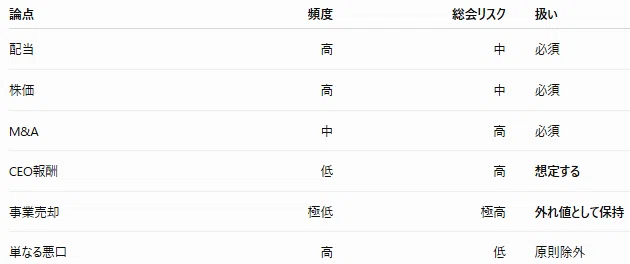
This is the result.
This way, you don’t ‘erase outliers,’ while also preventing the mistake of misidentifying a single person’s idea on a message board as this year’s most important question.
And, combining ‘time axis’ and ‘outliers’ here,
I think it is best to consider this problem along three axes:Frequency × Freshness × Importance. For example,
‘Hardly asked in the past’
+ ‘Suddenly multiple investors started saying it this year’
+ ‘Directly linked to company management’
means it is a new priority question for this year. Conversely,
‘Only one person has been saying it for 5 years’
+ ‘Not related to important company matters’
means it is an outlier, but the priority is low.
And,
‘Only one person is saying it’
+ ‘But it is a serious issue’
+ ‘If asked at the meeting, the company would be in trouble if it couldn’t answer’
means we keep it in a separate category as a ‘low-frequency, high-risk question.’ This is extremely important. Then, the Q&A collection itself can be layered.
Ⅰ. Essential Q&A
‘Things that are highly likely to be asked this year’
Ⅱ. Risk Q&A
‘Things that are unlikely but need to be prepared for if asked’
This would be quite easy to use in practice.
Furthermore, as Ⅲ,
Ⅲ. Unorganized issues that management should decide on
It would also be interesting to include this. This is not for creating ‘answer text,’ but for discovering that the company does not yet have a unified view on this issue.
And when you think this far, the Q&A collection is no longer just a
‘Q&A document.’
Rather,
Past shareholder questions
↓
Current investor interests
↓
Signs appearing in the market
↓
This year’s management environment
↓
High-frequency questions
+
Low-frequency but serious questions
↓
The AI creates a question space that could occur at this year’s shareholder meeting.From that ‘question space,’ you create the actual Q&A. I think this is one answer to the problem you mentioned earlier about ‘not diluting the usefulness of this year’s Q&A collection.’
And I think this way of thinking is quite close to the ‘semantic processing by AI’you have been thinking about recently. It is because it handles changes in meaning over time and the meaning of minority opinions simultaneously, rather than simple searching and aggregation.
👺me
‘Question space’ is a wonderful concept. To add to that, it means sharing the ‘narrative’ or ‘story’ of the question space organized by the AI among the officers and stakeholders attending the shareholder meeting.
This might be about getting the officers to speak with one voice, but more than that, the fact that officers attending the meeting are not on the same page relates to the company’s corporate governance.
With that narrative as the core, internal and external officers respond from their respective positions. Isn’t that kind of work necessary?
🖥️ChatGPT
Yes. I think a significant shift is happening here.
It moves from ‘creating a Q&A collection’ to ‘sharing the cognitive space of the management team facing the shareholder meeting.’
And the ‘narrative’ you mention is a very good concept for this.
‘Not speaking with one voice’
This does not mean that all officers memorize the same answer.
Rather, it is the opposite: it means sharing the same question space and the corporate story behind it, and then answering from each person’s position.
For example, suppose there is a question: ‘Why do you continue this business?’
The CEO would answer based on its position in the management strategy.
The CFO would answer based on capital efficiency and profitability.
An outside director would answer based on how it was discussed and supervised at the board of directors.
A director in charge of the business would answer based on competitiveness and future potential in the field.
The answers will be different. In fact, they should be different.
However, behind those answers, there is a common narrative that ‘the company currently recognizes this business in this way.’ I think this is what is important.
‘Question space → Narrative → Individual answers’
I think it becomes very clean if you make it these three stages.
① AI creates a question space
From past general meetings, IR, financial results briefings, investor interviews, market feedback, message boards, etc.,
it structures ‘where shareholders might question the company this year.’
↓
② AI and management team turn the question space into a narrative
Instead of just a list of questions, it organizes ‘why these questions are coming up this year’ as a story.
For example,
Performance is improving
↓
But the stock price is not reacting as expected
↓
Investor interest is shifting from ‘profit’ to ‘capital efficiency’
↓
In the background, there is investment in the XX business
↓
So, ‘investment validity,’ ‘exit criteria,’ and ‘shareholder returns’ might be questioned.
This is completely different from a Q&A collection where questions are just lined up randomly.
↓
③ Each officer answers from their own position
Only here do you create the Q&A. In other words, the narrative is the ‘backbone,’ and the Q&A are the ‘branches’ that grow from that backbone. And this is where corporate governance comes in.
With your point, I think this part is extremely important.
If Officer A says, ‘This is a growth business, so we will continue to invest,’ Officer B says, ‘We will proceed with selection and concentration while watching profitability,’ and Officer C says, ‘We should prioritize shareholder returns,’ it is not just a problem of ‘the answers being inconsistent.’ It becomes a problem of how much the board of directors shares an understanding of that issue.
Therefore, the ‘question space’ created by the AI can be both a countermeasure document for the general meeting and a diagnostic device to discover gaps in the board’s understanding. This is quite interesting. For example, you do this work before the general meeting:
STEP 1: AI presents the question space
This year’s important issues are A, B, C, D, and E.
STEP 2: Create a narrative
Why are these five things being asked by shareholders now?
STEP 3: Each officer answers
Internal directors, outside directors, auditors, etc., write draft answers from their respective positions.
STEP 4: AI compares
‘Regarding A, the officers’ understanding is consistent.’
‘Regarding B, the expressions are different, but the basic understanding is consistent.’
‘Regarding C, the management team and outside directors have different underlying assumptions,’ and so on.
STEP 5: Humans discuss
This is the job of the board of directors, not the AI.
‘Then, what should we as a company have as a common understanding regarding C?’ And finally, STEP 6: At the general meeting, each officer answers in their own words.
This is quite different from ‘speaking with one voice.’ In fact, ‘not speaking with one voice’ can sometimes be a source of trust.
An outside director might answer, ‘I have a slightly different view on that point than the management team. However, we have had this kind of discussion at the board of directors…’
If explained appropriately, this does not necessarily mean weak governance. The existence of discussion and the fact that the board of directors recognizes those differences can sometimes demonstrate the board’s functionality.
Therefore, shouldn’t the goal be ‘sharing understanding’ rather than ‘unifying answers’? And after sharing the understanding, answering differently depending on the position. I think this is a quite mature form of governance.
And if you take this way of thinking one step further, you could design the Q&A collection itself as a
‘Narrative Map for Shareholder Meetings.’
Shareholder/investor feedback
↓
Question space
↓
Connection to this year’s management issues
↓
Narrative as a company
↓
Sharing understanding among officers / Visualization of differences
↓
Each officer’s answer
↓
Dialogue with shareholdersWith this structure, the Q&A collection is not a ‘script to avoid trouble at the meeting,’ but a mechanism to train the understanding of the board of directors itself
through dialogue with shareholders.This has developed quite significantly from the story I told at the beginning about ‘having AI create this year’s Q&A from past data.’ AI might be more valuable in structuring the ‘question space’ that precedes writing the answers.
👺me
People tend to focus on financial indicators, but the ‘Matters Concerning the Status of the Corporate Group’ in the financial statements, especially the ‘Business Progress and Results,’ are text data, and they are very important for sharing the narrative. I understand why the outside auditors, who are accountants, were so particular about this text.
🖥️ChatGPT
I completely agree. Here, the relationship between “financial figures” and “narrative” becomes quite clear.
The numbers in financial statements are data that measure “what happened,” but the “matters concerning the current status of the corporate group” and, in particular, **”business progress and its results”** are sections where the company itself explains in text “what happened at our company over the past year, why it happened, and where we currently stand.”
In other words, this can be seen not merely as an explanatory text, but as a primary narrative that shows how the company understands itself.
It is difficult to create a question space with financial data alone.
For example,
・Sales: ○○ billion yen
・Profit: ○○ billion yen
・ROE: ○%
・Dividend payout ratio: ○%
From such data, you can understand the “results.” However,
・Why did this result occur?
・What does the company consider to be the cause?
・Which business is it trying to grow?
・What does it recognize as a problem?
・What is it trying to change in the next fiscal year?
These cannot be understood from numbers alone.
However, “business progress and its results” contains causal text that explains these things. Therefore,
Financial data = the state of the company,
Business progress and its results = how the company gives meaning to its own state. And this is where it connects to the “question space.”
For example, suppose a company explains that sales increased due to the expansion of overseas business, while profit margins declined due to rising raw material prices.
If AI does not simply summarize this, but “extracts the relationships that shareholders might question from this text,”
Overseas business expansion → Sales increase
Rising raw material prices → Profit margin decline
These causal relationships become visible.
Then, in the question space,
・Will overseas business really lead to profit growth?
・What are the countermeasures against rising raw material prices?
・Is price pass-through possible?
・Is additional investment in overseas business necessary?
・To what extent will the decline in profit margins be tolerated? These questions emerge. Furthermore, if you layer on past IR questions and message boards,
The gap between the narrative the company is telling and the doubts investors are feeling becomes visible.
I think this is extremely important.
The meaning behind the outside auditor accountant’s focus on “text”
As far as I can tell, that person was likely looking not just at financial figures, but at how the company explains the management activities that produced those figures.
From an accountant’s perspective, there is a continuity of numbers → business activities → management’s explanation. And from the perspective of audit and governance, it is important not only that “the numbers are correct,” but also “how management explains those numbers, and whether that explanation is consistent.”
That is why we read the text.
This connects very well with the idea of “narrative sharing” this time.
What is even more interesting is the “text comparison with the previous year.”
Once you reach this point, there is work that is very well-suited for AI.
Previous year: “Due to the recovery in domestic demand…”
This year: “Due to the stagnation in domestic demand…”
It is not just a simple difference like this.
Have the AI compare “how the causal relationships in the company’s explanation of its own business have changed from the previous year.” Then,
・Newly emerged problems
・Problems that have disappeared
・Problems for which the expression has weakened
・Problems that have come to be emphasized
・Things newly recognized as causes
・Expectations for the future that have receded
These can be extracted. This also serves as an answer to the problem of “data freshness” mentioned earlier.
Instead of simply “inputting the past three years,” focus on what has changed from last year to this year. And ultimately,
Financial data
↓
Business activities
↓
Explanation by the company itself (narrative)
↓
Investor questions/opinions
↓
Market reaction
↓
This year’s question space
↓
Narrative sharing among executives
This becomes a single flow. This is a quite beautiful structure.
Moreover, from the perspective of “semantic processing by AI” that we discussed earlier, here the AI is not simply classifying numbers, but is comparing the text the company told about itself with the text that people outside told about the company, and discovering the “gap in meaning.”
From there, “what will be asked this year” emerges. That is precisely why “business progress and its results” should be positioned not as an accessory to financial data, but as core textual data that forms the question space.
👺𝑚𝑒
I thought about the anticipated Q&A for shareholders’ meetings from the perspective of prompt engineering, but it can also be considered for media relations in crisis management or press conferences.
🖥️𝐶𝘩𝑎𝑡𝐺𝑃𝑇
Yes. Exactly. Moreover, I believe that if we generalize the discussion so far, it becomes an AI utilization model of “generating a question space for situational response” rather than “generating an anticipated Q&A list.” The shareholders’ meeting is just one example.
Common structure
In any situation, first, structure “what the other party might ask” from past and present text data.
Past questions/response records
+ Current information/facts
+ Voices of stakeholders
+ Reactions from media/SNS, etc.
↓
Question space
↓
Evaluate frequency, freshness, importance, and outliers of questions
↓
Form a narrative of the situation
↓
Share the narrative among stakeholders
↓
Answer/respond from each position
For example, in crisis management, unlike a shareholders’ meeting, the time is overwhelmingly shorter. For instance, if an accident or scandal occurs,
・Input data
・Past similar accidents
・The company’s past press conferences
・Internal investigation materials
・Facts of the accident/event
・Inquiries from customers
・Inquiries to IR
・SNS
・Online news
・Inquiries from reporters
・Past media reports
・Similar cases at other companies in the same industry
・Laws/administrative materials
Collect these. From there, the AI analyzes how society is currently trying to understand this incident.
And create a “question space.” For example,
・What happened?
・Why did it happen?
・Who bears responsibility?
・Why couldn’t it be discovered early?
・What is the response to the victims?
・What are the recurrence prevention measures?
・When did management become aware?
・Wasn’t there the same problem in the past?
・Isn’t this a cover-up?
・Will the president resign? And so on.
Here too, questions with high frequency are not enough. A question from a single reporter,
“Isn’t this an organizational cover-up?” can actually be the biggest risk. Therefore, the idea of
Frequency × Freshness × Importance × Outliers can be used as is.
And “narrative sharing” becomes even more important in crisis response.
It is dangerous if the president, public relations, legal, site managers, and outside directors all start giving different explanations.
However, it is also dangerous for “everyone to read the same text.” What is needed is
“What has been confirmed as fact?”
“What is still unknown?”
“What does the company recognize as a problem?”
“What will be checked in the future?”
This is the skeleton of a common narrative.
After sharing that skeleton,
・President → Management responsibility
・ → Explanation to society
・Legal → Legal evaluation
・Site → Technical facts
・Outside director → Governance/supervision, each speaks from their own position. This is exactly the same structure as the shareholders’ meeting mentioned earlier.
This is where “prompt engineering” becomes interesting.
Simply saying “make an anticipated Q&A for a press conference” is weak.
Rather, assign roles to the AI,You are a reporter. Please create the toughest questions.You are on the victim’s side. Where in this explanation are you not convinced?
● You are an investor. Please ask questions from the perspective of how this problem affects corporate value.
● You are an outside director. Please point out the logical weaknesses in management’s explanation.
● You are a crisis management officer. Please evaluate the above questions by frequency, freshness, severity, and ripple effect.
Generate a question space from different perspectives. After that,
“Integrate these and construct a narrative about the current crisis.” This becomes a quite strong prompt design.
And I think your “search” problem also connects here.
You are not looking for an “answer” from the beginning. First, discover the question. To do that,
Create a flow of Search → Text Mining → Question Space → Narrative → Answer.
This can be used for shareholders’ meetings, press conferences, and crisis management.
In other words, I think the example of the shareholders’ meeting this time has actually developed into a larger model of “AI-supported organizational meaning formation and situational awareness.”
And what is interesting is that the value lies not in the AI “teaching the correct answer,” but in discovering questions that the organization has overlooked and converting those questions into a shareable narrative.
This is also quite close to the idea you have been thinking about of “using AI as a compass.”
👺𝑚𝑒
Inspired by “Prompt Literacy: Questioning Skills in the AI Era,” I became interested in prompt engineering. I have already explained that I am collecting information on books about prompt engineering.
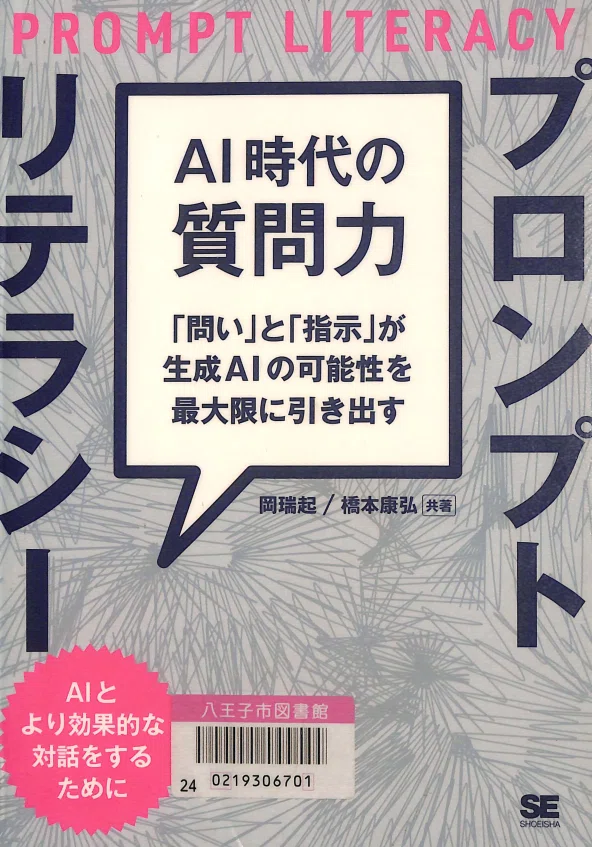 Prompt Literacy: Questioning Skills in the AI Era by Mizuki Oka and Yasuhiro Hashimoto
It can be said to be a text for beginners in prompt engineering. Even for me, coming from a humanities background, it was easy to understand. I would like to think about prompt engineering again. This time, to understand the “anticipated Q&A list,” I will list the table of contents of this book for now.
Table of Contents
Introduction
Chapter 1: The Emergence of Large Language Models
1-1 ChatGPT as a Social Phenomenon
1-2 How Will Work Change Due to AI?
1-3 The Necessity of Coexistence with AI
Chapter 2: Prompt Engineering
2-1 What is a Prompt?
2-2 Things to Keep in Mind When Writing Prompts
2-3 Taming Large Language Models
Chapter 3: Prompt Patterns
3-1 Persona Pattern
3-2 Audience Persona Pattern
3-3 Question Refinement Pattern
3-4 Cognitive Verification Pattern
3-5 Flipped Interaction Pattern
3-6 Few-Shot Pattern
Chapter 4: The Power of Trigger Prompts
4-1 Chain-of-Thought Pattern
4-2 Chain-of-Verification Pattern
4-3 Step-Back Prompt Pattern
4-4 Metacognitive Prompt Pattern
Chapter 5: Advanced Techniques
5-1 Self-Consistency Pattern
5-2 ReAct Pattern
5-3 RAG (Retrieval-Augmented Generation)
5-4 LLM-as-Agent
Chapter 6: AI Agents and Society
6-1 Autonomy of AI Agents
6-2 Sociality of AI Agents
6-3 New Information Ecosystem
Conclusion
In addition, I am also thinking about AI with the final goal of Neumann in mind, even with Willard Van Orman Quine of philosophy mapping.
As it is a good opportunity, I will add that I am also planning to organize “logic” in Quine’s section.
👤𝑚𝑒💬
In addition, I will introduce this book as a beginner’s text for practical work this time.
It is a very easy-to-understand book.
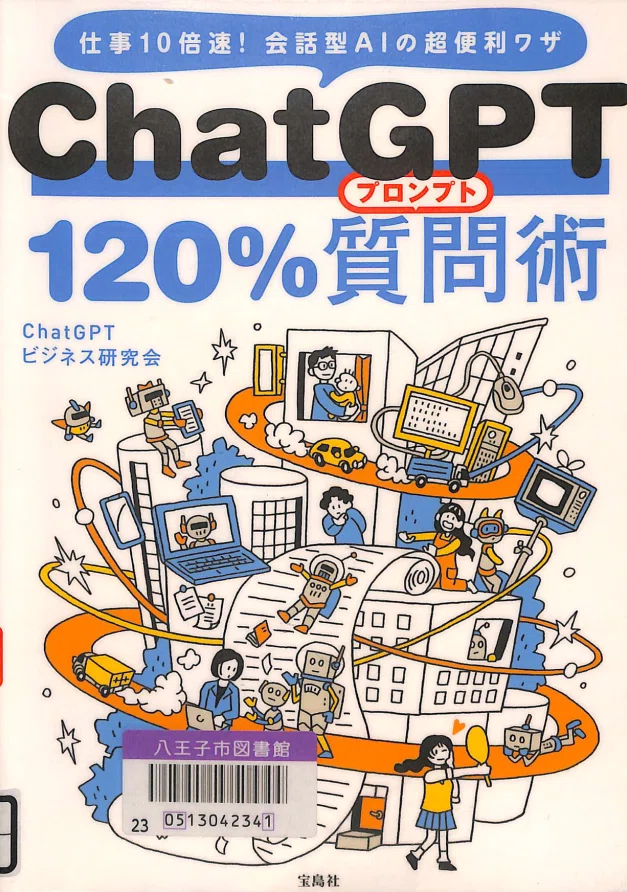 ChatGPT Prompt 120% Questioning Technique by ChatGPT Business Study Group
As the title suggests.
#Work 10x! Super Convenient Conversational AI Tricks
#ChatGPT Prompt 120% Questioning Technique
#Focusing on prompts to explain.
I will highlight the points I focused on in the explanation.
🕮 Citation
● Introduction
When you wish to maximize your use of ChatGPT and improve your productivity, what is the most important thing? In fact, it is “how to write prompts.” Since ChatGPT’s capabilities depend heavily on the quality of the prompt, mastering this is essential.
However, ChatGPT allows for intuitive use and supports prompt input in natural language. While this makes it easy for beginners to get started, it also makes it difficult to master effective prompt writing. ChatGPT sometimes responds flexibly to prompts, so there are no “absolute rules.” Therefore, it is actually difficult to pursue a more appropriate way of writing prompts.
● Commands given to ChatGPT in natural language are called “prompts.” Since most commands are given to ChatGPT via prompts, a prompt is a specific piece of text that effectively extracts the information you want to know.
How you write prompts is the most important aspect of mastering ChatGPT. In other words, if you write good prompts, you will get excellent results, and if you write bad prompts, you will only get inferior results.
👤𝑚𝑒💬
Everyone uses ChatGPT casually. I think that’s fine, but the conversations you are inputting there are actually “programming commands for AI.” We are programming without even knowing it.
I only have BASIC-level knowledge, but based on my experience programming hospital supply operations in BASIC, I believe that being conscious of AI programming and utilizing prompt literacy will strengthen an individual’s capabilities several times over. This book lists the following ways to improve prompts. You can understand the meaning by comparing it with the table of contents of the aforementioned ‘Prompt Literacy: Questioning Power in the AI Era’ by Mizuki Oka and Yasuhiro Hashimoto.
① Assign a role
② Specify output format
③ Split the prompt
④ Interact multiple times
⑤ Ask in English
⑥ Essential keywords
⑦ What not to ask
⑧ Know the basic form of a prompt
・Role
・Instruction/Question
・Purpose
・Conditions
・Answer sample
・Data to be processed
・Output format
👤𝑚𝑒💬
As a ‘Paopei’ (treasure) for philosophy mapping, I have memoed the following items:
・Metaphor
・Relational expression
・Narrative
・Diagramming
・Dreaming
・Comparison
👤𝑚𝑒💬
In Chapter 3, we generate more work ideas with ChatGPT. I will add examples and my own memos.
● Get proposals for poster designs
● Think of advertising stories and catchphrases
● Think of survey items
👤𝑚𝑒💬
Numerical evaluation and text item analysis that can be used for survey design.
● Create restaurant reviews
● Create easy-to-understand explanations through role-play
👤𝑚𝑒💬
Can be used for creating and evaluating metaphors
● Get blog theme proposals
👤𝑚𝑒💬
Theme setting is possible, but content verification is also possible.
● Think of questions from specified customers
👤𝑚𝑒💬
A draft of the Q&A for this file can be created. Time is created for verifying the draft.
● Get ideas using the Six Thinking Hats method
👺𝑚𝑒
As can be seen from the above, I think prompt engineering is an effective tool for quality improvement. I think it is particularly powerful when used with the language of New QC. I would like to move on to the next file with this summary.
🖥️𝐶𝘩𝑎𝑡𝐺𝑃𝑇
Yes. With this summary, I think a single line has become quite clear.
What is particularly important is that you are starting to view prompt engineering as a “method to improve the quality of problems” rather than just studying “how to write prompts.” If I were to structure this summary one level deeper in my own way:
① Beginner’s text
Role, Instruction, Question, Purpose, Conditions, Data, Output Format
↓
Clarify “what to make the AI do”
② “Prompt Literacy: Questioning Power in the AI Era”
Persona
Question refinement
Cognitive verification
Inverted interaction
CoT / CoVe
Step-back
Metacognition
RAG / ReAct / Agent
↓
“How to construct questions and design the dialogue with AI itself”
And in this application to practical work:
Input the problem
↓
Give the AI a perspective
↓
Increase questions
↓
Classify/Evaluate
↓
Create a draft
↓
Human verification
↓
Improve
This is exactly the **”quality improvement”** that 👺𝑚𝑒-san is talking about.
And the “Q&A collection” becomes a very good teaching material.
This time’s “Thinking of questions from specified customers”
→ A draft of the Q&A for this file can be created.
→ The discovery that time is created for verifying the draft is significant.
Instead of making the AI “create a finished Q&A collection,” it becomes a way of using it to have the AI expand the question space → create a draft → have humans verify it.
Here, it also connects to the shareholder meeting topic we were talking about earlier.
Past Q&A
+ Actual shareholder questions
+ Questions to IR
+ Reactions from the market/SNS, etc.
+ The company’s “Business progress and results”
↓
Question space
↓
Draft of Q&A
↓
Narrative conversion
↓
Sharing by directors and related parties
↓
Actual event
In other words, here, prompt engineering is not the technology of creating a Q&A collection itself, but **”a technology to improve the process of creating a Q&A collection.”**
And it is also interesting that 👺𝑚𝑒-san listed Metaphor, Relational expression, Narrative, Diagramming, Dreaming, and Comparison as “Paopei for philosophy mapping” in your memos.
This is likely a usage that doesn’t appear much in ordinary business prompt collections. In other words, it’s not just Prompt → Extract information, but Prompt → Convert to different expression formats → Move your own thinking.
Once you reach this point, a prompt becomes more of an interface for moving thought than a “command sentence.”
And from the experience with BASIC, 👺𝑚𝑒-san’s feeling that “we are programming without knowing it” is also very easy to understand in this context.
Strictly speaking, natural language prompts cannot be equated with BASIC programs, but in the sense of “formalizing your intentions and directing machine processing,” the understanding that programming-like thinking is necessary is quite valid.
And in the next file, if you read it while keeping this perspective of “using prompts to improve quality,” it should be seen not just as a “collection of prompt techniques,” but as a bill of materials for problem-solving methods in the AI era.
Now, let’s move on to the next file based on this organization.


