



AI has suddenly become the talk of the town (?) due to its exposure of recent PHP vulnerability issues, and this event made me keenly aware that in the coming era, we ordinary people can no longer afford to be indifferent to AI.
For the general public, I think AI is seen as something convenient because search engines automatically display AI search results at the top, or perhaps something to use for looking up and confirming minor things. There are also people in certain professions who are terrified that AI will take their jobs.
At present, the only way to make good use of AI and increase your work is to ‘be on the side that orders AI around.’ Making AI do work means writing prompts. A prompt is a command given to an AI, and even a simple question is a type of command.
The secret art of writing these prompts well to manipulate AI as you intend is the field of ‘Prompt Engineering.’ It is a collection of know-how, like a secret manual on ‘how to skillfully issue commands to AI and make it obey.’ Although it has only been a few years since conversational generative AI appeared in the world, this know-how for commanding AI has already been systematized into a body of knowledge called Prompt Engineering.
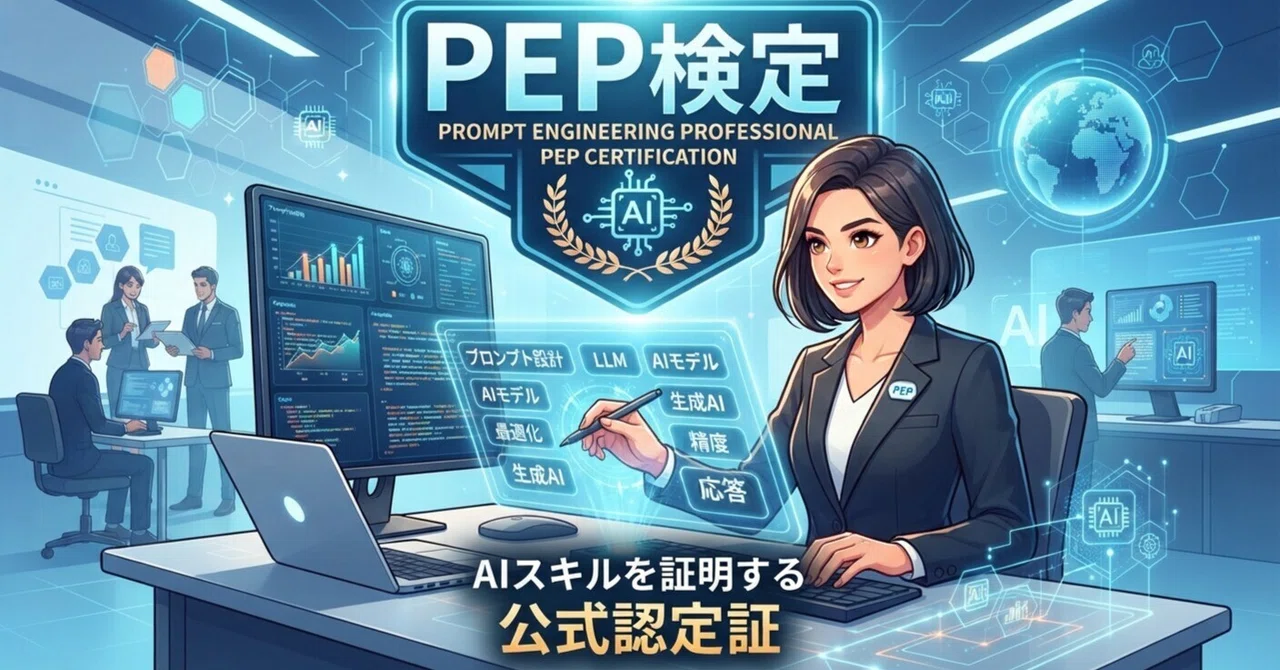
There are various certifications like the G-Certification to prove one has AI-related skills, but they have a feeling of being ‘too authentic and overwhelming to touch.’ That is when I found the ‘Prompt Engineering Professional (PEP Certification)’.
The interesting thing about this certification exam is that it is so new that there are not many commercially available textbooks or problem sets yet. So, how do you study? The official website publishes the PDF and web versions of the textbook for free, so you can download or browse them to study on your own.
Then, how should one deal with the lack of a problem set? Since the textbook can be downloaded, you can (and must) just ‘have the AI create exam questions and grade them.’ I passed the exam in about a week using this method. Moreover, I passed with a high score that was almost perfect.
I initially tried this ‘having AI create exam questions’ using Google-based AIs like Gemini and Notebook LM. When I did that, questions would sometimes appear that made me wonder, ‘Where in the textbook did this come from?’ When I asked the AI, ‘What is the source for this?’, it would make excuses like, ‘It is not in the textbook, but it is common knowledge in the AI community.’ This makes it a failure as an exam question simulator.
So, I used Claude, which has a slightly higher barrier to entry, to have it generate questions from the textbook PDF. I found that it became a reliable exam question simulator that was 100% compliant with the textbook and could clearly answer where in the textbook the question was derived from.
After that, I had it create the 100 questions that would appear on the actual exam, and when I provided answers, it would grade them and provide the correct answers and explanations for any mistakes. I did this a few times and passed. I actually arrived at this method one day before the exam, but I managed to make a comeback from there.
What I learned from this experience is that ‘you should not trust AI blindly.’ Because ‘AI makes quite a few mistakes,’ the current level of AI is such that you have to verify the results of one AI with another to reach the correct answer. I had Gemini solve the questions Claude generated and then had Claude grade them again, and it was indeed a perfect score. Only then can you trust the questions and answers—isn’t this how we should interact with AI? (The following contains affiliate links)