



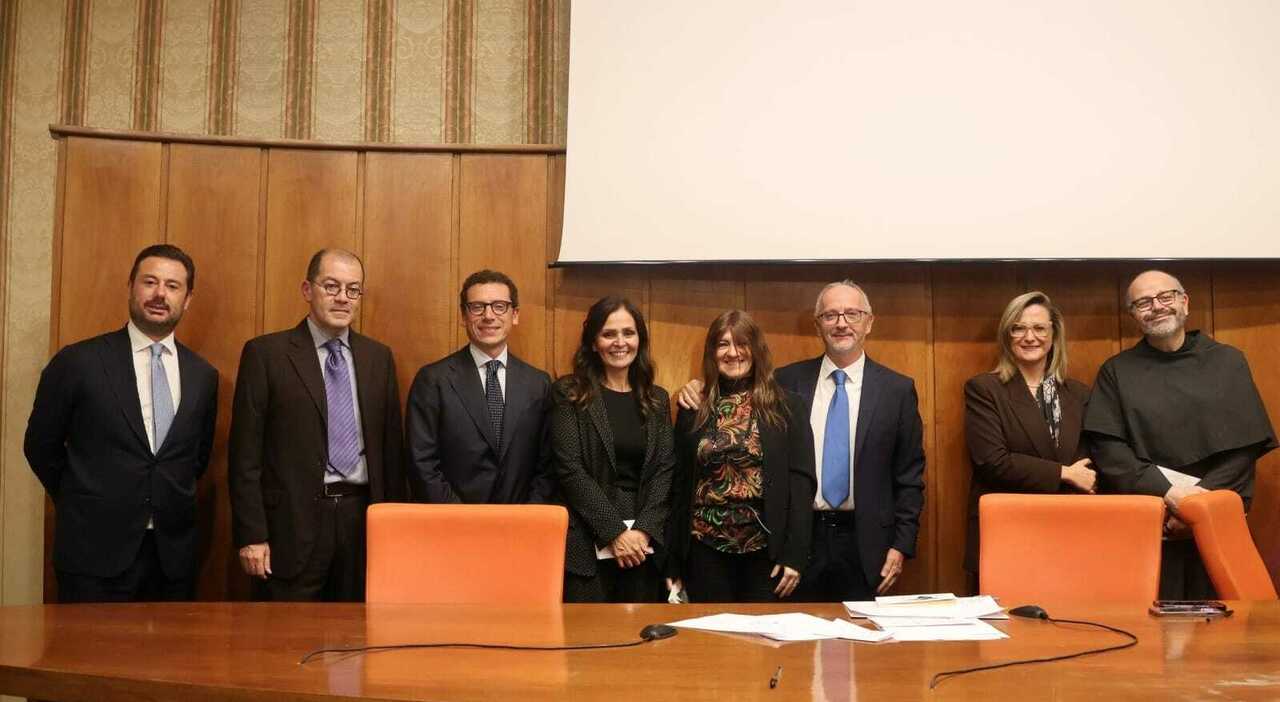
The relationship between ethics, artificial intelligence, and the future is more relevant than ever, in a future that is already present. For this reason, Confindustria Caserta decided to organize a dedicated event, promoted by vice presidents Adolfo Bottazzo and Clelia Crisci as part of the series organized by the Artificial Intelligence Working Group, which was established last year at the initiative of President Luigi Della Gatta, who introduced the afternoon. The main speaker at the event, held yesterday at the headquarters of the Caserta industrialists, was Father Paolo Benanti, a Franciscan, theologian, scholar of technology ethics, and author of the essay ‘The Guillou Case. Story of a Cancelled Identity’ (Silvio Berlusconi Editore, 2026). The case concerns last year’s incident involving Nicolas Guillou, a French judge at the International Criminal Court, who found all his access to platforms blocked: from messaging to email, from social media to home banking. Having approved and issued arrest warrants against Netanyahu and former Israeli Defense Minister Yoav Gallant led to a series of sanctions from the United States.
Thus, the Guillou case became the focal point and starting point for addressing the topic of the afternoon, moderated by Massimo Adinolfi, full professor of Theoretical Philosophy at the University Federico II of Naples and columnist for Quotidiano Nazionale.
Analysis
“What Spinoza experienced in the seventeenth century was, if you will, equivalent to excommunication from the Catholic world,” recalled Father Benanti. “It is the administration of power by an authority over which no other authority has the power to intervene. If today a person were to receive some kind of order from a judge, they could defend themselves. What happened to Spinoza allowed no appeal, just as what happened to Guillou. But the latter is peculiar because it happened today, to a French citizen, with the French president repeatedly asking to resolve the situation. Excommunication is this unappealable power that we have suddenly discovered in our pockets, which is the power of the digital.”
Father Benanti spoke of personal information transformed into contemporary currency, automated systems as true creators of rules, and digital platforms as surveillance structures that influence and anticipate people’s actions. Thus arises the need to promote algoretics: establishing limits and regulatory principles that guide digital development in respect of the individual to safeguard the stability of democratic systems.
The Companies
Regarding the relationship between businesses and artificial intelligence, he answered Bottazzo’s question. “We must distinguish between a multinational and smaller entities. The presence or absence of a research and development department is already a significant discriminant, and this tells us that artificial intelligence will not be the same for everyone: it will have different effects and could multiply inequalities and access to the market. Small and medium-sized businesses could even be harmed by this huge gap that artificial intelligence can create and by the amount of capital required to remain competitive. It is a challenge that does not simply concern individual adoption, but also becomes a social and associative issue.”
As for the ethics of technology, he explained that it falls within the scope of “what it means to release a technology in a social context knowing that it always functions as a disposition of power and is never good or bad, but not even neutral. Asking what it will do, who it will benefit and who it will disadvantage, is part of ethics. It is a discussion with different stakeholders who must find a mediation of justice. This has already been done in the past for other challenges of industrialization in Italy, and it must also be done for artificial intelligence.”
Through Crisci, Confindustria therefore emphasized that this was not an isolated case, but that throughout 2027 there will be new events with other national experts.
© ALL RIGHTS RESERVED
This article is automatically translated