


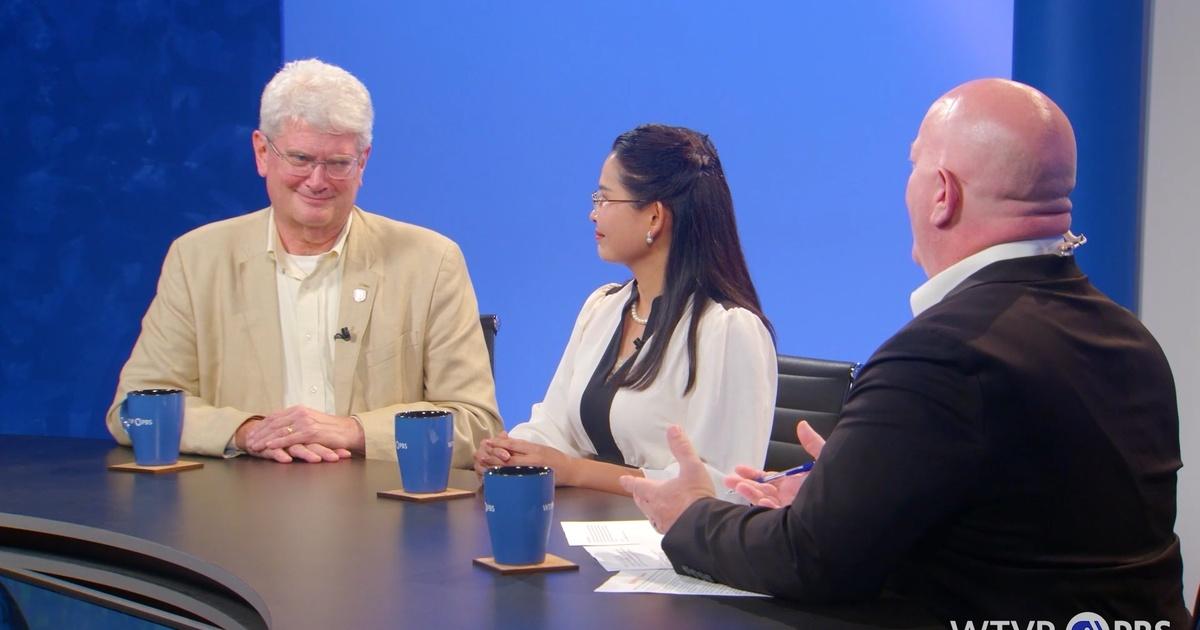
How do you know what you’re getting is legitimate or moral or anything else?
– There are two things I’d like to say about that.
You asked about new jobs because of AI.
Philosophy PhDs are getting, you know, taken into the IT AI world now because ethics are so incredibly important, and there are all sorts of ethical questions that are raised by AI.
We have a new course out of computer science called “AI for Everyone,” and it’s looking at innovation, the computer science that you need to use AI without being a programmer, and the ethics of it.
It’s very, very important.
So, you know, ChatGPT students, as soon as it came out, students started using it to write papers for them.
– What?
– Imagine.
– What?
– Yes, I know it’s hard to believe, Mark.
But we are all learning together, professors and students both, that AI doesn’t do the critical thinking.
It is a type of intelligence, but it is still our responsibility in the university to teach students how to think.
It’s not enough to have the data.
It’s, what does it mean?
How do we interpret this?
What are the implications?
How do you know it’s true?
How do you fact check it?
How do you ground it in truth?
Then you still have to decide, is that ethical or not?
You had talked about, you know, just because it’s in AI doesn’t mean it’s true.
– Exactly.
– So I feel no threat from AI as an educator.
I think it’s really exciting as students find new applications.
Well, we talk about it, you know?
You gave me this paper but you didn’t know what six of the words mean.
(laughs) Let’s talk about that.
– So then do you take your student’s paper and put it into AI to see if it’s been plagiarized or anything like that?
I guess you could.
– Actually, the AI checkers are notoriously bad.
– Really?
– But I don’t need an AI checker to know.
The signs of an AI, a ChatGPT paper, is that it’s written in inflated rhetoric, like an Oxford don, making sweeping generalizations and reference to lots of data, but it’s not necessarily on the prompt of the paper, and the arguments aren’t grounded in specific evidence typically.
If a paper is just informational, ChatGPT would probably do a very good job.
– Yes.
– But if it requires original thought and evidence-based argument, sometimes it’s completely useless or counterproductive.