


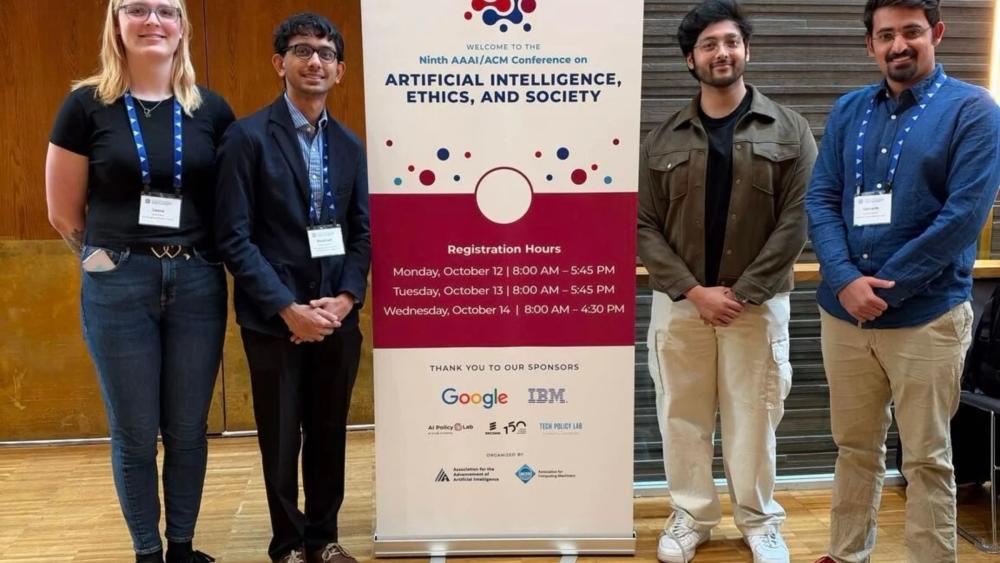
UNIVERSITY PARK, Pa. — When Leona Pierce arrived in Malmö, Sweden, for her first academic conference, she found herself surrounded by researchers whose work she admired and whose experience far exceeded her own. As an undergraduate at Penn State, she said she initially wondered whether she belonged among them. But as the week progressed, that uncertainty gave way to a growing appreciation for what she had already accomplished, along with a clear vision of where she wanted to go next.
Pierce is a fourth-year Penn State student and Schreyer Honors Scholar triple-majoring in data sciences in the College of Information Sciences and Technology (IST) and mathematics and statistics in the Eberly College of Science. She is also an undergraduate researcher working with Hadi Hosseini, an associate professor in the College of IST Department of Informatics and Intelligent Systems.
To showcase that research, Pierce traveled to Sweden in October to attend the Conference on Artificial Intelligence, Ethics and Society (AIES), an annual event jointly organized by the Association for the Advancement of Artificial Intelligence and the Association for Computing Machinery. There, she presented a paper published as part of the conference proceedings: “The Judgment-Consequence Gap: LLM Moral Reasoning in Healthcare Decisions,” which she co-authored with Hosseini and Samarth Khanna, a graduate student pursuing a doctoral degree in informatics in the College of IST. The study revealed that artificial intelligence (AI) and humans differ in the way they make high-stakes decisions, raising questions about the role of AI in ethically sensitive situations like healthcare decisions.
The presentation marked what Pierce called an important milestone in her undergraduate research experience: the opportunity to share work she helped develop with an international community of fellow researchers. And she credited Penn State and Schreyer Honors College for helping her get there.
“Schreyer helped fund my travel to the conference,” Pierce said. “It’s a good example of the way they support students to pursue amazing opportunities that may otherwise be cost prohibitive.”
An experience that initially felt intimidating became a source of pride for Pierce, she said. She was there not simply to observe the work of established researchers, but to contribute to the conversation herself.
“This is another way in which Schreyer prepared me for this opportunity,” she said. “There is a feeling of support throughout the honors college that everyone has interesting perspectives that are worth listening to, and that helped build my confidence.”
Pierce described the overall experience as both intimidating and exciting.
“My time at Penn State doing research gave me an opportunity to learn and achieve something that most undergrads don’t, and that has been really rewarding,” she said. “Hearing about everyone else’s research at the conference not only gave me ideas for my own projects but also cemented the idea that research is what I want to pursue in the future.”
When she returned to campus, she presented her research at the Eberly Science Undergraduate Poster Exhibition and earned first place in the Data and Mathematical Science Division.
Now, Pierce is applying to doctoral programs to continue studying AI alignment, building on the interests she developed through her undergraduate research and her excitement about the work still ahead.
Penn State is shaping the future of higher education in the age of artificial intelligence. Our focus is on human-centered, ethical AI innovation that delivers meaningful impacts for Penn State and the broader community. Through visionary planning, strategic partnerships, targeted hiring and strategic investments, we will equip every Penn State student, staff and faculty member with the AI-related knowledge, experience and confidence they need to succeed in the AI-powered future. Learn more at psu.edu/ai.