



As mentioned in my previous article, trends in AI utilization have shifted at a dizzying pace over the past year or two. The center of conversation has rapidly moved forward: from prompt engineering to context engineering, and further toward harness engineering and loop/graph engineering.
In this landscape, some might think, “Why talk about context engineering now?” Honestly, as a concept, it has been discussed for well over a year.
Yet, the reason I chose to tackle this theme head-on right now is that no matter how sophisticated an automated harness or autonomous agent you build, it is still context that fundamentally determines the quality of the outcomes. Moreover, what matters is not humans exerting effort to paste context every single time. It is preemptively building mechanisms into daily work and product operations where context automatically accumulates and is handed over to the AI only at the precise moment it is needed.
In this article, while clarifying why context engineering serves as the foundational bedrock once again today, I want to provide an end-to-end look at what I run in my day-to-day work: voice input, LLM Wikis, automated meeting ingestion, and drive-recorder-style feedback collection.
1. From Prompt Engineering to Context Engineering
Around the time GPT-4 and GPT-4o debuted, prompt engineering became a major topic. Many likely remember the technique where simply appending a persona at the beginning—such as “You are an experienced clinical psychologist”—would boost answer quality.
In fact, research presented at NAACL 2024, such as Better Zero-Shot Reasoning with Role-Play Prompting (Kong et al.), has confirmed that role prompting, which assigns a task-appropriate role, elevates the accuracy of zero-shot reasoning. Inside an LLM, vast amounts of knowledge and concepts are embedded in a high-dimensional representation space, and how inputs are provided changes which features and regions within the neural network are activated. As visualized in Anthropic’s Scaling Monosemanticity, activating specific features inside a model dramatically alters its output behavior. The larger a model becomes, the more strongly this property of deciding which regions of that colossal intelligence to draw out comes into play.
However, recent advancements in models have changed the underlying assumptions. As standalone model performance improved and the level of abstraction they can handle jumped dramatically, the core challenge shifted from “How do we coax out a clever answer?” to “How do we get it to deliver customized behavior that aligns with our expectations without deviating from our intent?”
Especially now that agent harnesses have grown complex, running an AI without feeding it sufficient background information results in massive amounts of implementations or documentation that clash with the user’s intent. In situations where AI user numbers are surging and inference wait times grow longer, or where complex agent workflows take several minutes per turn, the damage caused by this misalignment is substantial. Even when managing repositories with Git, the cost of rolling back off-target changes and starting over is nothing to sneeze at.
Amid these developments, Shopify CEO Tobi Lütke stated in a June 2025 post on X that the term “context engineering” captures the essence far better than “prompt engineering.” It was defined as the art of setting up the necessary context so that the LLM can smoothly resolve the task. Andrej Karpathy agreed with this perspective, and Anthropic subsequently published Effective context engineering for AI agents, shifting the focus away from tweaking one-off instructions toward “designing the entire information environment provided at inference time.”
2. Before Waiting for a New Model, First Speak via Voice Input for 2 to 3 Minutes
Whenever a new model is released by OpenAI, Anthropic, or Google, the ceiling of what can be accomplished with AI reliably expands. Yet, when it comes to “how close the output gets to what you truly want to do,” the fundamental reality remains unchanged: thoroughly providing context is essential, both then and now.
Whether dealing with graphics, branding, writing, or development, the principle is the same. Even in scenarios where I commission work with a single prompt, whenever I seek a solid output, I make it a rule to speak for at least two to three minutes using voice input to pour in my intentions and baseline premises.
Surprisingly few people do this, but voice input and transcription features are now built into almost all major AI tools—including Codex, Claude Code, Google Antigravity, and Grok—and their accuracy has surpassed practical utility thresholds. As a brief aside, regarding Japanese speech recognition accuracy, I feel that the OpenAI ecosystem (the foundation using GPT-4o-based speech recognition models alongside conventional Whisper) stands a cut above the rest; though it might be a bit unconventional, I sometimes even copy text spoken into the desktop apps of ChatGPT or Codex and paste it into another agent harness.
Most people try to operate AI by casually tossing in a short, single sentence from their keyboard. However, even for fast typists, the act of moving one’s fingers while verbalizing thoughts becomes a double task. I type quite fast myself, but with keyboard input, I still unconsciously tend to summarize thoughts into short sentences, making it easy to drop subtle nuances and background context lingering in my mind.
In that respect, voice input is powerful. Even if filler words like “uh” or “um” get mixed in, or minor transcription errors and self-corrections occur, modern LLMs extract intent from context with astonishing accuracy. There is no need to try writing a clean, polished prompt. Simply talk uninhibitedly for two to three minutes without worrying about typos or misstatements and pour it all in; the resolution of the returned output will improve beyond recognition.
3. Gather in Bulk, but Do Not Feed in Bulk
Here lies a principle that seems contradictory at first glance.
It is perfectly fine to provide prompts (the intent of the task you want done right now) in bulk. On the other hand, you must not blindly cram in background context in bulk. However, background information itself must be collected and accumulated in bulk.
Why must you not simply pass everything as is? Because even now with massive context windows, when input tokens multiply or irrelevant information gets mixed in, LLM inference accuracy inevitably drops. As demonstrated by Stanford University’s study Lost in the Middle—which highlights the phenomenon where information in the middle of long texts is easily overlooked—and Chroma Research’s Context Rot, which verifies how model performance degrades as inputs balloon and noise enters, context is a finite resource.
That is precisely why we need a structure where a large amount of background information is accumulated in advance, allowing AI agents to retrieve only the minimal and optimal information at execution time.
You cannot simply start from scratch and prepare makeshift background explanations every time you assign a task. For example, in company management, that means interactions between employees, the history of decision-making, where bottlenecks occurred, which initiatives worked well, and past work alongside its outcomes. For a novelist, it includes ideas generated so far, the written scope, the structure of foreshadowing, and a roadmap designed around the reader’s sense of pacing. Having such a foundation in place before issuing instructions prevents the AI from going off track through arbitrary interpretations.
4. Karpathy-Style LLM Wiki and OKF as a Practical Foundation
As a method to build this structure in an agile manner without specialized RAG infrastructure knowledge or vector DB operational skills, what I recommend in practice is the LLM Wiki proposed by Andrej Karpathy on GitHub Gist. I touched on this briefly in my previous article, and my workplace also operates a knowledge base grounded in this philosophy.
The LLM Wiki mechanism is simple yet very well-designed. The starting point is a lightweight AGENTS.md placed at the very front of the repository. Here, you write down only the core guidelines for agents in a compact manner, such as rules for saving information and procedures for referencing it.
Behind that, you implement a hierarchical structure of index, summary, and raw original text. Because AI consumes context window and degrades in performance every time it reads text, it should skip irrelevant documents, first check the index, follow only the necessary summaries, and read the raw text only when fine details are truly needed. It is designed to enable this kind of autonomous exploration.
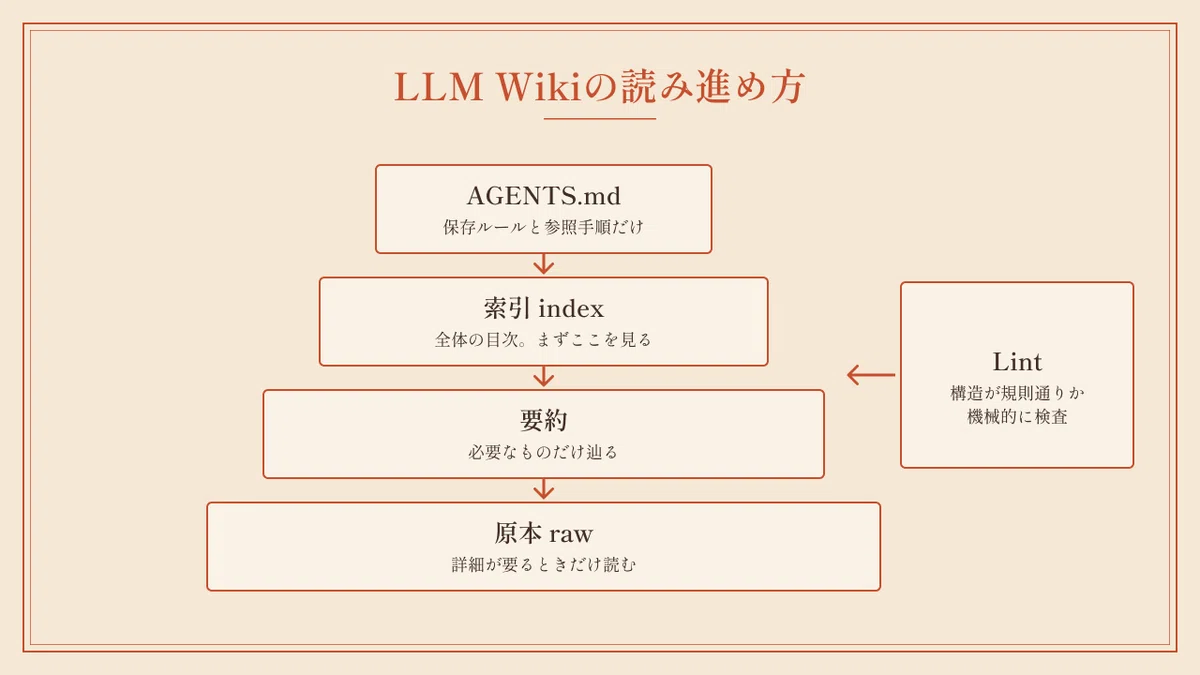
Even more crucial is the maintenance mechanism. In addition to updating the index, you prepare lint scripts to verify whether the library is organized according to the prescribed rules. Rather than relying on the whims or erratic behavior of an AI, it is essential to be able to mechanically check structural health using deterministic scripts.
The same applies to the input side. When you carry out actual work such as document preparation or research directly on the LLM Wiki repository, work histories and procedures naturally accumulate in accordance with the rules. While managing knowledge in Obsidian or Notion is also a common approach, I personally manage it on GitHub. Provided the environment allows non-engineers to use GitHub as well, you can set up design policy harnesses to inspect deliverables, or share background knowledge simply by passing the LLM Wiki repository via a GitHub connector when developing a brand-new product in an entirely different repository. Recent agents have also become quite stable when referencing external repositories.
Incidentally, such file-based knowledge management patterns that are not as heavy as conventional RAG are increasingly being standardized across the entire industry, and Google Cloud has published an open specification called the Open Knowledge Format (OKF), which consists entirely of Markdown and YAML front matter, index.md and log.md, and standard Markdown links.
Looking around, there is a growing volume of discourse discussing complex automation harnesses and loop/graph designs with convoluted jargon. To put it somewhat bluntly, quite a few of these discussions resemble infomercials where you wonder if the authors are actually producing results using AI in the real world. No matter how flashy an automation you construct, if you cannot provide the agent with the context of your own business or deliverables during the Plan stage of the PDCA cycle, all you are doing is running a misguided cycle at high speed. It is context engineering, unglamorous as it may seem, that truly determines the quality of the entire PDCA cycle.
5. Automatically Gathering Context: Circleback × LLM Wiki and Organizational Coherence
From here, things get a bit more advanced.
In the beginning, I nurtured the Wiki manually by interacting directly with the LLM Wiki repository and giving instructions to agents. Recently, however, I have come to feel strongly that how to build a pipeline where context is gathered automatically from day-to-day operations is far more important than having humans consciously write things down.
The clearest and most effective practical example has been integrating with the AI meeting notes tool Circleback. When you include Circleback in online meetings such as Google Meet—in my case, I spend at least 15 hours a week in meetings—all participants’ remarks and decisions are automatically transcribed and accumulated.
After that, all you need to do is trigger a webhook from Circleback’s Automations feature to process it on Cloudflare Workers or in a container, or fetch data via the API on a scheduled run such as every morning at 9:00 AM, and automatically integrate it into the LLM Wiki. Just by doing this, decisions and discussion backgrounds from 15 hours of meetings a week are cleanly structured and constantly kept up to date.
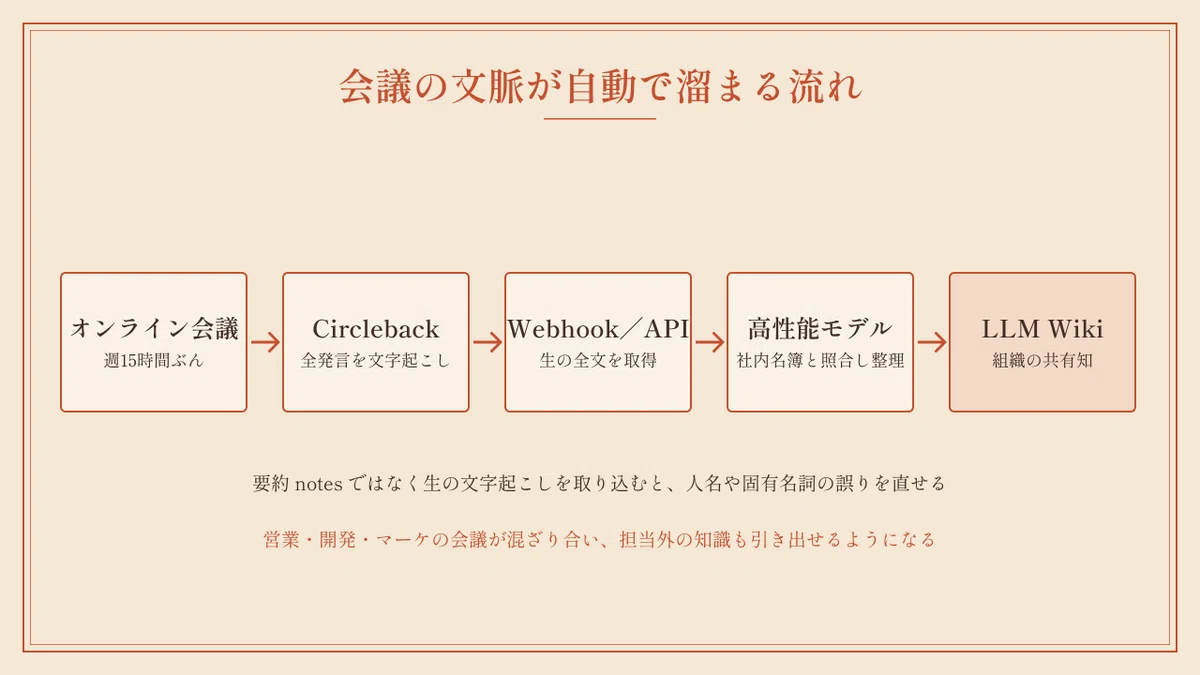
Here, I would like to add a subtle practical tip. From Circleback’s webhook and API, you can obtain both the summaries (notes) generated by Circleback and the full raw transcripts organized by speaker. At first glance, pulling in only the summaries might seem easier, but I recommend fetching the raw transcripts. Circleback’s recognition alone sometimes fails to match employee voices with names, or mistranscribes company-specific proper nouns and personal names. Passing the complete raw text directly to the LLM Wiki and having high-performance models such as Codex, Claude Code, or Gemini organize it against internal staff directories and registries yields far more precise and accurate knowledge.
Furthermore, the true power of this system extends far beyond assisting individual memory. In an organization with 10 or 20 employees, if everyone runs Circleback, knowledge outside your own working domain—ranging from external sales talks you did not attend to meetings of other teams—steadily accumulates as shared organizational knowledge.
With the widespread adoption of AI, boundaries between job functions—such as engineers and operators, engineers and sales, or engineers and marketers—are rapidly blurring. For that reason, how naturally one can draw upon knowledge outside one’s own domain has become decisively important in maintaining business coherence (consistency and alignment).
For instance, the widely noted case of Shopify making a major pivot toward highly transparent information sharing and context design premised on company-wide AI utilization, triggered by an internal memo, shares the exact same underlying structure. In a company where information remains locked in departmental silos, AI can only operate within those silos; but when shared context is open, AI serves as a nervous system connecting the entire organization.
Sales representatives become able to craft proposal decks that account for underlying operational and technical details, and product development teams can conduct data-driven development directly tied to real customer feedback gathered by sales and actual marketing metrics. What is more, developers without formal marketing training can query the AI to surface internal marketing expertise in reverse lookup from what they wish to accomplish. Automatic context collection lets us leap over not only departmental silos, but even the barriers of specialized training.
6. Eliminating Development Friction: Dashcam-Style Feedback Collection
Why am I revisiting the topic of context engineering now? It is because going forward, “what to build” will become overwhelmingly more important than “how to build it.” And to ensure you hit the mark on what to build, you must create a state where the context serving as raw material for decision-making and improvements gathers automatically, without friction.
Consider product development environments. For bug fixes and minor improvement requests that don’t require requirement definitions, we have already entered an era where scheduled AI agents can automatically complete implementations and even open pull requests. What, then, is the bottleneck constraining the speed of product improvement? It comes down to how much you can lower the hurdle—that is, the friction—of collecting requests and feedback.
I view this as a form of context engineering as well. That is why at our company, we prepared a mechanism called FeedbackKit as an independent repository, enabling a suggestion box to be placed in the lower-right corner of our services’ screens.
The defining characteristic of this mechanism is that it operates like a car’s dashcam. While a user interacts with the service, every single move—screenshots of the screen, which DOM selectors were clicked, and what screen transitions occurred—is continuously recorded in a local sliding window on the browser side. Then, the moment a user notices an issue or thinks of a request and hits the report button, the entire preceding background context is sent all at once.
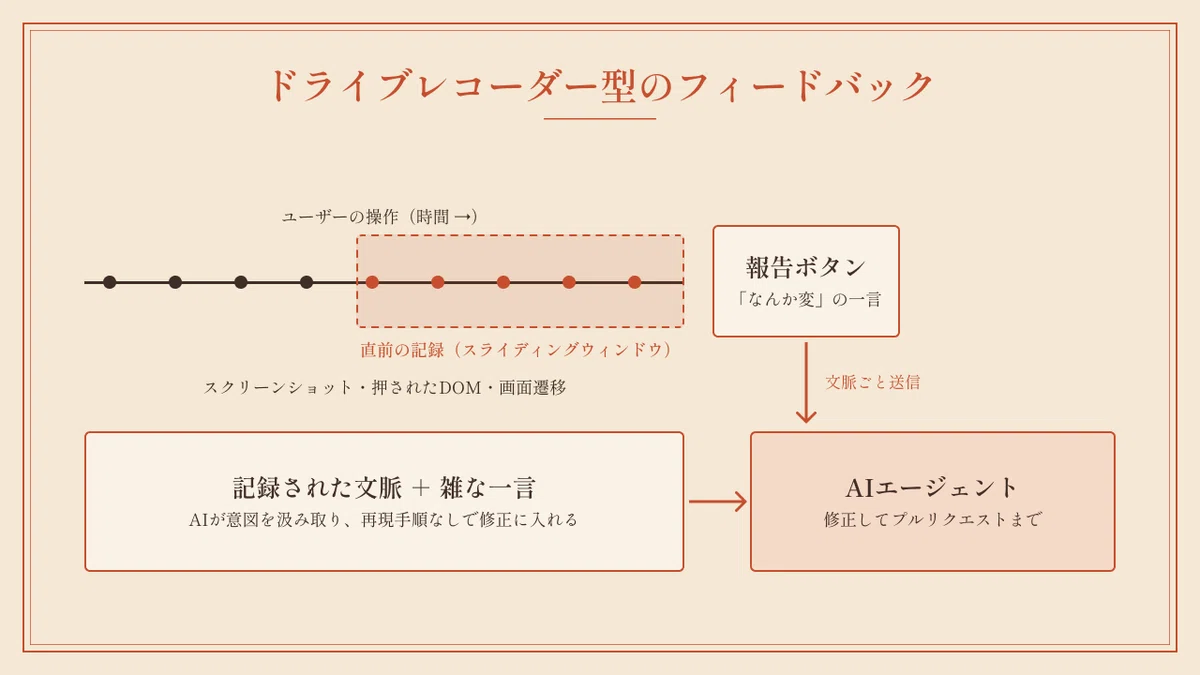
Doing this dramatically lowers the psychological barrier for the person reporting. There is no need to write elaborate reproduction steps or specification documents. Even if they submit an abstract, offhand comment like “This feels kind of awkward to use” or “The button looks weird,” all the dashcam context is readily available behind the scenes. As a result, the AI can accurately grasp their intent and jump straight into fix work without producing off-target implementations.
Whether using Circleback to automatically gather meeting context and cultivate an LLM Wiki, or using a dashcam approach to automatically gather user interaction context, the underlying design philosophy is identical. Context is collected automatically before a trigger is ever pulled, and when it is time to run the AI, everything is handed over fully prepared. That alone elevates both the precision and speed of autonomous development to a whole new level.
Conclusion: Build an Environment Where Context Accumulates Before You Touch AI
In future articles, I plan to write about slightly more advanced operations, such as loop engineering and autonomous resident agents. However, no matter how far we advance, context engineering remains the underlying foundation of everything.
So for now, without overthinking it, try setting up an environment tailored to your work or creative projects that “automatically collects and organizes context, feeding only what is necessary to the AI” before putting AI to serious use.
The first step is surprisingly simple. Just paste the URL of Karpathy’s LLM Wiki Gist into your everyday AI agent and ask, “I want to accumulate my context for this purpose, so please create a repository with a similar setup.” Today’s AI is perceptive enough to assemble a practical boilerplate and even linting scripts in no time.
First, create a small repository and experience how natural it feels as daily notes, meetings, and work logs steadily accumulate. You should notice not only a shift in the accuracy of the AI’s responses, but also a sense that the overall resolution of your own work and organization has leveled up.